Chapter 3 · Food
Packing dry food in Mylar bags, oxygen absorbers and buckets
A foil bag holds out oxygen, an absorber removes what's left inside, and a bucket keeps rodents off. Each step fails in a known way. Here is the method, step by step, with the reason for each part and the foods that should never be packed like this.
Read first: Long-term food storage
Long-term food storage explains why dry staples keep for decades and how long each one lasts. This page is the workbench: how to actually pack them, so the bag holds its seal, the absorber does its job and the bucket protects both.
The method has three layers, and each one answers a different enemy:
| Layer | What it stops | What it can't do |
|---|---|---|
| Mylar-type foil bag | Oxygen and moisture getting in over the years | Stop rodents, which can chew through it (Utah State) |
| Oxygen absorber | The oxygen already sealed inside the bag | Work in a container that leaks, or make moist food safe |
| Food-grade bucket | Rodents, crushing and light | Hold a low-oxygen space by itself: plastic lets oxygen back in |
Skip any one layer and the others are weakened. That is the whole logic of the bag-inside-a-bucket method.
The bag
"Mylar" is a trade name, and Utah State University Extension notes it is often used loosely for any foil storage pouch. The bags used for food are a laminate of PET (polyester) plastic and foil. Utah State says the foil layer is what dramatically cuts the passage of oxygen and moisture. A plain plastic bag doesn't have it, and the difference shows in storage: Utah State reports a study in which dried milk kept four years in ordinary plastic bags had a stale, oxidized flavor and rated worse than milk kept in cans. BYU's long-term storage table, whose shelf lives assume airtight, moisture-proof, low-oxygen containers, gives beans, split peas and lentils about 25 years.
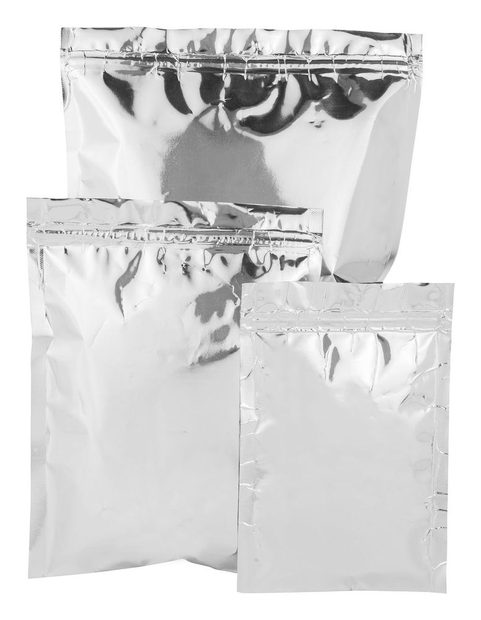
Photo: iStock.
Why the bag needs a bucket
Plastic alone does not keep oxygen out for long. Utah State's fact sheet on oxygen absorbers says oxygen will pass through plastic over time, and that lining plastic buckets with Mylar reduces that exchange. Its packaging guide says plastic can let significant oxygen in within one to two years. Its wheat page adds that 5-gallon buckets can't be kept oxygen-free, because oxygen re-enters. So the bucket on its own is a pest-proof box, not a long-term seal.
The reverse is also true: the bag on its own is a good seal but no armor. Utah State warns that rodents can chew through plastic bags. The bucket keeps them out and keeps the bag from being punctured or crushed on the shelf.
The absorber
An oxygen absorber is a small packet of iron powder and salt. Utah State's fact sheet explains the chemistry: moisture in the food and air lets the iron rust, and rusting uses up the oxygen around it. The maker IMPAK describes the same reaction, adds that its packets also contain activated carbon for odors, and says that in a well-sealed, high-barrier bag or can the oxygen falls to about 0.01%, the same target Utah State gives.
Air is about 78% nitrogen and 21% oxygen, Utah State's food storage guidance notes, so once the oxygen is gone what's left around the food is almost pure nitrogen. That is why a sealed bag pulls in tight around the food a few hours after sealing: about a fifth of the air has been taken up.
Sizing: how many cc
Absorbers are sold by cc (cubic centimeters), which is how much oxygen each can absorb. Utah State says they come in sizes from 20 cc to 2,000 cc. The sources size them two ways:
| Container | Utah State fact sheet (2011) | Be Ready Utah |
|---|---|---|
| Quart | One 50 cc absorber | — |
| Gallon, or a #10 can | 300 cc | One 300 cc packet per gallon container |
| 5-gallon container | Three 500 cc absorbers (1,500 cc) | — |
IMPAK's chart sizes by bag dimensions and food type instead. For each bag size, it gives roughly twice the absorber for pasta and other bulky, less dense foods as for fine grains like sugar and flour. The reason is air: fine, dense food leaves little air between the grains, so there is less oxygen to remove, while pasta traps a lot.
| Bag size (IMPAK) | Fine grains | Pasta and bulky foods |
|---|---|---|
| 10" × 14" | 100 cc | 200 cc |
| 10" × 16" | 150 cc | 300 cc |
| 16" × 18" | 500 cc | 1,000 cc |
| 20" × 30" | 1,000 cc | 2,000 cc |
IMPAK says its chart is approximate and not a final authority. The two methods don't fully agree. Utah State's 1,500 cc for a 5-gallon container falls between IMPAK's figures for its largest bag. Follow the chart from the maker of the absorbers you buy, and size for bulkier food when a bag holds pasta or other loose items.
Handling: the 15-minute rule
An absorber starts working the moment it meets air, so it can be used up before it ever goes into a bag.
- Unopened packs keep for about 6 months to a year, per Utah State.
- Once a pack is opened, Utah State says to use the absorbers within 15 minutes.
- Unused absorbers go straight into an airtight glass jar or PETE bottle, where Utah State says they keep for up to 6 months.
- A spent absorber is brown and clumped together; a fresh one is a pink or gray powder that moves inside the packet (Utah State).
- Absorbers are not harmful, but they are not food. Utah State says to throw them away when you open the container.
IMPAK adds a warning worth repeating: hand warmers, which also work by rusting iron, are not a substitute. They can contain inedible materials that don't belong in food.
What to pack, and what not to
This is the most important section on the page. Low-oxygen packing suits a short list of foods and is dangerous for others.
Moist food sealed without oxygen can cause botulism
Utah State says foods for absorber storage should be below 10% moisture, and warns that storing moist food in reduced-oxygen packaging may result in botulism poisoning. Its packaging guide says vacuum packing does the same thing, because removing oxygen helps botulism bacteria grow, and that food which needs refrigeration or freezing must still be refrigerated or frozen after it is vacuum-packed. An Ask Extension specialist puts it simply: food-grade absorbers are only recommended for properly dried foods. Never use a bag and absorber as a substitute for canning, refrigeration or freezing.
| Food | Low-oxygen pack? | Why (source) |
|---|---|---|
| White rice | Yes | Utah State: absorbers preserve quality and guard against insects; up to about 10 years at a constant 70°F, up to 30 years in cooler storage |
| Dry beans, split peas, lentils | Yes | Utah State's packaging guide recommends absorbers for dried beans; BYU gives legumes about 25 years in low-oxygen containers |
| Rolled oats, pasta, dried milk, dried vegetables | Yes | Utah State lists dried milk and dried vegetables among absorber uses; see shelf lives in long-term food storage |
| Wheat and corn | Optional | Utah State's fact sheet says wheat, beans, corn and peas are not oxygen-sensitive and absorbers make little difference; its wheat page says oxygen removal is needed only if insects are present. (Its packaging guide does recommend absorbers for dried beans, so Utah State's own pages differ on beans.) |
| Sugar | No absorber | Ask Extension: absorbers use water in their reaction and pull moisture from the food, and sugars are the most affected. Utah State's packaging guide doesn't recommend absorbers for sugars. Keep sugar dry in an airtight container instead |
| Salt | Not needed | BYU gives iodized salt 30 years or more; keep it dry, as long-term food storage explains |
| Brown rice, whole-wheat flour, nuts, anything oily | Short-term only | Utah State: products low in moisture and oil are best with absorbers. Its packaging guide still lists brown rice among absorber uses, but the oil limits how long it keeps: Ohio State gives brown rice 6–12 months and whole-wheat flour 6–8 months. Be Ready Utah says ground grain loses food value much faster than whole grain, so store whole kernels instead |
| Home-dried food that is leathery or soft, fresh food, cooked food, anything kept in the refrigerator | Never | Too moist: the botulism warning above |
Packing a bucket, step by step
This is the standard method, with the reason for each step. It assumes a 5-gallon food-grade bucket and a Mylar-type bag sized to line it.
- Start with dry, clean food. Utah State's rice page says to inspect it for insects or discoloration before storing. If grain may carry insects, freeze it first: Utah State's wheat page says to freeze bags of up to 15 pounds for 2–3 days, then let them warm for 24 hours, and notes that more than one freeze-and-warm cycle may be needed to kill hatching eggs. Why: insect eggs travel in grain and hatch later.
- Let frozen or freshly dried food reach room temperature and dry completely. Utah State's packaging guide warns that packing warm food makes it sweat, which can leave enough moisture for mold to grow.
- Use a clean, dry, food-grade bucket (Utah State lists food-grade plastic buckets for wheat, barley and sugar). Line it with the bag, opening folded over the rim.
- Fill the bag, leaving room at the top to seal it. Sorbent Systems warns against overfilling. Why: the seal needs a clean, flat strip of bag to bond, and the less empty space in the bag, the less air the absorber has to work on (IMPAK's sizing is based on that air).
- Get everything ready before you open the absorbers. Lay out every bag, the iron or sealer, and a board. Sorbent Systems suggests filling about ten buckets first, then sealing them one after another, so the absorbers spend as little time in the air as possible.
- Open the absorber pack and place the absorbers on top of the food, sized to the container (see the tables above). Reseal the leftover absorbers in a jar at once.
- Seal the bag. Sorbent Systems' method is to lay the top edge of the bag on a board set across the bucket opening and iron it shut with a clothes iron or a bag sealer. The page gives no heat setting; our suggestion is to use the one the bag or sealer maker recommends and to seal straight across the full width of the bag.
- Look along the seal before putting the lid on (our suggestion). It should run unbroken across the bag; if any part looks doubtful, seal it again.
- Close the bucket lid and label it with the contents and the date packed.
- Check again after a few hours. Sorbent Systems says the bag should pull in around the food as the absorbers work. Our suggestion: a bag that stays loose and puffy probably has a leak or a spent absorber, so open it, add a fresh absorber and reseal.
Other containers
The same rules hold for other airtight containers, which are better for smaller amounts:
- #10 cans are the container BYU's long-term storage table is built on. Utah State says one holds about 5.7 pounds of rice, and recommends cans with a food-grade enamel lining for rice.
- PETE bottles (soda-type plastic, marked PET or PETE on the bottom) suit small amounts of food that is low in moisture and oil and that you rotate regularly. Utah State's method: use only bottles that held commercially packaged food, with screw lids that have a plastic seal. Test each empty bottle for leaks by capping it and pressing it under water. Wash, rinse and dry it, add an absorber, fill, wipe the sealing edge, cap it tightly and tape the edge of the lid.
- Glass jars with tight lids work for small amounts of dry food, Utah State says, but keep them in the dark: it warns that light harms dried milk and fades beans, and suggests dark glass for dried vegetables.
Dry ice instead of absorbers
Utah State describes a carbon-dioxide method for wheat in a bucket without a bag: a few inches of grain, 2–3 ounces of crushed dry ice, the bucket filled, the lid set loosely on top for about 30 minutes, then pressed down. Utah State says it controls most adult insects and larvae but usually not eggs or pupae. The full steps are in long-term food storage. Utah State says to use gloves when handling dry ice, and its method leaves the lid loose for those 30 minutes before sealing it.
Storing the buckets
A perfect seal still fails in a hot room. Heat is the main factor that shortens storage life (see long-term food storage for the research).
- Cool and steady. Utah State's wheat page calls 40–60°F optimal for home-stored grain; its rice page says 40°F or below is best.
- Off the floor and away from walls, on pallets or shelving so air moves around them (Be Ready Utah).
- Dark. Light degrades food (Utah State).
- Not in an attic or garage. BYU notes that food stored at higher temperatures, such as in attics and garages, has a much shorter shelf life, and FSIS lists a damp garage or basement among the places not to keep stored food.
- Labeled and in your rotation. Packed food is still food to eat, not a monument. Add each bucket to the household's rotation list.
Opening a bucket
Once a bag is opened, the clock resets to ordinary pantry storage. Utah State says to use opened rice within one to two years. Keep the opened food in an airtight container. Everyday handling of the opened food belongs to the three-month pantry.
Common mistakes
| Mistake | What goes wrong | Fix |
|---|---|---|
| Absorber in a bucket with no bag | Oxygen comes back through the plastic, and the absorber is wasted | Seal it in a Mylar-type bag, can or jar first |
| Opening absorbers too early | They are spent before they go in | Fill everything first; use within 15 minutes; jar the rest |
| Packing food that isn't fully dry | Mold, or the botulism risk | Below 10% moisture; dried foods only |
| Sugar with an absorber | It sets into a hard block | No absorber; airtight, opaque container |
| Hand warmers as absorbers | Inedible materials next to food | Use food-grade absorbers |
| Storing buckets in the garage or attic | Heat cuts the shelf life sharply | A cool interior room, off the floor |
| No label | Nobody knows what or how old it is | Contents and date on every bag and lid |
Packing day
- Dry staples, inspected, frozen if needed, back at room temperature
- Food-grade buckets with lids, clean and dry
- Mylar-type bags sized to the buckets
- Oxygen absorbers sized for each container, with the maker's chart
- An airtight glass jar for leftover absorbers
- A clothes iron or bag sealer, and a board to lay across the bucket
- A permanent marker for labels: contents and date packed
- Gloves, if using dry ice
- A cool, dark storage spot with shelving or pallets
- The household rotation list, ready to add each bucket
Where to go next
How long each food keeps once packed: long-term food storage. The everyday foods that sit in front of the buckets: the three-month pantry. Cooking stored grains and beans without power, including retained-heat cooking that saves fuel: cooking without power.
Sources
- Utah State University Extension — Oxygen Absorbers (Carolyn Washburn, FN/Food Preservation/2011-01pr, October 2011)
- Utah State University Extension — Packaging Foods
- Utah State University Extension — 7 Factors That Prolong Your Food Storage Supply (2015)
- Utah State University Extension — Storing Wheat
- Utah State University Extension — Storing White Rice
- Be Ready Utah (Utah Division of Emergency Management) — Food
- Ask Extension — Oxygen absorbers (answered April 2026)
- IMPAK Corporation (via Sorbent Systems) — Oxygen Absorbers, an informational document
- Sorbent Systems — Mylar bags (sealing in buckets)
- BYU Department of Nutrition, Dietetics, and Food Science — An Approach to Longer-Term Food Storage (revised June 2024)
- Ohio State University Extension — Pantry Food Storage (HYG-5401, 2010)
- USDA Food Safety and Inspection Service — Shelf-Stable Food Safety (updated October 24, 2024)