Chapter 1 · Start Here
Rotation: keeping stored water, food, batteries, fuel and medicine fresh
Supplies don't keep forever, and a store that was complete three years ago may be quietly useless now. Rotation is the habit that keeps it honest: date everything, use the oldest first, and check it all on a calendar you already keep.
Read first: Start here
Most of what a household stores for emergencies has a shelf life: home-bottled water six months, bleach a year, canned food a year or several, medicines until the date on the label. Gasoline goes stale too, though we found no federal source that puts a number on it. None of it announces when it has gone stale. The bottle of bleach still looks like bleach after two years, and the batteries in the drawer look the same whether they're fresh or half drained.
Rotation is the answer, and it is less work than it sounds. It rests on three habits: date everything when it goes in, use the oldest first, and check on a fixed schedule. This page sets out each habit, then the replacement interval for each kind of supply from its source, and ends with a yearly calendar that fits all of it into two afternoons and a few minutes a month.
The three habits
Date it when it goes in
The federal sources agree on marking the date. CDC says to label home-filled water containers as drinking water with the date you filled them. FEMA's Food and Water in an Emergency says to date replacement food with ink or a marker. The Almanac's 72-hour kit page adds one more label: the earliest expiration date inside, written on the outside of the bin, so a glance tells you when it needs attention.
The reason is that you can't rotate what you can't read. Manufacturers' dates are often missing, small or in code, and a date you wrote yourself in large marker is the one you'll actually see.
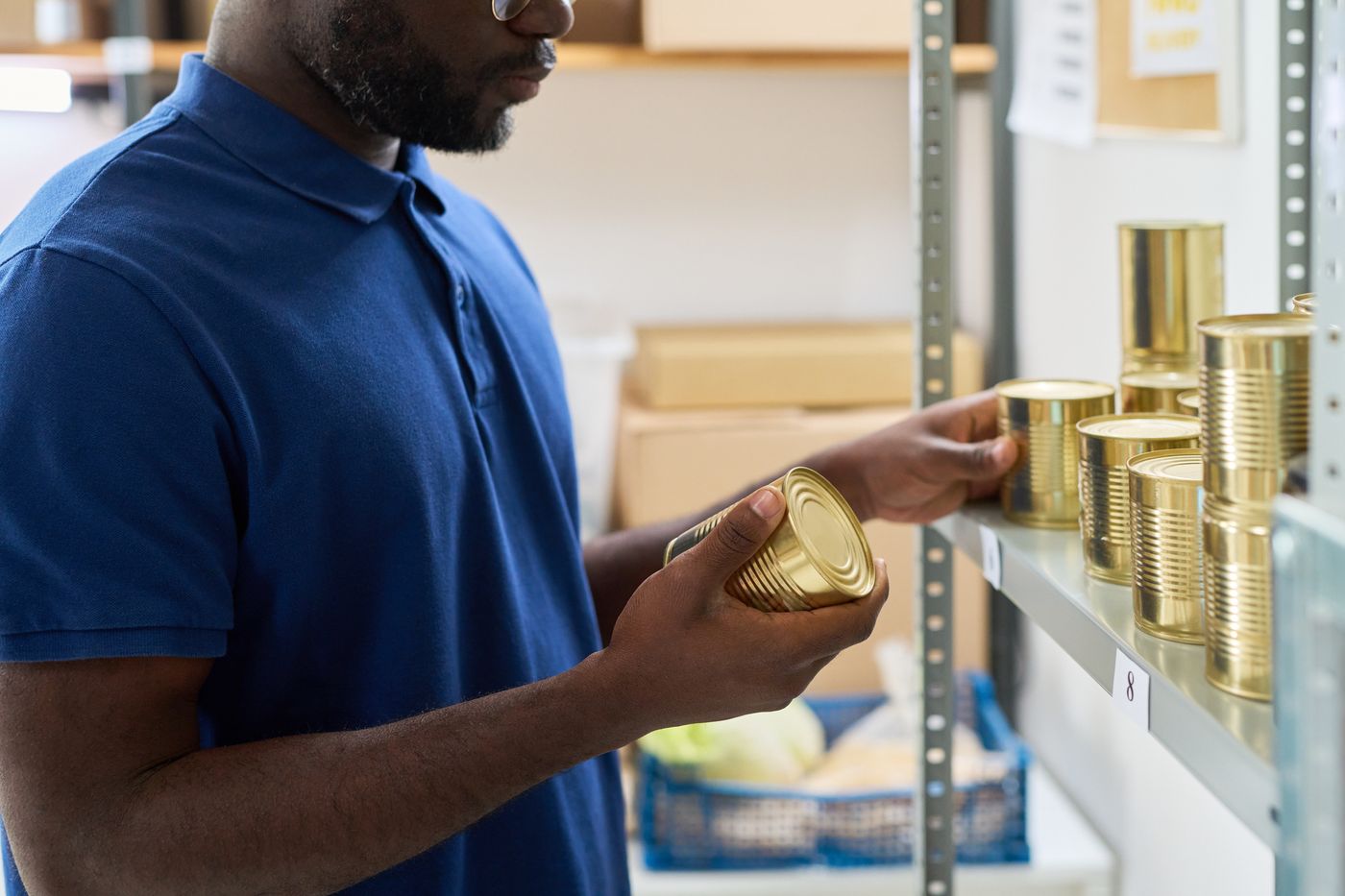
Photo: iStock.
First in, first out
FEMA's booklet gives the whole method in one line: put new items at the back of the storage area and older ones at the front, and use foods before they go bad, replacing them with fresh supplies. FEMA also says that you may not need to buy special foods at all; the canned goods, dry mixes and staples already in your cupboard can be the emergency supply, as long as you check dates and keep to first-in, first-out.
That is the core of a rotating pantry: the emergency store is simply the far end of the food you eat every week. Nothing sits long enough to expire, because it's eaten and replaced in the normal course of shopping. Building that pantry is the subject of the three-month pantry; this page keeps it turning.
Check on a schedule
Things that aren't eaten in the normal course of life, such as stored water, a go-bag, fuel and spare medicine, need a fixed check. Ready.gov says to replace expired kit items as needed and to rethink your needs every year, updating the kit as your family's needs change. A calendar is what makes "every year" actually happen. The calendar at the end of this page is the Almanac's suggestion for doing it.
Water
| Water | Replace | Source |
|---|---|---|
| Water you bottled yourself | Every six months | CDC; FEMA 477 |
| Commercially bottled water | By its expiration or "use by" date | CDC |
CDC's storage conditions are what let the water last that long: keep containers somewhere cool, about 50°F to 70°F, out of direct sunlight, and away from toxic substances such as gasoline and pesticides. Don't put water next to the fuel cans in the garage.
Rotating water is simple: on the replacement date, use the old water for cleaning, flushing or the garden, then wash, refill and re-date the containers. How to store water covers containers, cleaning and how much to keep.
Bleach
The bleach you'd use to treat water goes stale too, and it's the most overlooked item on the shelf. EPA says to use fresh liquid chlorine bleach, or bleach that has been stored at room temperature for less than one year. Date the bottle when you buy it and replace it within the year. How to purify water has the doses.
Food
What the dates on food mean
USDA's Food Safety and Inspection Service (FSIS) says that, except for infant formula, product dating isn't required by federal law, and dates are about quality, not safety. Its definitions:
- "Best if Used By/Before": when the product will be at its best flavor or quality. Not a purchase or safety date.
- "Sell-By": for the store's inventory. Not a safety date.
- "Use-By": the last date recommended for peak quality. Not a safety date, except on infant formula.
- "Freeze-By": when to freeze the product to keep peak quality.
FSIS says a product whose date passes during home storage should still be safe if handled properly, until signs of spoilage appear: an off odor, flavor or texture. Infant formula is the exception. FDA requires a "Use-By" date on it to guarantee the nutrients on the label, and FSIS says not to buy or use formula past that date. If you store formula, it gets the strictest rotation in the house.
Can codes are a different thing. FSIS explains they're a manufacturer's code for the date and time of canning, used to track product and for recalls, and are not meant to be read as a "best if used by" date. That is one more reason to write your own purchase date on the can.
How long shelf-stable foods keep
FSIS's storage chart gives these times on the shelf:
| Food | Keeps on the shelf | After opening |
|---|---|---|
| High-acid canned foods: juices, tomatoes, fruit, pickles, sauerkraut, foods in vinegar sauces | 12 to 18 months | 5 to 7 days in the refrigerator |
| Low-acid canned foods: meat, poultry, stews, soups (except tomato), pasta products, potatoes, corn, carrots, spinach, beans, beets, peas, pumpkin | 2 to 5 years | 3 to 4 days in the refrigerator |
| Shelf-stable canned ham | 2 to 5 years | 3 to 4 days in the refrigerator |
| Home-canned foods | 12 months | 3 to 4 days in the refrigerator |
| Rice and dried pasta | 2 years | Cooked: 3 to 4 days in the refrigerator |
| Commercially packaged jerky | 12 months | — |
| Tuna and other seafood in retort pouches | 18 months | 3 to 4 days in the refrigerator |
| USDA dried egg mix | 12 to 15 months, below 50°F, preferably refrigerated | Use within 7 to 10 days |
FSIS adds that home-canned food should be boiled before use: 10 minutes for high-acid foods and 20 minutes for low-acid foods.
MREs and heat. FSIS's chart shows how strongly temperature drives shelf life, using MREs as the example: about 7 years at 60°F, 4½ years at 70°F, 4 years at 80°F, 2½ years at 90°F, 1½ years at 100°F, and only 1 month at 120°F. The same principle applies to everything in this table, which is why every source says to store food somewhere cool. A hot garage or attic shortens every shelf life on the list.
FEMA's replacement guide
FEMA's 2004 booklet gives a simpler, more cautious guide for common emergency foods:
| Use within six months | Use within one year, or by the label date | Can be stored indefinitely in proper containers and conditions |
|---|---|---|
| Boxed powdered milk | Canned condensed meat and vegetable soups | Wheat |
| Dried fruit | Canned fruits, fruit juices and vegetables | White rice, dried corn, soybeans |
| Dry, crisp crackers | Ready-to-eat and uncooked instant cereals | Dry pasta |
| Potatoes | Peanut butter, jelly | Salt, baking powder, bouillon products |
| Hard candy and canned nuts | Instant coffee, tea and cocoa | |
| Vitamins | Vegetable oils; noncarbonated soft drinks | |
| Powdered milk in nitrogen-packed cans |
The sources give different times
FEMA's one-year rule for canned goods is shorter than FSIS's chart, which allows 12 to 18 months for high-acid cans and 2 to 5 years for low-acid ones. Both are guidance on quality, not safety. FEMA's shorter times make a simpler rotation; FSIS's chart tells you how much margin you have. FEMA also lists vegetable oils as keeping indefinitely, while the Almanac's long-term food storage page, from university extension sources, says oils and fats need rotating about yearly. Our suggestion: rotating oil on the yearly schedule costs little and avoids storing a rancid fat.
Cans to throw out
Whatever the date, FEMA and FSIS both say to discard cans that are swollen, dented or corroded (FEMA) or dented, rusted or swollen (FSIS). Inspect each can as you move it to the front of the shelf. That's the moment rotation earns its keep: you catch the bad can while there's still time to replace it.
FEMA's storage tips for keeping food at its best: a dry, cool spot, dark if possible; reseal opened boxes tightly; keep crackers and cookies in plastic bags inside sealed containers; and move opened sugar, dried fruit and nuts into screw-top jars or airtight canisters to keep pests out. Ready.gov adds that canned food belongs in a cool, dry place and boxed food in tightly closed plastic or metal containers.
Medicines
FDA says medicines past their expiration date shouldn't be used: their chemistry can change and their strength can drop, so their safety and effectiveness are no longer assured. FDA has required expiration dates on prescription and over-the-counter medicines since 1979; look for the date on the label or stamped on the bottle or carton, sometimes after "EXP".
For rotation, that means:
- Keep the reserve in use. Fill the next prescription before the last one runs out, and take from the oldest supply first, so the reserve is always the newest stock. The medications page covers building a reserve with your doctor and pharmacist.
- Store medicines where they'll last. FDA says most medicines belong in a cool, dry place such as a dresser drawer, closet shelf or kitchen cabinet away from the stove and sink, and not a damp bathroom cabinet.
- Check the kits. First-aid kits, go-bags and car kits hold medicines too. The first-aid kit page lists what's in one.
- Dispose of expired medicine properly. FDA's first choice is a drug take-back site (pharmacies, hospitals, clinics and law enforcement) or a mail-back envelope, then the FDA flush list only for medicines on it, then FDA's household-trash method.
Batteries
Battery makers give storage advice that keeps batteries fresh longer. Energizer says to keep batteries in a cool, dry place at normal room temperature, that a refrigerator isn't necessary, and not to store batteries or battery-powered devices in hot places, where heat can cause capacity loss, leakage or rupture.
For rotation, Energizer's advice adds up to a few rules:
- Take the batteries out of stored devices. For a device you won't use for a long time, such as the spare flashlight in a kit, Energizer says to switch it off and remove the batteries. A leaking battery can ruin the light it was meant to power.
- Never mix old and new, or different types or brands, in one device. Replace all of a device's batteries at once with new ones of the same size and type.
- Remove dead batteries promptly and dispose of them properly.
- Keep rechargeables charged. Energizer says to charge stored rechargeable batteries at least every 6 to 9 months.
The practical habit: on each check, test every flashlight and radio with its own batteries, swap in spares where needed, and move the older spares into everyday use.
Smoke and carbon monoxide alarms
Alarms run on batteries too, and they're the ones that protect you while you sleep. The U.S. Fire Administration's schedule depends on the alarm type:
| Alarm type | Test | Battery | Replace the alarm |
|---|---|---|---|
| 9-volt battery | Monthly | At least once a year | Every 10 years |
| Nonreplaceable 10-year lithium battery | Monthly | Not replaceable | By the maker's instructions |
| Hardwired with battery backup | Monthly | Backup at least once a year | Every 10 years |
Carbon monoxide alarms matter most when you're running a generator or a fuel-burning heater in an outage; follow the maker's instructions for each one. Generator safety and fire safety cover where each kind of alarm goes.
Fuel
Gasoline goes stale in storage, but we found no federal source that gives a shelf life for it, so this page gives no number. What the sources do give is a maker's rules for stabilizing and rotating it. Honda's generator fuel guidance is a useful example:
- Add fuel stabilizer to portable gas cans each time you fill them, following the stabilizer maker's instructions. When you first add it to the generator, run the engine for 10 minutes, outdoors, so treated fuel reaches the carburetor.
- Stabilizer has limits. Honda says all stabilizers have a shelf life and lose effectiveness over time, and that stabilizer won't restore fuel that has already gone stale.
- Fuel in the carburetor's float bowl deteriorates faster than fuel in the tank. Honda's storage steps start at 30 days without use, call for draining the carburetor for storage of 2 to 12 months, and draining both tank and carburetor beyond a year. Follow your own generator's manual.
- For rotating the cans themselves, Honda passes on an EPA suggestion: once stabilized fuel has been in a portable container for 12 months, add it to a car's gas tank, as long as the car's tank is fairly full, and refill the can with fresh fuel.
- Honda says not to use fuel with more than 10% ethanol in its generators. Check what your own equipment's manual allows.
How much fuel to keep, which containers, and the local rules on quantities are in fuel storage. The rotation habit is the same as for water: date each can, empty the oldest into the car, refill and re-date.
Fuel and engines can kill
CDC says to keep stored drinking water away from gasoline. When you run a generator to burn off old fuel or test it, run it only outdoors: Ready.gov says to run generators outdoors and well away from the home, never inside a home or garage, because of carbon monoxide poisoning. Generator safety has the placement, refueling and alarm rules.
The plan and the kit
The paper in your kit expires too. FEMA's communication-plan guide says to review, update and practice the household plan at least once a year, or whenever information changes, and Ready.gov says to rethink your kit's needs every year. Children outgrow clothes and shoes, prescriptions change, phone numbers change. Put the household plan review on the same day as the kit check, and redo the risk assessment whenever you move.
A yearly calendar
No source sets these dates. The calendar below is the Almanac's way of grouping the intervals above so the work happens on two fixed days, six months apart, plus a few minutes each month. Choose two dates you already notice, such as the start of spring and of fall, and keep to them.
| When | What to do | Why then |
|---|---|---|
| Every month | Test smoke and CO alarms. Take from the front of the pantry, put new purchases at the back | USFA's monthly test; first-in, first-out |
| Spring check | Replace home-filled water. Check every can and the dates in the food store. Check medicines in all kits. Test flashlights and radios. Charge rechargeables | CDC's six-month water interval; Energizer's 6–9 months for rechargeables |
| Fall check | Everything in the spring check, plus: replace alarm batteries, replace the bleach, rotate the oldest fuel can into the car, review and practice the household plan, update kit clothing for the season | USFA's yearly battery change; EPA's one-year bleach; EPA's 12-month fuel suggestion; FEMA's yearly plan review |
| Before each storm season | Top up water and fuel, refill prescriptions, check the car kit | So the store is full when it's most likely to be needed |
| When anything changes | Update the plan, swap clothes and medicines, re-date what you replace | A new phone number or prescription can't wait for the next check |
The six-month check
- Empty, rinse, refill and re-date home-filled water containers
- Move older cans and packages to the front; throw out any swollen, dented, rusted or corroded cans
- Note anything that will pass its date before the next check, and use it this month
- Check medicines in the house, the go-bag, the car and the first-aid kit; replace expired ones and take them to a take-back site
- Test each flashlight and radio; swap tired batteries; take batteries out of devices in long storage
- Charge rechargeable batteries and power banks
- Test smoke and CO alarms (and, at the fall check, replace their batteries)
- Check the date on the bleach (replace yearly)
- Check the dates on the fuel cans; rotate the oldest into the car
- Re-read the household plan and fix anything out of date
What not to do
- Don't store and forget. A store that isn't checked will expire all at once.
- Don't keep supplies somewhere hot. FSIS's MRE figures show what heat does to shelf life; a garage or attic shortens every interval above.
- Don't store water near fuel or chemicals (CDC).
- Don't use formula past its "Use-By" date (FSIS), or expired medicines (FDA).
- Don't trust a stabilizer to rescue stale fuel (Honda).
- Don't mix old and new batteries in one device (Energizer).
Where to go next
The two biggest jobs in rotation are water and food: start with how to store water and the three-month pantry. For fuel, read fuel storage before you buy the cans.
Sources
- CDC — Creating and Storing an Emergency Water Supply
- FEMA — Food and Water in an Emergency (FEMA 477, 2004)
- USDA FSIS — Shelf-Stable Food Safety
- USDA FSIS — Food Product Dating
- EPA — Emergency Disinfection of Drinking Water
- FDA — Don't Be Tempted to Use Expired Medicines
- Honda Power Equipment — Avoiding Fuel-Related Problems (EU generators)
- Energizer — Battery Care, Use and Disposal
- U.S. Fire Administration — Smoke Alarms
- Ready.gov — Build a Kit
- Ready.gov — Evacuation
- FEMA / America's PrepareAthon! — Create Your Family Emergency Communication Plan (July 2015), Ready.gov copy