Chapter 1 · Start Here
Writing the household plan: contacts, meeting places, roles and practice
A plan is the cheapest thing in this library and the one that does the most. It answers, on one sheet of paper, the questions nobody wants to work out while the phones are down: who calls whom, where you meet, who fetches the children, and what each person needs.
Read first: Start here
The opening page of this chapter puts the plan before any supplies, and this page is how to write it. The aim is a single sheet, copied for every person, that still works when phones are dead, the power is out and half the household is somewhere else.
Ready.gov's reason for planning is simple: when a disaster comes, your family may not be together. A child is at school, one adult is at work across town, another is on the road. FEMA's communication-plan guide adds the second half of the problem: mobile phones and computers may be unreliable in a disaster, and the power may be off. A plan settles in advance the things that are hardest to decide in the moment, so that everyone acts on the same assumptions without having to talk first.
What Ready.gov asks you to decide
Ready.gov frames the plan as four steps: meet with your household, assess what your household needs, write the plan down, and practice it. The first step is a conversation around five questions:
- How will we get emergency alerts and warnings?
- Where will we shelter if we stay?
- What is our evacuation route if we have to leave?
- How will we reach each other (the communication plan)?
- Does our emergency kit need updating?
The plan below answers each of those. Two of them have whole pages of their own. Alerts: how your phone receives Wireless Emergency Alerts and how a weather radio backs it up are covered in phone alerts and NOAA Weather Radio. Which hazards to plan for: the household risk assessment turns your address into a short list of the hazards that matter there. It is worth doing first, because the meeting places and the evacuation route depend on whether you are planning for a flood, a wildfire or a chemical release.
Step one: collect the information
FEMA's guide starts with a paper copy of every number and address the household might need. The reason it gives is practical: if you don't have your phone, or its battery has died, a number stored only in the phone is gone. Most people can't recite more than two or three numbers from memory. FEMA suggests a small test to prove the point: ask everyone in the house to recite the important numbers without looking, then imagine doing it during an emergency.
FEMA's fillable card (FEMA P-1095, July 2017) is a good model to follow. It asks for:
| Section | What to write | Why it's there |
|---|---|---|
| Household | Home phone and address | So a stranger or a responder can get a child home |
| Each person | Name, mobile number, another number or social media account, email, important medical information | Several ways to reach each person if one network is down |
| School, child care, caregiver, workplace | Name, address, emergency or hotline number, website, emergency plan or pick-up procedure | Disasters happen during school and work hours; you need their plan as well as yours |
| In Case of Emergency (ICE) contact | Name, mobile, home number, email, address | The person a responder or hospital should call |
| Out-of-town contact | Name, mobile, home number, email, address | A central point everyone reports to (below) |
| Meeting places | Indoor, neighborhood, out-of-neighborhood, out-of-town, with instructions | Where to go when you can't talk (below) |
| Important numbers | Police, fire, poison control, doctors, pediatrician, dentist, medical insurance, hospital or clinic, pharmacy, homeowner or renter insurance, flood insurance, veterinarian, kennel, electric, gas and water companies, accessible transportation | The calls you'll make in the days after |
Ready.gov's online form, Make a Family Emergency Plan, collects the same information and emails you a PDF. Ready.gov says the information you type into it is not saved, stored or shared by any government agency. The form also has room for assistive devices (make, model, supplier and serial number) and a veterinarian.
The two contacts that matter most
An out-of-town contact. FEMA's guide recommends choosing someone outside your community or state to act as the household's central point of contact. Its reason: in a disaster, a long-distance call may go through when a call across town won't, because local lines can be jammed. Everyone in the household calls or texts that one person, who keeps track of who is safe and where. Our suggestion: choose someone who is usually reachable, and tell them they've been chosen.
An ICE entry in every phone. FEMA suggests storing at least one emergency contact in every mobile phone under the name "In Case of Emergency" or "ICE", so that someone helping you can find who to call. FEMA also says to tell your emergency contact about any medical issues or other needs you have.
Children, schools and workplaces
Because a disaster may strike during school or work hours, FEMA's guide says to learn the emergency plans of each school, child-care provider and workplace, and how each one will keep families informed. Talk those plans through with your children, and tell them who might come to pick them up. Children without phones should know to follow the instructions of a responsible adult such as a teacher or principal. Household members with phones should sign up for alerts from their school, workplace and local government.
Step two: choose the meeting places
The communication plan assumes the phones might not work at all. Meeting places are the fallback: if nobody can talk, everyone still knows where to go. FEMA's guide names four, each for a different situation.
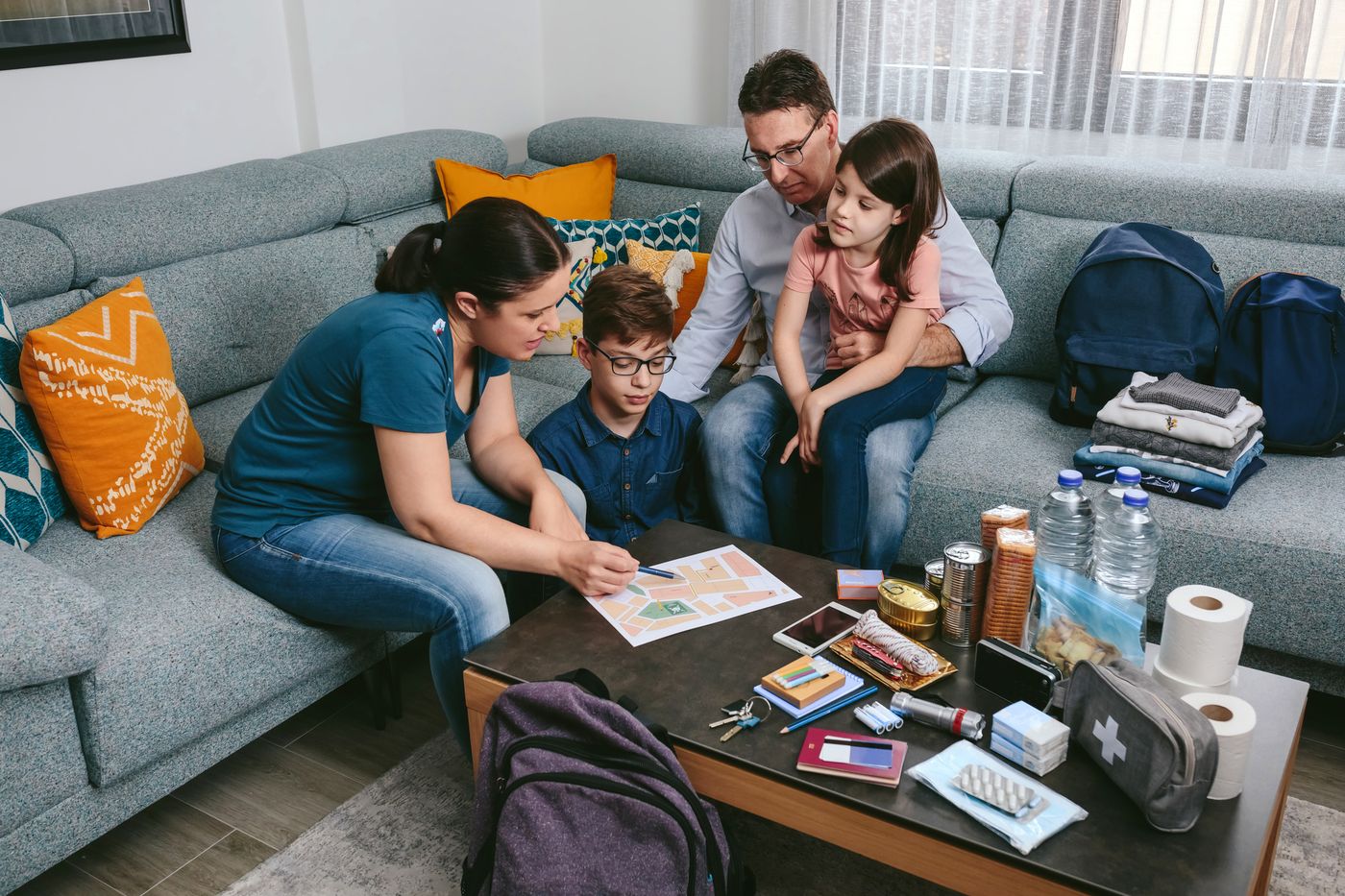
Photo: iStock.
| Meeting place | When you'd use it | FEMA's examples |
|---|---|---|
| Indoor | High wind: tornado, hurricane or other severe storm | A small, interior, windowless room such as a closet or bathroom on the lowest level of a sturdy building, or a tornado safe room or storm shelter |
| In the neighborhood | A fire or other emergency forces you out of the house | A big tree, the mailbox at the end of the driveway, or a neighbor's house |
| Outside the neighborhood | Something happens while you're away and you can't get home | A library, community center, house of worship or a family friend's home |
| Outside the town or city | You can't reach home or the local meeting place, or the household is split up and the area is ordered to evacuate | The home of a relative or family friend |
FEMA adds two conditions for every place on the list. It must be accessible to everyone in the household, including anyone with a disability or access and functional needs. And if you have pets or service animals, think about places that will accept them. Ready.gov's evacuation page warns that public shelters may allow only service animals, so a pet-friendly destination is worth finding in advance; the pets page covers this.
For the out-of-town meeting place, make sure everyone knows the address and has talked about how they would get there. Ready.gov's evacuation guidance goes further: pick several possible destinations in different directions, such as a friend's home in another town or a motel, and learn the alternate roads out of your area, since the road you'd normally take may be the one that's closed.
The indoor meeting place is the start of a wider subject. Which room to use depends on the hazard: the windowless interior room that is right for a tornado is the same idea officials use for some chemical emergencies, but not for a flood. Shelter in place explains the differences.
Step three: give everyone a role
A plan that says what to do but not who does it tends to fail in one of two ways: two people do the same job, or nobody does. Ready.gov asks households to consider each member's responsibilities for assisting others, and two of FEMA's sources name specific roles worth assigning:
- The messenger. FEMA's practice section asks who will be the lead person to send out information about the meeting place. That person texts the group list and the out-of-town contact.
- The kit carrier. Ready.gov's evacuation page says everyone should know where the go-bag is and who is responsible for it.
Beyond those two, the jobs depend on your household. Write a name next to each one that applies:
Roles to assign
- Sends the group message and calls the out-of-town contact
- Picks up each child from school or child care (and a backup if that person can't)
- Carries the go-bag and the documents
- Brings the pets, their carriers and their food
- Checks on an older neighbor or relative who lives alone
- Shuts off utilities if officials say to, or if there is damage (see utility shutoffs)
- Takes the medications and any medical equipment
- Keeps the car fueled; Ready.gov says to keep at least half a tank at all times
Special needs, written down
Ready.gov's second step, assessing household needs, is where a store-bought kit falls short. It lists the things to account for: ages of household members, responsibilities for assisting others, places you go often, dietary needs, medical needs including prescriptions and equipment, disabilities or access and functional needs including devices, languages spoken, cultural and religious considerations, pets or service animals, and school-aged children.
For anyone in the household with a disability or a medical condition, Ready.gov's disability page adds several steps that belong in the plan:
- A support network. Name the people who can help you in a disaster, give them a current contact list, tell them where your supplies are, and consider giving a trusted person a key.
- Medications. Keep at least several days' supply of prescription medicines and a list of your prescriptions that includes your diagnosis, the dose, how often you take each one, the medical supplies you need, and any allergies. Ask your doctor or pharmacist how to build an emergency supply. The medications page explains storage, expiration dates and what to ask.
- Treatment you can't miss. Ready.gov says anyone on dialysis or another life-sustaining treatment should know where more than one facility that can provide it is, and whether it's available.
- Power-dependent equipment. Ask your doctor how to keep electrical medical equipment running in an outage, and ask your utility to put you on its priority restoration list.
- Communication. Carry printed cards that explain how to communicate with you, and wear a medical alert tag or bracelet where it helps. Ready.gov suggests a weather radio with a text display and flashing alerts for people who are deaf or hard of hearing.
- Transportation. Ask your local emergency management office and transit providers about accessible transportation for an evacuation, and whether your community keeps a voluntary registry for people with disabilities.
FEMA's guide adds that for anyone who is deaf or hard of hearing or has a speech disability and uses relay services, the plan should say how to reach them through those services.
Step four: share it
FEMA's guide is specific about where the plan goes once it's written:
- A copy for every person, carried in a wallet, backpack or purse. FEMA's 2015 guide said a plan made on Ready.gov's online form could be printed as a wallet-sized card; today's form emails you the plan as a PDF to print instead.
- A copy posted somewhere central at home, such as the refrigerator.
- The household and emergency contacts entered into every phone, with at least one ICE entry.
- A group list on every phone of the people you'd need to reach in an emergency.
- A check, from time to time, that people are actually carrying their copy.
Put a copy in each kit as well: the 72-hour kit, the get-home bag and the car kit. Keep it with the documents described in documents to copy and store.
Text first, call briefly
FEMA's communication-plan guide and the FCC's current tips make the same point: text rather than call when you can. FEMA's guide explains why: a text needs far less network capacity than a voice call, so it may get through when a call can't, and a text that can't go out right away may be saved and sent automatically once capacity frees up. The FCC adds that texts may still be delayed when the network is congested, and that 911 is for emergencies (in some places you can text 911; check ahead whether yours takes texts).
The FEMA guide dates from 2015, and some of its phone tips have aged, so the list below follows the FCC's tips page, last reviewed May 1, 2026, where the two differ:
- If you do call, keep it short and say only what matters. Fewer calls also save battery (FCC).
- Wait 10 seconds before redialing a call that didn't connect. Redialing in quick succession adds to the jam (FCC; FEMA's guide says the same).
- Save the battery: dim the screen and turn off apps you don't need. The FCC adds that if there's no signal at all, switching the phone off stops it draining the battery while it hunts for one. FEMA's guide also suggests airplane mode and avoiding video and games, which load the network.
- Keep extra batteries, a car charger and a solar charger. FEMA's guide adds TTYs, amplified phones and caption phones to the list of devices that need backup power.
- Don't text, read texts or make a call while driving without a hands-free device (FEMA).
- Know what kind of home phone you have. FEMA's 2015 guide suggests a landline with an analog phone. The FCC's current advice is more specific: phone service carried over broadband (VoIP) won't work in a power outage without a battery or other backup, so test that battery and know how long it lasts; traditional copper-line service may still work, but you may need a corded phone, because many cordless phones need household power.
- If you evacuate and your home line has call forwarding, forward it to a mobile phone (FCC).
What should the text say? FEMA's example is about as short as a message can be: "I'm OK. At library." Say that you're safe and where you are. Agree on that format now so nobody has to think about it later.
Charging a phone in the car can kill
FEMA warns that if you charge a phone in a running car, the car must be somewhere well ventilated, never in a closed garage, because of the risk of life-threatening carbon monoxide poisoning. The FCC gives the same warning, and adds: don't try to reach your car if it isn't safe to. The same rule applies to any engine: generators, too, run only outdoors and away from the house (Ready.gov).
When cell service fails completely, radios take over. Which radio services a household can use, and how to set up channels, call times and a printed card, are in radio services and the household radio plan. Write the radio plan's channel and check-in time on the household plan, so the two match.
Practicing the plan
A plan nobody has rehearsed is a plan nobody remembers. Ready.gov's fourth step is to practice it, and FEMA's guide lists what to rehearse:
- Texting and calling. Each person sends a text or calls the out-of-town contact, and sends a group text to the household list.
- Message content. Agree what a text should say: that you're safe and where you are.
- The messenger. Confirm who sends out the meeting-place information.
- Gathering. Bring everyone to the indoor and neighborhood meeting places. Talk through how each person would reach the out-of-neighborhood and out-of-town places, including by public transportation, rail and paratransit for anyone who needs it.
- Calling 911. Make sure everyone, children included, knows how and when to call 911. FEMA says 911 is for life-threatening emergencies only.
- Ongoing conversation. Talk about the plan now and then: who to text or call, and where to go.
After each practice, FEMA suggests talking it over. What worked? What didn't? What information is out of date? If anything changes, print fresh copies for everyone.
How often. FEMA's guide says to review, update and practice the plan at least once a year, or whenever any information changes. Ready.gov's kit page asks you to rethink your needs every year too. The rotation page puts the plan review on the same yearly calendar as the water, food and batteries, so it isn't forgotten.
What not to do
- Don't keep the plan only on a phone. FEMA's reason for paper is that a phone can be lost, broken or flat.
- Don't choose a local person as the only contact. Local lines jam first; the out-of-town contact is there because a long-distance call may connect when a local one won't.
- Don't choose meeting places that only some of you can reach or that won't accept your animals.
- Don't call when a text will do, and don't redial in rapid succession.
- Don't let it go stale. A phone number that changed last spring is the one you'll need.
One-page household plan
- Every household member's name, mobile number, a second way to reach them, and key medical information
- Each school, child-care provider and workplace, with its emergency plan and pick-up rules
- One out-of-town contact, who knows the role
- An ICE contact stored in every phone
- Four meeting places: indoor, neighborhood, outside the neighborhood, outside the town, with directions
- Who does what: messenger, child pick-up and backup, kit carrier, pets, neighbors, utilities, medications
- Each person's special needs: medications list, equipment, communication, transportation
- Important numbers: doctors, pharmacy, insurance policies, veterinarian, utilities
- Radio channel and check-in time, matching the household radio plan
- A copy in every wallet and kit, one on the refrigerator, and a date for the next practice
Where to go next
If you haven't yet, work out which hazards the plan is for with the household risk assessment. Then set your phones up properly with phone alerts, and give the plan a radio backup with the household radio plan.
Sources
- Ready.gov — Make a Plan
- FEMA — Family Emergency Communication Plan, fillable card (FEMA P-1095, July 2017)
- FEMA / America's PrepareAthon! — Create Your Family Emergency Communication Plan (July 2015), Ready.gov copy
- FCC — FCC/FEMA Emergency Communications Tips (reviewed May 1, 2026)
- Ready.gov — Make a Family Emergency Plan (online form)
- Ready.gov — Evacuation
- Ready.gov — People with Disabilities
- Ready.gov — Build a Kit