Chapter 10 · Kits & Bug-Out
The car kit: what to keep in the vehicle by season, and what to do if you're stranded
A car is shelter, a radio, a phone charger and a ride out, as long as it has fuel and the right few things in the trunk. Here is the kit, compared across the federal lists, and the rules for waiting out a storm inside it.
Read first: The 72-hour kit
Most emergencies that catch people away from home catch them in or near a car: a commute in a sudden snow squall, a long drive on an evacuation route, a breakdown on a hot back road, a flooded underpass. The car can carry far more than a backpack, so its kit can be generous. The trick is to pack for the seasons you actually drive in, keep the tank from running low, and know the few rules that keep a stranded car from becoming dangerous.
This page covers the vehicle. The get-home bag is the part you can carry if you have to leave the car and walk, and many people keep it in the trunk. The 72-hour kit is what waits at home.
The three federal lists, side by side
Ready.gov, CDC and the National Weather Service (NWS) each publish a car kit. They overlap a lot, but each includes things the others leave out. Ready.gov's is a short year-round list; CDC's and NWS's are written for winter.
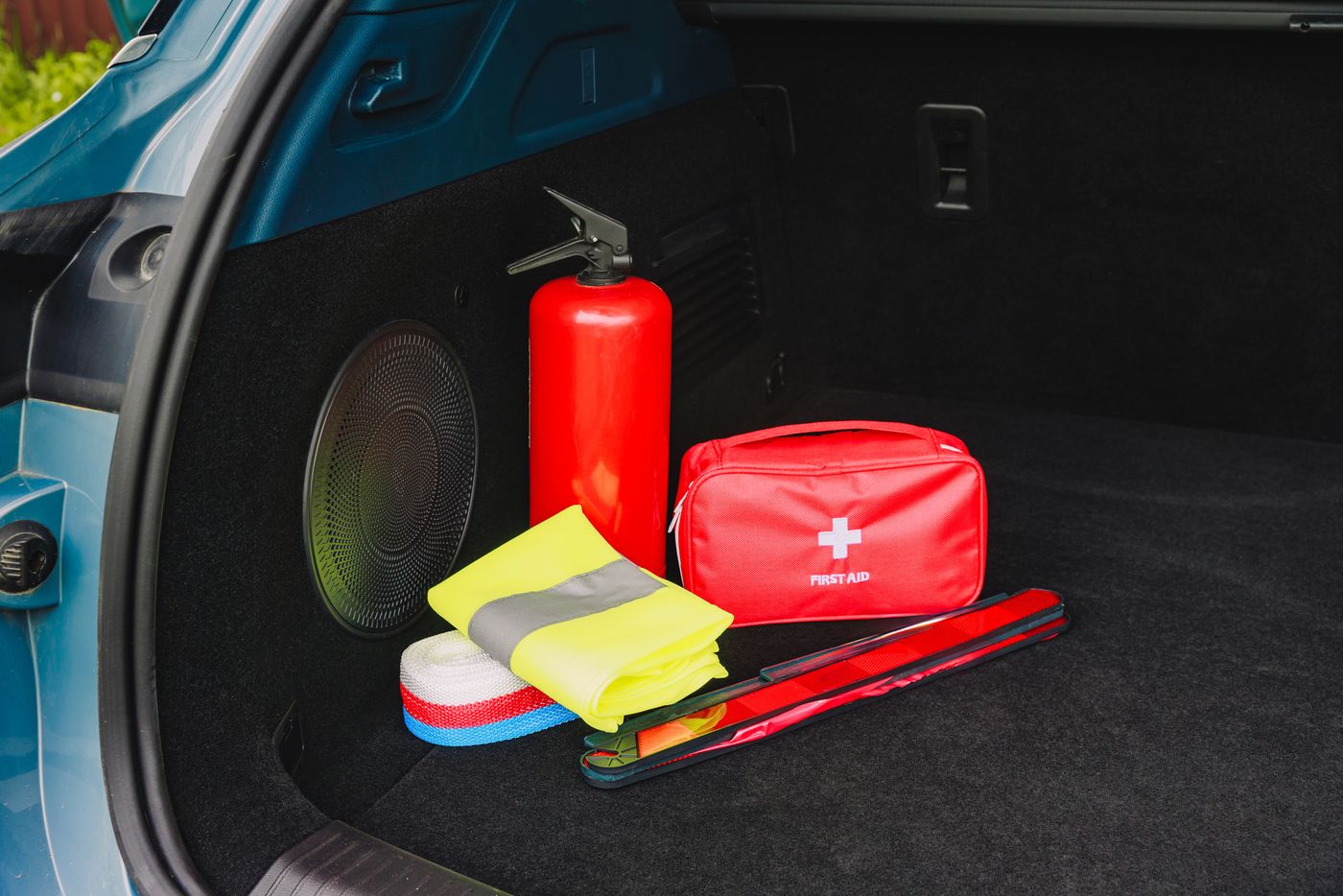
Photo: iStock.
| Item | Ready.gov car page | CDC winter car kit | NWS winter survival kit |
|---|---|---|---|
| Jumper or booster cables | Yes | Yes (or booster cables with a charged battery pack) | Yes |
| Flares, reflective triangle or hazard reflectors | Yes | Yes, plus a bright flag or help sign | — |
| Ice scraper | Yes | Yes | Yes, with a brush |
| Phone charger | Yes (car charger) | Yes (portable charger and spare batteries) | Yes (phone, charger, batteries) |
| Blanket | Yes | Yes, with extra hats, coats and mittens | Blankets or sleeping bags |
| Map | Yes | Road maps | Compass and road maps |
| Cat litter or sand for traction | Yes | Yes, or road salt | Yes |
| Water and food | — | Water and snacks | High-calorie non-perishable food; a water container |
| Flashlight and spare batteries | — | Yes | Yes |
| First aid kit | — | Yes, with needed medications and a pocket knife | Yes, and a knife |
| Battery radio | — | Yes, with spare batteries | — |
| Shovel | — | Yes | Yes |
| Tow chain or rope | — | Yes | Tow rope |
| Tire chains | — | Yes | — |
| Tire sealant (compressed air with sealant) | — | Yes | — |
| Tool kit | — | — | Yes |
| Extra dry clothing | — | Warm items | Yes |
| Matches and a can to melt snow for water | — | Waterproof matches and a can | Small can and waterproof matches |
| Emergency toilet: large empty can, tissues, toilet paper, paper towels | — | — | Yes |
| Candle and matches, for light and emergency heat | — | — | Yes |
Two items deserve a word. NWS includes a large empty can as an emergency toilet, which sounds odd until you are stuck for six hours; see emergency toilets for doing this hygienically. NWS also lists a candle, for light and, in an emergency, lifesaving warmth. Neither Ready.gov nor CDC lists one, and an open flame inside a closed car is a fire risk; if you carry one, read the candle rules in fire safety first.
The kit by season
The table below sorts the federal items into a core kit that stays in the car all year and additions you swap in and out. The sorting is the Almanac's; every item comes from one of the lists above, except where marked suggested.
| Season | Add to the core kit | Why |
|---|---|---|
| All year (core) | Jumper cables; flares or reflective triangle; phone charger; blanket; paper map; flashlight and batteries; first aid kit and any daily medications; water and snacks; tire sealant; tool kit; tow rope | Breakdowns, flat tires and dead batteries happen in every month; a map and charger matter when phones and signal fail |
| Winter | Ice scraper and brush; shovel; cat litter, sand or road salt; tire chains where your area requires them; extra hats, coats, mittens and dry clothing; sleeping bags or more blankets; waterproof matches and a can to melt snow; high-calorie food; emergency toilet can and paper | Snow traps cars, and a stranded car gets cold fast once the engine is off |
| Hot weather | More water than in winter, and a hat and light layers in case you have to walk (suggested) | Heat illness comes on quickly in a stalled car or on foot beside a highway; see heat illness |
| Hurricane and evacuation season | Water and non-perishable food for the drive (Ready.gov evacuation page); a printed route with alternates; a full tank when an evacuation looks likely | Ready.gov warns that gas stations may close or be unable to pump during outages |
Before winter: getting the car itself ready
A kit doesn't help a car that won't start. Ready.gov lists the things to have a mechanic check before an emergency: antifreeze level, battery and ignition, brakes, exhaust system, fuel and air filters, heater and defroster, lights and hazard lights, oil, thermostat, and wipers and washer fluid. CDC's autumn list adds:
- Switch to a winter windshield-washer fluid.
- Check tire tread and pressure, replacing worn tires; CDC notes most cars take 30 to 35 psi, but follow your own car's recommended pressure.
- Keep the gas tank near full, which CDC and NWS both say helps prevent ice in the tank and fuel lines.
Ready.gov adds good winter tires with enough tread, plus any chains or studs your area requires.
Fuel: never let it run low
Ready.gov's evacuation page sets the floor: keep at least half a tank at all times, and fill up when an evacuation looks likely, because gas stations may close or be unable to pump without power. Its car page says to keep the tank full ahead of evacuations and outages, and that a full tank also helps keep the fuel line from freezing. A half-full tank is also your heater if you are stranded in the cold. Storing extra fuel at home has its own rules; see fuel storage.
Before you leave on a winter trip
NWS reports that on average more than 5,000 people are killed and more than 418,000 injured in weather-related crashes each year. Its advice before any winter drive:
- Check road conditions. NWS says to call 511 for traffic, construction and weather conditions before you leave.
- Tell someone your route and your departure time, with an alternate route, so they know where to start looking. NWS also advises against traveling alone.
- Clear all snow and ice from the whole vehicle before you start, because snow blowing off cars causes crashes.
- Charge your phone and carry the car charger.
- Stay home if you can. Ready.gov's winter page says to stay off roads if at all possible during a winter storm.
On the road, NWS says to slow down, drive as if the road is icy whenever temperatures are near freezing (black ice is hard to see), and in a skid to ease off the gas and steer where you want the front of the car to go; with anti-lock brakes, press steadily and don't pump. Ready.gov adds: turn off cruise control on slippery roads. If visibility drops too far, NWS says to pull over, stop, turn off your lights and set the parking brake, so a driver behind doesn't follow your taillights into you.
Stranded in snow: what to do
NWS's instructions for a car stuck in a winter storm are short and each one has a reason.
- Stay in the car. NWS warns that wind-driven snow and cold can disorient you quickly once you leave it. The car is your shelter. Ready.gov's winter page says the same: if trapped in your car, stay inside.
- Run the engine about 10 minutes each hour for heat. This stretches your fuel and limits exhaust.
- Clear the exhaust pipe of snow before and while the engine runs. A blocked tailpipe pushes exhaust into the car.
- Open a window slightly while the engine runs, for fresh air.
- Make yourself visible. Run the dome light at night while the engine is on, tie a bright cloth (red if possible) to the antenna or door, and raise the hood once snow stops falling.
- Keep moving and keep warm. NWS advises moving your arms, legs, fingers and toes to keep blood flowing, but avoiding overexertion, especially if you are not in good health: pushing a car, shoveling heavy snow or walking in deep snow in the cold can bring on a heart attack, and sweating leads to chills.
- Drink, but melt snow first. NWS says eating snow lowers your body temperature; melt it in your can first.
Carbon monoxide in a stranded car
Exhaust is carbon monoxide, which has no color or smell and can kill. In a stranded car, keep the tailpipe clear of snow and a window open a crack whenever the engine runs (NWS). CDC adds that a small leak in the exhaust system can let carbon monoxide build up inside a car, so have the exhaust checked by a mechanic every year; that if only the tailgate is open, exhaust gets drawn into a car or SUV, so open vents or windows too; and never run a car in a garage attached to a house, even with the garage door open. CDC lists headache, dizziness, weakness, upset stomach, vomiting, chest pain and confusion as the common symptoms, and warns that people who are asleep can die before they notice anything.
Cold injuries are the other risk while you wait. Ready.gov's winter page lists the signs of frostbite (numbness, white or grayish-yellow skin, skin that feels firm or waxy) and of hypothermia (shivering, exhaustion, confusion, fumbling hands, memory loss, slurred speech, drowsiness), and calls a body temperature below 95°F an emergency. What to do about each is in hypothermia and frostbite.
Stranded in heat
Heat is less dramatic than a blizzard but kills too. Ready.gov's heat page is blunt: never leave people or pets in a closed car on a warm day. A page from one NWS local office, Louisville, Kentucky, explains why (the page shows no date, and its counts end in 2016): a car works like a greenhouse, its inside can rise 20 degrees in as little as 10 minutes and 50 degrees in an hour even when the air outside is in the 70s, and it can reach 120°F within minutes. It says cracking the windows gives little if any relief, and children's body temperature rises three to five times faster than an adult's. It counts 700 children who died in hot cars nationwide from 1998 to 2016.
Those figures mean a broken-down car with the air conditioning off is no place to sit with the windows up on a hot day, and opening them a crack doesn't fix it. Keep water in the car, and watch everyone for the signs of heat exhaustion and heat stroke in heat illness. Ready.gov calls heat stroke (a body temperature above 103°F, hot dry skin, confusion) a 911 emergency.
Look before you lock (NWS Louisville)
- Check the back seat every time you get out; make "look before you leave" a habit
- Put a purse or briefcase in the back seat as a reminder that a child is there
- Ask the school or child care to call you if your child doesn't arrive
- Lock the car and keep keys away from children; teach them a car is not a play area
- If you see a child alone in a hot car, call 911
- Leave pets at home in summer
Water on the road
Don't drive into floodwater
Do not drive into water covering a road. NWS says it is never safe to drive or walk into floodwater. The sources give slightly different depths, and both are worth knowing:
- Ready.gov: about six inches of water can make a car stall or lose control, and about one foot can float many vehicles.
- NWS: 12 inches of rushing water can carry away most cars, and two feet can carry away SUVs and trucks. NWS adds that, per CDC, over half of all flood-related drownings happen when a vehicle is driven into hazardous floodwater, and that the road under the water may have collapsed.
The takeaway is the same: you can't tell how deep water is, or whether the road is still there, from the driver's seat. Ready.gov also warns that roads may have weakened and could collapse under a car's weight. More on floods in floods.
Other roadside dangers
- A power line on the car. Ready.gov says to stay inside until a trained person removes the line, because stepping out risks electric shock.
- Losing control. Ready.gov's advice is to pull over, stop and set the parking brake.
- Damaged roads. If an emergency could have weakened the road, avoid overpasses, bridges, power lines and signs (Ready.gov).
- Evacuating. Ready.gov asks for one car per family to reduce traffic, recommended evacuation routes rather than shortcuts, and leaving early enough not to be caught by the weather. The hurricanes page covers evacuation zones.
Car kit (core plus winter, from Ready.gov, CDC and NWS)
- Jumper cables or a charged jump pack
- Flares, reflective triangle or hazard reflectors; a bright cloth or help sign
- Phone charger for the car, and a charged portable battery
- Flashlight with spare batteries
- Battery-powered radio with spare batteries
- First aid kit, daily medications, pocket knife
- Water and high-calorie snacks
- Blankets or sleeping bags
- Extra hats, coats, mittens and dry clothes
- Paper road maps and a compass
- Ice scraper and brush
- Shovel
- Cat litter, sand or road salt
- Tow rope or chain; tire chains where required
- Tire sealant with compressed air
- Basic tool kit
- Waterproof matches and a metal can to melt snow
- Large empty can, toilet paper and paper towels for an emergency toilet
- A get-home bag with walking shoes, if you'd walk home from here
Keeping it ready
- Swap seasonal items when you change your clocks or switch tires (suggested), so winter gear goes in before the first storm.
- Rotate food and water in the car more often than at home (suggested), because a car's inside gets hot (NWS Louisville's figures above). Replace anything past its date.
- Recharge jump packs and battery banks every few months (suggested); batteries lose charge sitting in a trunk.
- Check the half-tank rule every time you pass a station on the way home.
Where to go next
If you'd have to abandon the car and walk, pack a get-home bag. For storms that keep you home, see power outages and the 72-hour kit.
Sources
- Ready.gov — Car Safety
- Ready.gov — Evacuation
- Ready.gov — Winter Weather
- Ready.gov — Extreme Heat
- CDC — Preparing for a Winter Storm
- CDC — Carbon Monoxide (CO) Poisoning Basics
- NWS — Winter Safety: Before a Storm
- NWS — Winter Safety: During a Storm
- NWS — Flood safety: driving and walking in floodwater
- NWS Louisville — Beat the Heat, Check the Back Seat