Chapter 11 · Navigation & Skills
Ten knots that matter, and how each one fails
A household needs about ten knots, not a hundred: two stoppers, three ways to join rope, one fixed loop, three hitches for posts and logs, and one shortening. Each has a job and a known way of failing, and the failure is the part worth learning.
Read first: Start here
Rope is one of the cheapest and most useful things a prepared household owns, and most of its usefulness is in the knot at the end of it. A tarp over a broken window, a load tied onto a roof rack, a log dragged out of the driveway, a line strung for wet laundry: each needs a knot that holds while it's loaded and lets go when you're done.
The 1911 Boy Scouts Handbook put the test of a good knot in three parts: it is quick to tie, it holds fast when pulled tight, and it comes undone readily. A. Hyatt Verrill, in a rope-work manual first published in 1912, remarked that a bad knot comes more naturally than a good one, and that a beginner joining two ropes nearly always ends up with one that slips or one that jams.
This page teaches ten knots from those two books and from two current U.S. Army sources: the Army's survival manual, ATP 3-50.21 (2018), and the Knot Guide of the Army Mountain Warfare School (2010). The old books give the knots and their uses, the Army sources give the checks and the cautions, and where they disagree, both are given.
Before you tie anything
Three names for the parts of a rope
The four sources use the same three ideas, though not always the same words, and the instructions below depend on them.
- The standing part is the long, idle part of the rope, the part that goes off to the load or the anchor (Verrill, Boy Scouts Handbook).
- The end (the Army calls it the running end) is the part you work with to tie the knot.
- A bight is a U-shaped bend in the rope where it doesn't cross itself. Once it crosses itself it is a loop (Army Mountain Warfare School).
Whip the ends
A rope end that unravels won't go through a knot cleanly. Verrill advises whipping the end of every rope before using it, and the Handbook teaches whipping before any knot. The method in both, in outline: lay a piece of twine along the rope's end, wind it tightly around rope and twine, lay a loop of the twine back along the rope, wind over that too, then pull on the free end of the twine to draw the loop and its turns tight. ATP 3-50.21 adds that if you're going to cut a rope, whip it on both sides of the cut first, so neither piece starts to untwist. ATP 3-50.21 counts a tight wrap of tape as whipping too.
Dress it, set it, check it
ATP 3-50.21 calls straightening and aligning every part of a knot dressing it, and says a knot left undressed can lose half its strength. Tightening every part so it binds on the others is setting it. A loosely tied knot, the manual warns, can deform under load into a slipknot or come untied.
The Army's mountaineering guide adds the caution that matters most: no knot is permanent. Knots work loose over time, so every knot has to be checked again and often re-tied. It also says strength is not the only reason to choose a knot. How easily it ties, whether it can be untied after a load, how likely it is to work loose and how quickly it can be inspected all count.
Every knot weakens the rope
The Army's mountaineering guide gives the figures below. Read them with care: they are for single kernmantle rope, the sheathed nylon rope climbers use, and the guide gives no figures for the twisted manila, cotton or polypropylene rope most households keep. A different rope will give different numbers. The table is here to show the size of the loss, not to rate any rope you own.
| Knot | Strength left in the rope |
|---|---|
| No knot | 100% |
| Figure eight | 75–80% |
| Bowline | 70–75% |
| Two half hitches | 60–70% |
| Overhand | 60–65% |
| Clove hitch | 60–65% |
Source: Army Mountain Warfare School Knot Guide (2010), for single kernmantle climbing rope only.
ATP 3-50.21 puts the overhand lower: it says an overhand knot alone cuts a straight rope's strength by 55%, which would leave 45%, and it doesn't say for what kind of rope. Neither source says how its figure was measured. The point they share is that the knot is the weak spot in a loaded rope. Verrill made the same point about the bulky open-hand knot: overload the rope and it will probably part at the knot before anywhere else.
This page is not for lifting or lowering people
Both of the old books mention lowering people with a bowline, the Handbook from a burning building and Verrill over cliffs, and ATP 3-50.21 describes a bowline sling for lifting a casualty. We don't teach any of it. The Army's mountaineering course teaches its knots by small-group instruction, with climbing rope and hardware, and tests each student against a timed standard; nothing on this page stands in for that. For getting out of an upstairs room in a fire, see the escape ladder advice in home fire safety. Don't climb on, hang from, or lower anyone on a household rope and a knot learned from a page.
The ten knots at a glance
| Knot | Family | Use it for | How it fails | Verrill figure |
|---|---|---|---|---|
| Overhand | Stopper | Keeping an end from slipping out; securing other knots | Costs the rope the most strength; tied in a bight as a loop, it jams | Figs. 7–8 |
| Figure eight | Stopper | A bigger stopper than the overhand | No failure given; the sources use it only as a stopper | Figs. 9–10 |
| Square (reef) knot | Joins two ends | Tying around a bundle, bandages, the two ends of one cord | Slips when the ropes differ in size; tied wrong it becomes a granny or thief knot | Figs. 11–15 |
| Sheet bend | Joins two ropes | Ropes of different sizes | Single form can loosen when the load comes off | Figs. 22–23 (weaver's knot) |
| Fisherman's knot | Joins two lines | Fishing line, twine, small cord | No failure given; it is made for fine line, not rope | Figs. 17–18 |
| Bowline | Fixed loop | A loop that won't tighten, at the end of a rope | Works loose over time like any knot; the Army adds an overhand safety | Figs. 58–59 |
| Clove hitch | Hitch | Rope to a post, pipe or rail; starting lashings | Seldom slips (Verrill); the Army checks which way it faces the pull | Fig. 36 |
| Round turn and two half hitches | Hitch | Anchoring to a tree or post under heavy load | A single half hitch on its own shakes loose | Figs. 34–35 (two half hitches) |
| Timber hitch | Hitch | Dragging or lifting a log or pole | Relies on the strain to hold; needs a half hitch for a heavy drag | Figs. 38–39 |
| Sheepshank | Shortening | Shortening a rope without cutting it; bridging a worn spot | The simple form is undependable unless the ends are seized (Verrill) | Figs. 78–80 |
The "how it fails" column comes from the sources' own cautions, described under each knot below.
Stoppers
1. Overhand knot
The simplest knot of all, and part of many others. Verrill used it to finish the ends of yarns and strands; ATP 3-50.21 lists it for keeping a rope end from untwisting, for putting a knob in the end of a rope, and as part of other knots.
To tie it: make a loop near the end and pass the end through it, then pull tight (ATP 3-50.21, Verrill Figs. 7–8; Fig. 11-1).
Its main job now is as a safety. ATP 3-50.21 says the overhand should take the place of the half hitch as the finishing knot for other knots, and the mountaineering guide uses it as the "safety" tied in the tail of a square knot or bowline, dressed down snug against the knot it secures.
How it fails: it costs the rope more strength than any other knot in the table. ATP 3-50.21 warns that an overhand tied in a bight to make a loop tends to jam so hard once loaded that it may have to be cut off.
2. Figure-eight knot
ATP 3-50.21 uses the figure eight where you want a bigger knob than an overhand gives, to keep the end from slipping through a ring, an eye or a loop in another rope. Verrill describes a variation for the same purpose, stopping a rope from running through an eye, ring or pulley block.
To tie it: make a loop in the standing part, take the end around behind the standing part, back over one side of the loop and down through it, then pull tight (ATP 3-50.21). It looks like the numeral 8 (Fig. 11-1).
Why choose it: it leaves more of the rope's strength than an overhand (75–80% against 60–65%, in the mountaineering guide's figures).

- Left: the overhand knot, open and tightened (Verrill Figs. 7–8).
- Right: the figure-eight knot, open and tightened (Verrill Figs. 9–10).
From A. Hyatt Verrill, Knots, Splices and Rope Work (1912), Figs. 7–10. Public domain; cropped, with Verrill's printed captions removed and the engravings set side by side.
Joining two ropes
3. Square knot (reef knot)
Verrill rated the square knot the best general-purpose knot there is. The Handbook gives it as the usual knot for tying two ropes together, and notes its use in first-aid bandaging; triangular bandages and swathes are in fractures.
To tie it: Verrill's memory aid is "left over, right over." Pass the left end over and under the right end, then the right over and under the left. Check it: each end should come out lying alongside its own standing part (ATP 3-50.21), with the two ends at opposite ends of the knot but on the same side of the standing parts (Mountain Warfare School; Fig. 11-2).
The reef knot is the same knot made with a bight of one end instead of the end itself, which Verrill says makes it quicker to cast off (Fig. 12, A).
How it fails, three ways:
- The granny. Cross the ends wrongly and you get the granny knot (Handbook, Verrill Fig. 13; Fig. 11-2). Verrill had nothing good to say about it; the Handbook says it is always bad; ATP 3-50.21 says it slips under strain and shouldn't be used.
- The thief knot. ATP 3-50.21 describes a look-alike that comes from feeding the second rope through the bight from the wrong side. Each end still lies alongside its own rope, so it passes a quick glance, but it slips under strain and is hard to untie.
- Unequal ropes. Verrill says neither square nor reef knots are reliable when the two ropes are different sizes: they slip and sooner or later pull apart (Fig. 14). ATP 3-50.21 gives the sheet bend for ropes of unequal size.

- Left, large: the square knot being tied (Verrill Fig. 11).
- Left, top: the square knot finished. Left, bottom (A): the reef knot, made with a bight so it casts off quickly (Verrill Fig. 12).
- Right: the granny knot, open and tightened, the wrong way to cross the ends (Verrill Fig. 13).
From A. Hyatt Verrill, Knots, Splices and Rope Work (1912), Figs. 11–13. Public domain; cropped, with Verrill's printed captions removed and the engravings set side by side.
The sources disagree on how far to trust it
Verrill and the 1911 Handbook both say the square knot never slips or jams. ATP 3-50.21 says a true square knot draws tighter under strain, but limits it to ropes of equal size. The Army's mountaineering guide uses it to join equal ropes under tension only with an overhand safety tied on each side. Verrill himself seized the ends down to the standing parts when the ropes were uneven (Fig. 15). For a bundle or a bandage, the plain knot is fine. For anything that carries a real load, follow the Army: safety each end, or use a sheet bend.
To untie it: take hold of the two bights where they wrap each other and pull the knot apart (ATP 3-50.21).
4. Sheet bend
The knot for joining two ropes that aren't the same size, which is the job the square knot fails at. The Handbook and ATP 3-50.21 both give weaver's knot as another name for it. Verrill says the weaver's knot suits small line and twine better than rope, and that nothing beats it for thread.
To tie it (ATP 3-50.21): make a bight in the larger rope. Pass the end of the smaller rope up through the bight, around behind both parts of the larger rope, and back under itself. Pull tight.
How it fails: ATP 3-50.21 limits the single sheet bend to dry ropes of unequal size, and says it draws tight under light loads but may loosen or slip when the tension comes off.
The fix is the double sheet bend. Before tightening, take one more turn around the bight with the small rope's end, and tuck it under itself again. ATP 3-50.21 says the double sheet bend works better for ropes of equal or unequal size, for wet rope, and for tying a rope to an eye, and that it won't slip or draw tight under heavy loads.
5. Fisherman's knot
For fine line and cord, where bigger knots won't grip. The Handbook gives it for silk-worm gut fishing line and says it never slips; Verrill thought it probably the strongest way known to join fine lines.
To tie it: lay the two lines alongside each other, pointing in opposite directions. With each end, tie an overhand knot around the other line's standing part. Pull the standing parts and the two overhands slide together and lock (Handbook, Verrill Figs. 17–18).
To untie it: the Handbook says pulling the two short ends apart loosens it. For gut fishing line, Verrill's advice was to leave the knot slightly open and wrap the gap between the halves with silk.
A fixed loop
6. Bowline
The loop that doesn't tighten on what's inside it and doesn't slip. Verrill rated it the sailor's knot above all others, one that holds without slipping or jamming and still comes undone easily. ATP 3-50.21 recommends it for a loop at the end of a rope and notes that it is easy to untie. Around the house it's the knot for a loop over a post, around a tree or through a ring that you want to come off again.
To tie it (Handbook and ATP 3-50.21):
- Leave enough end for the size of loop you want, and make a small loop in the standing part, with the end side crossing over the standing part (Verrill Fig. 59, A).
- Bring the end up through that small loop from underneath.
- Take it around behind the standing part.
- Bring it back down through the small loop, alongside itself.
- Hold the big loop and pull the standing part to tighten.
Verrill's Fig. 59 shows the stages, A through D, beside his Fig. 58, the finished knot (Fig. 11-3). The check (Mountain Warfare School): the end finishes on the inside of the big loop.
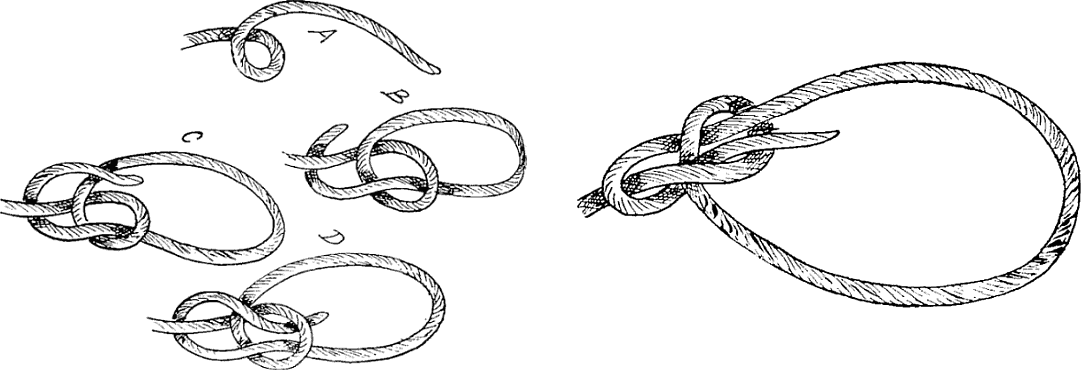
- A: a small loop with the end crossing over the standing part.
- B: the end comes up through the small loop.
- C: the end goes around behind the standing part.
- D: the end goes back down through the small loop, alongside itself. Verrill's text names a last stage, E, the knot drawn taut; the engraving letters only A to D.
- Right: the finished bowline (Verrill Fig. 58), with the end inside the loop.
From A. Hyatt Verrill, Knots, Splices and Rope Work (1912), Figs. 58–59. Public domain; cropped, with Verrill's printed captions removed and the engravings set side by side.
How it fails: none of the four sources says how, only how to guard against it. The Army mountaineering guide requires an overhand safety in the tail of every bowline, and its general rule applies with force here: knots work loose with time and must be checked.
Variations: the bowline on a bight makes a loop in the middle of a rope where there's no free end (ATP 3-50.21, Verrill Fig. 60). A running bowline, with the end passed through the loop, makes a slip knot that tightens on what it holds (Verrill Fig. 61).
Hitches: rope to an object
A hitch ties a rope to a post, pipe, tree or ring. ATP 3-50.21 defines it as a knot that holds for the time being and can be undone easily.
7. Clove hitch
The quick hitch for a post, rail, pipe or pole. The Handbook gives it for fastening poles together in scaffolding, where it holds snug and doesn't slide sideways. Verrill says builders used it for the same job, and that it grips a smooth timber and a wet spar. ATP 3-50.21 starts and finishes every lashing (square, diagonal and shear) with a clove hitch.
To tie it at the end of a rope: pass the rope around the post, cross over the standing part, go around the post a second time, and tuck the end under that second turn (ATP 3-50.21, Handbook; Fig. 11-4).
To drop it over the top of a post: make two loops in the rope, one after the other, lay the second on top of the first without flipping it, and slip both over the post (ATP 3-50.21, Mountain Warfare School).
The check: two turns with a diagonal bar across them, and both rope parts coming out of the middle (Mountain Warfare School). That guide also wants the bar facing against the direction of pull.
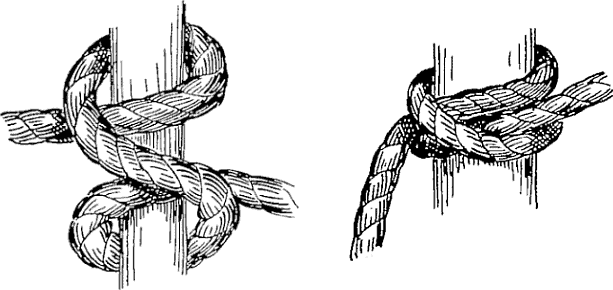
- Left: the clove hitch being tied (Verrill Fig. 36 A).
- Right: the clove hitch complete (Verrill Fig. 36 B).
From A. Hyatt Verrill, Knots, Splices and Rope Work (1912), Fig. 36 A and B. Public domain; cropped, with Verrill's printed captions removed and the engravings set side by side.
How it fails: Verrill says that even on a slippery, slimy post it rarely slips, and the Army's check on which way the bar faces the pull is the guard against that "seldom." Where it must not move, Verrill knotted the ends, which he called the gunner's knot (Fig. 37).
8. Round turn and two half hitches
The anchor knot for a heavy load. ATP 3-50.21 makes it the Army's chief anchor knot wherever a heavy load would jam other knots and make them hard to untie, most often to fix a rope to a pole or tree.
To tie it: take the rope around the tree or post one and a half times (Mountain Warfare School), so the end comes out heading the same general way as the standing part (ATP 3-50.21): that is a round turn. Then take the end around the standing part and back under itself: one half hitch. Do it again, the same way round: two half hitches (ATP 3-50.21, Verrill Figs. 34–35).
How it fails: a lone half hitch. ATP 3-50.21 says the half hitch was once the Army's finishing knot but tended to undo itself with no load on it, so the overhand replaced it. The old books were more confident: Verrill thought two half hitches would never work loose, and the Handbook says they won't slip under any strain. The Army's caution is the safer one to follow: two hitches, never one, and an overhand on the tail if it must stay put.
9. Timber hitch
For moving logs and poles. Pass the end around the log, around its own standing part, and twist it around itself: three or more times in Verrill, two or more in the Handbook. ATP 3-50.21 says the turns must be around the rope's own end or the knot won't tighten on the pole.
For a firmer hold, both ATP 3-50.21 and Verrill add a half hitch around the log, a couple of feet from the timber hitch in Verrill's version (Fig. 39; Fig. 11-5). ATP 3-50.21 gives the pair for lifting or dragging heavy poles: the strain comes on the half hitch, and the timber hitch stops the half hitch from slipping.
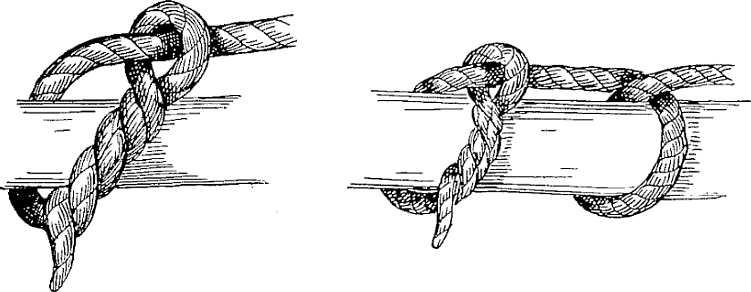
- Left: the timber hitch (Verrill Fig. 38).
- Right: timber hitch and half hitch (Verrill Fig. 39). The strain comes on the half hitch; the timber hitch stops it slipping.
From A. Hyatt Verrill, Knots, Splices and Rope Work (1912), Figs. 38–39. Public domain; cropped, with Verrill's printed captions removed and the engravings set side by side.
How it fails: it holds only by the strain on it; the Handbook says the pull is what keeps it secure. That is why both the Army manual and Verrill add the half hitch when they want a surer hold, rather than trusting the turns alone.
Shortening
10. Sheepshank
ATP 3-50.21 gives two uses, shortening a rope and taking the load off a weak spot, and says it is never tied at the end of a rope. Verrill adds that it can be made in the middle of a rope whose ends are both made fast.
To tie it: fold the rope into an S, so three parts lie side by side. At each end, make a half hitch in the standing part and drop it over the bight (ATP 3-50.21, Handbook). For a worn spot, the weak section goes in the middle of the three parts.
How it fails: Verrill says the simple form isn't to be trusted unless its ends are seized (bound down) with twine (Figs. 79–80; Fig. 11-6), and he rated a form made with running knots the best and most secure (Fig. 78). If it must stay, seize it.
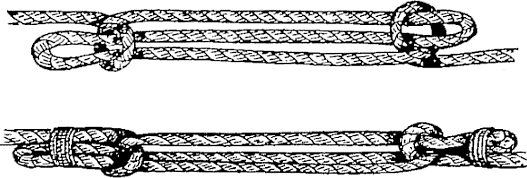
- Top: the simple sheepshank (Verrill Fig. 79).
- Bottom: sheepshank with ends seized with twine (Verrill Fig. 80).
From A. Hyatt Verrill, Knots, Splices and Rope Work (1912), Figs. 79–80. Public domain; cropped, with Verrill's printed captions removed.
What rope to keep
ATP 3-50.21 divides rope into two kinds:
- Natural fiber (manila, hemp, sisal, cotton): resists heat from friction, but loses strength if it isn't kept clean, and most natural rope is thick and hard to knot.
- Synthetic (nylon, polypropylene and the like): strong, water and weather resistant and good for knots, but friction heat and abrasion break it down. Keep it clean and out of the sun to protect it from ultraviolet light.
Verrill gave a rule of thumb for the safe load on manila rope from its circumference, but it was written for ship's rope measured in inches around, and a household can't check it against a modern cord. Treat it as history, not as a rating, and remember from the table above that every knot takes a share of whatever strength the rope has.
Practice
The Handbook suggested practicing with a short piece of hemp rope, its ends whipped. The Army's mountaineering test allows 30 seconds for most of its basic knots, including the clove hitch, bowline and square knot, which is a fair target for these.
Knot practice
- Two short practice ropes of different thicknesses, ends whipped or taped
- Overhand and figure eight, tied without looking
- Square knot tied right, and a granny tied on purpose to see the difference
- Sheet bend joining the thick rope to the thin one, then a double sheet bend
- Bowline around a post and through a ring or a bucket handle, with an overhand safety in the tail
- Clove hitch tied both ways: around a post, and dropped over the top
- Round turn and two half hitches on a tree
- Timber hitch and half hitch on a log or a length of firewood
- A sheepshank, then the same sheepshank with its ends seized with twine
Every knot, before you trust it
- Dressed: no crossed or twisted parts
- Set: every part pulled tight
- The right knot for this rope: equal or unequal sizes, wet or dry
- A safety (overhand) in the tail where the load is real
- A tail of about 4 inches left past the knot (see the note below)
- Checked again later, and re-tied if it has loosened
How long a tail
ATP 3-50.21 says the tail left past a knot should be no more than 4 inches, to save rope and keep it out of the way. The Army mountaineering guide says every tail must be at least 4 inches, so it can't pull back through. Both land on about 4 inches; the climbing guide's minimum is the one that matters when a knot is loaded.
Rope belongs in several kits: a length in the car kit for tying down a load or a tarp, and lighter cord in the get-home bag and the bug-out bag.
Sources
- A. Hyatt Verrill — Knots, Splices and Rope Work (1912; Project Gutenberg text of the second revised edition)
- Boy Scouts of America — Boy Scouts Handbook (1911), "Knots Every Scout Should Know" by Samuel A. Moffat, pp. 48–52 (Project Gutenberg 29558)
- U.S. Army — ATP 3-50.21, Survival (September 2018), Appendix A, Survival Knots and Rope
- U.S. Army Mountain Warfare School — Military Mountaineer Course Knot Guide, Basic Knot Tying (December 2010)