Chapter 6 · Power & Light
Storing gasoline, diesel and propane safely
A generator is only as useful as the fuel you have for it, and fuel stored badly is a fire waiting for a spark. Here are the legal limits fire departments publish, the containers to use, how long each fuel keeps, and a rotation that keeps it fresh.
Read first: Generator safety
Fuel is the part of a generator plan that people leave until the storm is forecast, when the station lines are long and the pumps may soon have no power of their own. Storing some ahead makes sense, but gasoline is one of the most dangerous things a household keeps. Its vapor is heavier than air, it spreads along the floor, and it ignites from a pilot light or a static spark.
This article covers how much each fuel a home may legally hold, the containers to use, how long each fuel keeps and how to make it keep longer, and the handling that prevents fires. Running the generator itself safely is in generator safety.
Fuel and vapor can explode
- Never store fuel inside the home. Keep gasoline, propane, kerosene and other flammable liquids outside living areas, in properly labeled, non-glass safety containers, and not near a fuel-burning appliance such as a gas water heater in a garage (CPSC).
- Gasoline vapor is heavier than air and can travel along the floor to a flame or spark (Maryland Department of the Environment, citing API); OSHA says vapors can travel long distances to an ignition source.
- Never refuel a running or hot engine. Gasoline spilled on hot parts can ignite (CPSC, OSHA).
- Never siphon by mouth. Gasoline can be harmful or fatal if swallowed; if someone swallows it, don't make them vomit, and get medical help at once (MDE).
The three fuels compared
| Gasoline | Diesel (and kerosene) | Propane | |
|---|---|---|---|
| Hazard class in fire codes | Flammable liquid (Class I-A) | Combustible liquid (Class II) | Liquefied petroleum gas in pressurized cylinders |
| How long it keeps | Degrades in as little as about 30 days untreated (Gold Eagle; Honda says fuel in the carburetor goes stale fastest) | Keeps longer than gasoline but does degrade, and can grow microbes (FEMA P-1019) | Can be stored indefinitely (FEMA P-1019) |
| Container | Approved gas can, 5 gallons or smaller (Unified Fire Authority) | Approved container, not jars or milk jugs (Lehi) | DOT cylinder with an OPD valve, inspected by date (Anoka County) |
| Where | Detached garage or shed preferred; limited in an attached garage; never in a basement (Commerce Township, Lehi) | Outside the residence; never in a basement (Lehi) | Outdoors or in a detached shed or garage, not in the house or an attached garage; Lehi alone allows two 1-pound cylinders inside (Commerce Township, Lehi) |
Gasoline powers most portable generators: almost all the generators in the CPSC's CO death records with a known fuel used it. Propane needs a generator built or converted to burn it (a "dual fuel" model, for example), and diesel needs a diesel engine. Choose the generator and the fuel together.
How much you may store
Home fuel storage is governed by the fire code your state, county or city has adopted; all three examples below are based on an edition of the International Fire Code (IFC). Limits vary from place to place, by code edition and by local amendment, so the numbers below are examples from three fire departments, not the law where you live. Check your own limit with your local fire department or fire marshal before you buy cans.
| Rule | Commerce Twp., Mich. (2021 IFC) | Lehi, Utah (2012 IFC) | Unified Fire Authority, Utah (older IFC edition) |
|---|---|---|---|
| Gasoline (and camp fuel) total at a home | 30 gallons, preferably in a detached garage or shed | 25 gallons, preferably in a detached garage or shed | 30 gallons |
| In an attached garage | No more than 10 of those gallons | No more than 10 gallons | Not stated separately |
| In a basement | None | None | Not stated |
| Diesel, kerosene, lamp oil | Not covered | 60 gallons outside the home; the page gives two different attached-garage limits (10 and 25 gallons) | 120 gallons of diesel |
| Container size | Approved type | Approved or original retail containers | 5 gallons or smaller |
| Empty cans | Count as full | Count as full | Not stated |
| Fuel in vehicle tanks | Doesn't count | Doesn't count | Not stated |
| Fire extinguisher | At least one 2A:20B:C, 10 to 50 feet from the fuel | One 2A:10B:C above 5 gallons, 10 to 50 feet away | A 2A:10B:C suggested |
| Propane cylinders | Never inside the building, full or empty | Up to 25 gallons of portable cylinders, in a detached garage or shed; two 1-pound cylinders may be kept inside | Not covered |
Two things stand out. First, empty cans count as full where the code says so, because an "empty" can still holds explosive vapor. Second, the codes and the fire departments disagree on propane indoors: Commerce Township, citing the 2021 IFC, says no propane cylinder of any size may be stored inside a building, while Lehi, citing NFPA 58, allows two 1-pound cylinders inside. The safer reading is to keep all propane outdoors.
Lehi's own recommendation is more modest than its legal limit: about 5 gallons of flammable liquids and 25 gallons of propane in portable cylinders, used within six months.
How much you actually need
Work out fuel from what your generator burns, not from a round number. Makers publish a runtime for one tank at a stated load. One example: Champion lists its model 201321 dual-fuel inverter as running 22 hours at 25 percent load on its 4.02-gallon gasoline tank, or 21 hours at 25 percent load on a 20-pound propane cylinder.
- Find your generator's tank size and runtime at a given load in its manual or spec sheet.
- Divide tank size by runtime to get gallons per hour at that load. For the Champion example, 4.02 ÷ 22 is about 0.18 gallons an hour at quarter load.
- Multiply by the hours a day you will really run it. Many households run a generator in blocks (to cool the refrigerator, pump water, charge batteries) rather than around the clock. Four hours a day at that rate is under a gallon; 24 hours is about 4.4 gallons.
- Multiply by the days you want to cover, then check the total against your local limit.
Heavier loads burn more fuel per hour, so use the figure for the load you will actually run; generator size shows how to add up that load. If the daily total is more than you can store legally or rotate, plan fewer running hours, or cover small loads with a power station and solar instead.
Containers
Gasoline. Use only containers approved and labeled for gasoline. OSHA says fuel should be stored and moved in approved containers designed and marked for their contents; the CPSC specifies non-glass safety containers; Maryland's fact sheet says never glass or unapproved containers; Lehi and Commerce Township say no milk jugs.
Cans sold in the U.S. since January 1, 2009 meet two federal rules, as NDSU Extension explained when they took effect: air-toxics rules that require a spout that locks shut and seals when not pouring, and walls with barrier layers that hold vapor in; and the Children's Gasoline Burn Prevention Act, which requires a child-resistant closure. Older cans don't have to be thrown away or upgraded. The new spouts take practice: fuel won't pour until you press the lever.
Fill no more than 95 percent full, so the fuel has room to expand as it warms (MDE). Cap it tightly, and don't use a can that won't seal.
Propane. Portable propane cylinders are pressure vessels regulated by the Department of Transportation. Anoka County, Minnesota, lists the checks:
- Look for the date stamped on the collar. A cylinder more than 12 years old must be recertified before it can be refilled.
- Cylinders from 4 to 40 pounds, the common 20-pound grill tank included, made after September 30, 1998, need an OPD (overfilling prevention device) valve. It has a three-lobed handwheel and "OPD" marked on the brass. A cylinder without one can't be refilled, though some retailers will swap it for a filled cylinder that has one.
- Replace any cylinder that is corroded or has loose parts. Never try to remove the valve.
Filling cans at the pump
Static electricity causes fires when cans are filled in the wrong place. Maryland's fact sheet, drawn from American Petroleum Institute guidance:
- Turn off the vehicle, and any camper heater, stove or pilot light.
- Put the can on the ground. Never fill it inside a vehicle, in a trunk, in a pickup bed, on a flatbed or on a trailer floor. Gold Eagle explains why, citing NIOSH: a can sitting on a plastic bed liner or carpet isn't grounded, so static from the flowing fuel can't drain away and can ignite the vapor.
- Keep the nozzle touching the can the whole time, and fill slowly.
- Hold the nozzle by hand; don't use a latch.
- Stop at 95 percent and cap it tightly.
- Let any spill on the can evaporate before putting it in the vehicle.
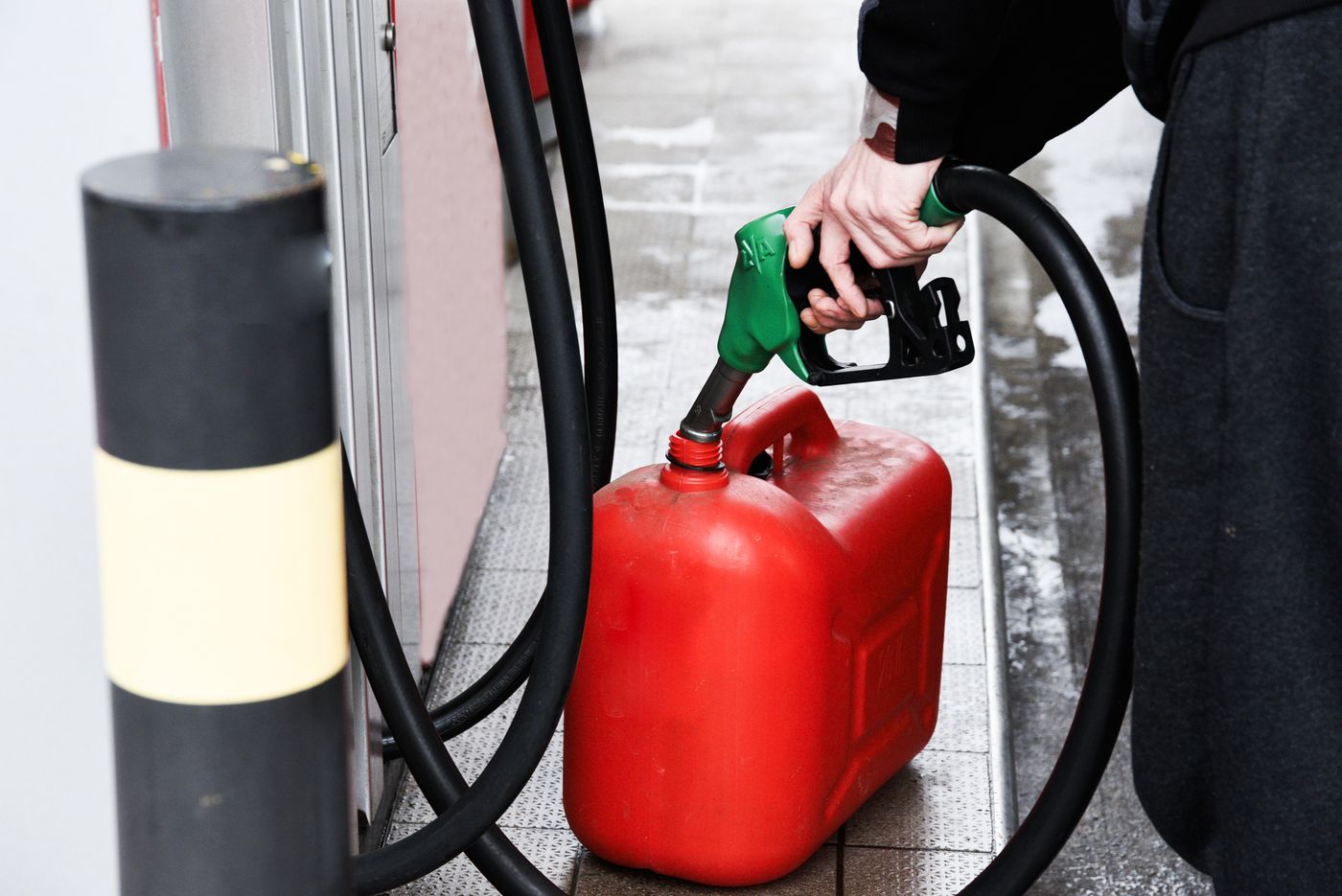
Photo: iStock.
Gold Eagle adds touching metal on your vehicle before filling, to discharge static, and setting the can about five feet from the vehicle.
Carrying it home. Secure the can so it can't tip or slide. The sources differ on where: Maryland says never to leave it in direct sun or in a car trunk, while Gold Eagle says to carry it in the trunk or truck bed and, in a car, to prop the trunk lid slightly open to limit heat. Propane cylinders travel and are stored upright, valve at the top, never on their side (Anoka County).
Where to keep it at home
- A detached shed or garage is best (Commerce Township, Lehi). Never the house or a basement.
- Away from heat and flame: water heaters, furnaces, space heaters, electric motors, car engines and the sun (MDE, Unified Fire Authority, CPSC). OSHA adds the generator itself, cigarettes, lighters and matches.
- Cool and well ventilated, at roughly room temperature (MDE, Unified Fire Authority).
- Caps on, spouts and vents sealed (Unified Fire Authority).
- Propane outdoors (Commerce Township), upright and away from the grill it isn't connected to (Anoka County), and, Lehi says, at least 10 feet from gasoline or other flammable liquids if they share a space.
- A fire extinguisher nearby but not next to it: the departments above put it 10 to 50 feet from the fuel, so you can reach it without reaching into the fire. See home fire safety.
Keeping fuel fresh
Gasoline
Gasoline starts to break down within weeks. Gold Eagle, which makes STA-BIL, says untreated fuel can start degrading in as little as 30 days, forming gum and varnish that clog carburetors and fuel lines. Honda says fuel in the carburetor bowl goes bad faster than fuel in the tank, because there is little of it, it sits near engine heat and it is exposed to air. Honda also advises against fuel with more than 10 percent ethanol in its generators, because ethanol is corrosive and pulls water from the air into the fuel.
Stabilizer slows the breakdown; it doesn't reverse it. Honda says plainly that stabilizer will not restore stale fuel, and that stabilizers themselves have a shelf life. Gold Eagle claims STA-BIL Storage keeps gasoline fresh for up to 24 months when added to fresh fuel and stored in "proper conditions"; that is the maker's own claim, and the page doesn't spell out what those conditions are.
- Add stabilizer at the pump or as soon as you get home, to fresh fuel. Honda says to treat each can every time you refill it. Gold Eagle's dose for STA-BIL Storage is 1 ounce per 2.5 gallons; follow the label of the product you buy.
- Keep the generator's tank nearly full in storage. Honda says a partly filled tank lets air speed up deterioration; Gold Eagle says to fill the tank at least 95 percent before adding stabilizer. Cans are the exception: fill them no more than 95 percent, so the fuel has room to expand (MDE).
- Run the treated fuel through the engine. Honda says to run the engine outdoors for 10 minutes the first time you use stabilizer, so treated fuel replaces untreated fuel in the carburetor; Gold Eagle says about five minutes.
- Date every can with a marker the day you fill it.
Storing the generator itself. Honda's guidance for its small EU-series generators, by how long the machine will sit:
| Unused for | Honda's guidance |
|---|---|
| 1 to 2 months | Fill the tank with fresh fuel and stabilizer, run the engine briefly, close the fuel cap vent, store cool and dry |
| 2 to 12 months, or used less than once a month | Drain the carburetor, close the fuel cap vent, store cool and dry |
| More than a year | Drain the tank and carburetor |
Honda's engine division gives a different cut-off for its GCV and GSV engines: stabilized fuel for 30 to 90 days, and for longer than 90 days, run the engine until the whole fuel system is empty. Your generator's own manual decides.
Diesel
FEMA's guide to emergency power says diesel is less volatile than gasoline and keeps longer, but it does degrade over time, and degraded diesel can make a generator unreliable. Its advice, written for facilities, scales down to a household: don't store more than you will use, test or replace fuel when its quality drops, and keep fuel filters clean, because biological growth in stored diesel clogs them. Our suggestion, in the same spirit as FEMA's advice to share a tank with equipment that burns fuel often: cycle stored diesel through a vehicle or tractor that uses it regularly.
Propane
FEMA P-1019 says propane can be stored indefinitely, which is its great advantage for a household that runs a generator only a few times a year. The trade-off is that it is stored under pressure and is highly volatile, so cylinder condition and inspection dates matter more than the fuel's age.
A rotation that works
The safest stored gasoline is gasoline you use. A simple cycle, with dates on every can:
Fuel rotation
- Fill cans with fresh fuel and stabilizer; write the date on each can
- Within six months, as Lehi's fire department advises, pour the oldest can into a car with a fairly full tank, and refill it fresh (Honda passes on the EPA's suggestion to use year-old stabilized fuel this way; Maryland says good excess gasoline can go into a car or truck tank)
- Don't pour two-stroke fuel mixed with oil into a car (Maryland)
- Check propane cylinders' dates and valves each season
- Recount your total against your local limit, counting empty cans as full
- Put the schedule on the household's rotation calendar
Getting rid of bad fuel. Never pour gasoline on the ground, down a drain or into a stream, or put it in the trash; it can cause fires and contaminate water, and fines may apply (MDE). Take stale or contaminated gasoline to a household hazardous waste collection. Don't put propane cylinders in the trash either, even empty ones: Anoka County says they can explode in garbage trucks. Take them to a propane dealer, gas retailer or gas service company instead.
What not to do
- Don't store fuel in the house, a basement, or an attached garage beyond your code's small allowance.
- Don't keep gasoline in glass, milk jugs or any container not made for it.
- Don't fill a can sitting in a truck bed, trunk or trailer.
- Don't store fuel next to the water heater, furnace or the generator.
- Don't keep more than you can use and rotate; old fuel is a hazard and a starting problem.
- Don't refuel a hot or running generator.
- Don't use gasoline as a cleaner or to start a fire. Maryland says to use it as motor fuel only.
During a long outage, fuel runs out sooner than people expect and stations may close. The power outages page sets out what fails and when, and hurricanes covers the run-up to a storm, when fuel should already be stored rather than bought.
Sources
- CPSC — Portable Generator Hazards (Safety Alert, Publication 5123)
- OSHA — Using Portable Generators Safely (Fact Sheet FS-3286)
- Maryland Department of the Environment — Gasoline Safety fact sheet (2009, from API guidance)
- Charter Township of Commerce, Michigan — Home Storage of Flammable Liquids (2021 International Fire Code)
- Lehi Fire Department, Utah — Home Fuel Storage Limits (2012 International Fire Code)
- Unified Fire Authority, Utah — Allowable Home Storage for Flammable and Combustible Liquids (older IFC edition)
- NDSU Extension — New regulations imposed on portable fuel containers (May 4, 2009)
- FEMA P-1019 — Emergency Power Systems for Critical Facilities (September 2014, WBDG copy)
- Anoka County, Minnesota — Propane Tanks
- Honda Power Equipment — Avoiding fuel-related problems (EU-series generators)
- Honda Engines — Storage and transportation, GCV and GSV engines
- Gold Eagle — STA-BIL Storage essentials
- Gold Eagle — Essential tips on how to fill a gas can
- CPSC — Fatal Incidents Associated with Non-Fire Carbon Monoxide Poisoning from Engine-Driven Generators and Other Engine-Driven Tools, 2010–2020 (June 2021)
- Champion Power Equipment — 4500W Dual Fuel Open Frame Inverter (model 201321) specifications