Chapter 6 · Power & Light
Solar power for a household outage
A solar panel makes power for free and silently, but only while the sun is on it, and only as much as its label says on a cool, perfect day. Here is how the parts fit together, how to read the numbers, and how to size a small system that keeps the essentials running.
Read first: Power stations
Solar is the one source of household power that doesn't run out of fuel. It makes no exhaust, so unlike a generator it carries no carbon monoxide risk, and it makes no noise. Its limits are just as real: it produces only while light falls on the panel, far less than the label suggests on a hot or hazy day, and nothing at night unless you store it in a battery.
For a household preparing for outages, solar is best understood as a way to refill batteries: a power station, a battery bank, phones and radios. Running a whole house from the sun takes a professionally installed system with storage. This article explains how the parts work, how to read a panel's label, and how to size a small system for the loads that matter. Choosing the battery box itself is covered in how to choose a portable power station.
Why rooftop solar may not help in an outage
Many people with solar on the roof are surprised when their lights go out with everyone else's. A typical grid-tied system feeds the house and the utility through an inverter, and the DOE's Solar Energy Technologies Office explains that standard small inverters ride through brief flickers in the grid but, during longer or larger disruptions, disconnect themselves from the grid and shut down. That protects line crews from power being fed back into lines they are repairing, the same danger described in transfer switches.
The DOE says solar systems with batteries can run without support from the grid during an outage if they are designed to do so. Its homeowner's guide notes that storage lets you use solar power when the sun isn't shining, including when the power goes out, and suggests asking your installer about battery options. If you have rooftop solar, find out now which kind you have; don't assume.
The rest of this article is about systems you can set up yourself: portable panels and small off-grid setups that charge batteries directly.
How a solar panel works
The EIA describes a photovoltaic (PV) cell as a device with no moving parts that turns sunlight straight into electricity. Light arrives as photons; those absorbed by the cell knock electrons loose in the semiconductor, and the cell's construction sweeps those electrons toward the front surface. That builds up a voltage between the front and back of the cell, much like a battery's two terminals, and current flows when a circuit connects them (see Fig. 6-4).
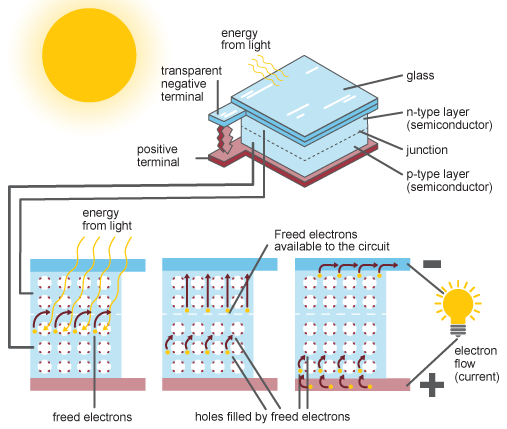
From U.S. Energy Information Administration, "Inside a photovoltaic cell", Solar explained (eia.gov). Public domain; title, source line and logo cropped. Not endorsed by EIA.
- One cell makes only 1 or 2 watts.
- A panel (module) is many cells wired together in a weatherproof frame. More cells or more area means more output.
- An array is two or more panels working together.
Panels make direct current (DC), the kind a battery stores. Household outlets and most of the grid use alternating current (AC), so an inverter is needed to run ordinary plugs.
Efficiency has climbed: the EIA says commercial panels averaged under 10 percent in the mid-1980s, about 15 percent by 2015, and close to 25 percent for the best modules now. Higher efficiency doesn't mean more power from a "100-watt" panel; it means the panel needs less area, and so less weight, to make those 100 watts.
Pointing it. The EIA says panels produce most when they face the sun directly. Most fixed systems in the Northern Hemisphere face due south at a set angle. A portable panel you can tilt and turn through the day will collect more than one laid flat.
Reading a panel's label
Every panel carries numbers measured under Standard Test Conditions (STC): light of 1,000 watts per square meter, roughly noon sun, with the cells at 25°C (77°F). Carroll Electric Cooperative's guide to panel ratings explains each one:
| Label figure | What it means | Why you care |
|---|---|---|
| Pmax (rated power) | Maximum power at STC, the "100 W" in the name | The ceiling, not the daily output |
| Vmp | Voltage at the maximum power point | What an MPPT controller tries to hold the panel at |
| Imp | Current at the maximum power point | Vmp × Imp = Pmax |
| Voc (open-circuit voltage) | Voltage with nothing connected | The highest voltage the panel makes; must stay under your controller's or power station's input limit |
| Isc (short-circuit current) | Current with the leads joined | The most current the panel makes; check it against your controller's or power station's input limit |
| Temperature coefficient of Pmax | Power lost per degree the cells run above 25°C | How much a hot day costs you |
| NOCT | The cell temperature reached in more realistic test light and air temperature | Used to estimate real output |
Renogy's 100-watt RSP100DC datasheet, for example, gives Vmp 19.97 V and Imp 5.01 A (19.97 × 5.01 ≈ 100 W), Voc 22.79 V and Isc 5.31 A, with a module efficiency of 20.0 percent. (Renogy's product page for the same panel line advertises 25 percent efficiency; the datasheet it links to says 20.0. When a maker's figures disagree, go by the datasheet and ask the maker.)
Why a panel makes less than its label
Heat. Panels in sun run hotter than the air. Carroll Electric's guide shows how to estimate the loss: multiply the temperature coefficient by the difference between the NOCT and 25°C. For its example panel, -0.45 percent per °C × (45 − 25) = a 9 percent loss. The same arithmetic on Renogy's datasheet figures (-0.32 percent per °C, NOCT 47°C) gives about 7 percent. Victron's charge-controller paper shows the extreme: its example 100-watt panel, at a cell temperature of 75°C (167°F), makes about 77.5 watts.
Sun hours. Carroll Electric puts average peak sun hours in Arkansas and Missouri at about 4 a day, even where the sun is up for 7; Carroll describes peak sun hours as the part of the day's sunshine that is usable for efficient production. Your area and season will differ.
Everything else. The same guide lists soiling, shading, wiring losses, inverter losses, panel aging and roof heat as further losses. On partial shading, the DOE notes that with panels wired in a series "string" to one inverter, shade on one panel can pull down the output of the whole string.
The cold has the opposite effect on voltage. Victron's paper shows panel voltage falling as the cells heat up, so on a cold, bright morning the panel's voltage is at its highest. Leave headroom between the panel's Voc and your controller's or power station's maximum input voltage, especially if you wire panels in series, and follow the equipment maker's limits.
The four parts of a small solar system
| Part | Job | Notes |
|---|---|---|
| Panel | Turns light into DC | Portable (folding) or framed rigid |
| Charge controller | Feeds the battery safely and stops overcharging | PWM or MPPT; built into power stations |
| Battery | Stores energy for night and cloudy days | Lead-acid or lithium (LiFePO4) |
| Inverter | Turns battery DC into household AC | Not needed for 12-volt or USB loads |
A portable power station combines the last three in one box, which is why it is the easiest starting point: you plug a panel into it. Building the system from separate parts gives you more capacity for the money and lets you grow it, at the cost of wiring, fusing and more to learn.
Charge controllers: PWM or MPPT
Victron's white paper sets out the difference clearly.
- PWM (pulse width modulation) is in essence a switch between the panel and the battery. When it closes, the panel is pulled down to near the battery's voltage. As the battery fills, the controller switches the panel on and off rapidly to avoid overcharging, which gives it its name.
- MPPT (maximum power point tracking) finds the voltage at which the panel delivers its most power, holds the panel there, and converts that power down to the battery's voltage. That lets a 12-volt battery be charged from panels wired in series at, for example, 36 volts. It costs more.
How much that matters depends on temperature. In Victron's worked example, a 100-watt panel at 25°C delivers 100 watts through MPPT but about 81 watts through PWM, 19 percent less, because the PWM controller holds the panel at about 13.5 volts instead of its 18-volt sweet spot. At a cell temperature of 75°C the panel's own best voltage has dropped so far that both deliver about 77 watts. Victron's summary: MPPT outperforms PWM in cold to temperate climates, and the two perform about the same in subtropical to tropical ones.
When a PWM controller is fine
A PWM controller works best when the panel's Vmp sits only a little above the battery's charging voltage, such as a "12-volt" panel (Vmp around 18 to 20 V) on a 12-volt battery, and in hot weather. A higher-voltage panel, like Renogy's 200-watt panel with a Vmp of 31.03 V, is a poor match for PWM on a 12-volt battery; it needs MPPT to use its voltage.
Batteries
Lithium iron phosphate (LiFePO4) is used in many power stations, including all four in the Almanac's comparison; its long cycle life and stability are compared with other chemistries in how to choose a portable power station.
Lead-acid batteries are common in home-built systems, and they need care. Battery University's guide to charging them:
- A full charge takes 12 to 16 hours, longer for big stationary banks. About 70 percent goes in during the first 5 to 8 hours; the last 30 percent takes another 7 to 10. That matters with solar, because the sun may set before the battery is full.
- Leaving one partly charged ruins it. Skipping the topping charge, or storing it low, causes sulfation and permanent capacity loss. Store it fully charged and give it a topping charge every six months (every 6 to 12 months for AGM types).
- Charging makes hydrogen, especially when overcharged, and hydrogen is explosive. Charge in a well-ventilated area; our suggestion is never in a closed room where people sleep.
- Heat calls for a lower float voltage above about 85°F, and Battery University advises against charging above 120°F (49°C).
Batteries and DC wiring can burn
- Lead-acid batteries give off explosive hydrogen while charging. Ventilate the space and keep flames and sparks away (Battery University).
- A panel in light has voltage across its leads even with nothing connected; that is its open-circuit voltage, Voc (Carroll Electric). Treat the leads as live in daylight, and cover the panel or work in shade when you wire it (our suggestion).
- Respect the fuse and voltage ratings on the panel's datasheet. Renogy's panels, for example, list a maximum series fuse rating of 15 A and a maximum system voltage of 600 VDC.
- Large banks wired into a house belong to a licensed electrician, like a transfer switch.
- If someone is burned, see burns.
Sizing a small system: a worked example
The method is the same arithmetic as for a power station, run in reverse: start from what you need each day, then work out how much panel and battery it takes.
1. List the daily loads. Using the typical draws in the power station guide (a phone charger at 20 W, a laptop at 50 W) and the 15 W LED bulbs used in generator size:
| Load | Watts | Hours a day | Watt-hours a day |
|---|---|---|---|
| Two phones charging | 20 | 2 each | 80 |
| Laptop | 50 | 3 | 150 |
| Four LED bulbs | 60 | 4 | 240 |
| Total | 470 Wh |
Check your own devices' labels; these are planning figures.
2. Allow for the inverter. If these run from AC outlets, the power station guide's planning factor of 0.85 means drawing about 470 ÷ 0.85 ≈ 553 Wh from the battery. USB and 12-volt loads skip most of that loss.
3. Size the panel. Divide by your peak sun hours, then allow for heat. With Carroll Electric's 4 peak sun hours: 553 ÷ 4 ≈ 138 W. Allowing about 9 percent for heat (Carroll's example) brings that to about 152 W. Soiling, wiring and shade take more, so a 200-watt panel is a sensible minimum for this list in that climate, and more if you want to catch up after a cloudy day.
4. Size the battery. To carry two days of clouds, you need about 2 × 553 ≈ 1,100 Wh of usable capacity. A 1 kWh-class LiFePO4 power station is close. A lead-acid bank must be larger than its usable figure, because the maker limits how deeply it should be discharged; use the maker's figure.
5. Check the season. The free PVWatts calculator from the National Renewable Energy Laboratory, which both the DOE and Carroll Electric point to, estimates output by address and month. Size for your worst month if you want the system to work in a winter outage.
Sizing your own
- List each load, its watts and hours a day; total the watt-hours
- Divide AC loads by 0.85 for inverter loss
- Find your peak sun hours (PVWatts), and use your worst month
- Panel watts = daily Wh ÷ peak sun hours, plus at least 10% for heat and more for shade and dirt
- Usable battery Wh = daily Wh × days of cloud you want to ride through
- Panel Voc under the controller's or power station's maximum input, with headroom for cold
- Panel watts within the power station's maximum solar input
Portable or rigid panels
Portable folding panels pack away and set up in a minute. The catch is weather: Jackery rates its SolarSaga 100 Air IP68 yet its FAQ says not to leave it in rain or soaking in water. Several fold for travel and include a kickstand or angle guide. Bifacial models collect some light from the back as well; EcoFlow's 220-watt panel lists 220 W front and 175 W rear, while its page claims both "up to 25%" and "up to 28%" more energy from the dual-sided design, so treat the gain as variable.
Rigid framed panels of glass and aluminum carry long warranties (Renogy: 25 years on power output, 10 on materials) and can be mounted permanently, but are heavy (Renogy's 200-watt panel weighs 23.4 lb) and need a mount and a separate controller.
Small USB panels, around 20 watts, charge phones, lights and radios directly. Goal Zero's Nomad 20 gives up to 10.5 W from its USB port, or up to 20 W from its 8 mm solar port into a power bank or power station. A panel holds no charge, so whatever it powers stops when the light goes. For keeping a weather radio and phones alive, that may be all a household needs.
Setting up during an outage
- Face the panel south, tilted toward the sun, and turn it through the day if you can (EIA).
- Keep every panel out of shade. The DOE notes that shade on one panel in a series string can cut the output of the whole string.
- Keep the battery or power station in the shade. Jackery's own guidance is to keep the power station away from heat and direct sun while the panel sits in it.
- Turn the power station on. Jackery's support answer on the product page notes its units charge from solar only when switched on.
- Wipe the glass with a soft, damp cloth when dusty (Jackery).
- Run the big loads at midday, when the panel is producing, and save the battery for night.
Solar, generator or both
Solar can't start a well pump or run an air conditioner the way a generator can, but it needs no fuel, makes no exhaust and works for as long as the outage lasts. A generator delivers big power on demand but needs fuel you have stored safely and must run outdoors because of carbon monoxide. Many households pair them: the generator for a few hours of heavy loads, solar to refill the batteries that carry the night. See power outages for how needs change from the first day to the first weeks.
Solar panels compared
Match the panel to what it will charge: a USB panel for phones and lights, a folding 100–220 W panel for a power station, or framed panels and a charge controller for a battery bank. Check the panel's open-circuit voltage (Voc) against your controller's or power station's maximum input. Specs are the makers' own, as published on the date shown; ratings are at Standard Test Conditions.
Goal Zero
Nomad 20
- Rated power
- 20 W
- Open-circuit voltage
- 18–22 V
- Outputs
- USB 5 V up to 2.1 A (10.5 W max); 8 mm solar port 14–22 V up to 1.3 A (20 W max)
- Cells
- Monocrystalline
- Weight
- 2.28 lb
- Size folded
- 11.5 × 7.4 × 1.25 in
- Warranty
- 2 years
- Price on maker's page
- $149.95
Jackery
SolarSaga 100 Air
- Rated power
- 100 W
- Efficiency
- Up to 23% (bifacial PERC cells)
- Outputs
- 100 W to a power station; USB-A and USB-C ports
- Weight
- 7.1 lb
- Water rating
- IP68, but the maker's FAQ says not to leave it in rain or soak it
- Operating temperature
- -4 °F to 149 °F
- Cable
- 9.84 ft, with DC8020 to DC7909 adapter
- Price on maker's page
- $299.00
EcoFlow
NextGen 220W Bifacial Portable Solar Panel
- Rated power
- 220 W (±5 W) front, 175 W rear
- Open-circuit voltage
- 21.5 V (Vmp 18.4 V)
- Short-circuit current
- 12.4 A front (Imp 11.9 A)
- Efficiency
- 25% (N-type TOPCon cells)
- Weight
- About 15.4 lb
- Size folded
- 24.2 × 23.2 × 1.3 in
- Water rating
- IP68
- Warranty (US)
- 12 months
- Price on maker's page
- $449.00
Renogy
100W 12V Monocrystalline Panel (RSP100DC)
- Rated power
- 100 W
- Open-circuit voltage
- 22.79 V (Vmp 19.97 V)
- Short-circuit current
- 5.31 A (Imp 5.01 A)
- Efficiency
- 20.0% per datasheet (product page advertises 25%)
- Temperature coefficient of power
- -0.32% per °C
- Weight
- 13.0 lb, framed glass
- Size
- 34.1 × 22.8 × 1.2 in
- Warranty
- 25 years power output, 10 years materials and workmanship
Renogy
200W 24V Monocrystalline Panel (RSP200DC)
- Rated power
- 200 W
- Open-circuit voltage
- 37.44 V (Vmp 31.03 V)
- Short-circuit current
- 6.85 A (Imp 6.45 A)
- Efficiency
- 20.7% per datasheet (product page advertises 25%)
- Temperature coefficient of power
- -0.32% per °C
- Weight
- 23.4 lb, framed glass
- Size
- 49.7 × 30.1 × 1.2 in
- Warranty
- 25 years power output, 10 years materials and workmanship
Specs are the makers’ published figures, read November 3, 2026. “Used” marks gear the editor has used; the rest is compared on specs only. How we compare gear.
None of these panels was tested by the Almanac; the specs are the makers' own, read on the review date.
Sources
- EIA — Solar explained: Photovoltaics and electricity
- DOE Solar Energy Technologies Office — Solar Integration: Inverters and Grid Services Basics
- DOE Solar Energy Technologies Office — Homeowner's Guide to Going Solar
- Carroll Electric Cooperative — A Guide to Solar Panel Ratings
- Victron Energy — Which solar charge controller: PWM or MPPT? (January 20, 2020)
- Battery University — BU-403: Charging Lead Acid
- Renogy — RSP100DC 100W monocrystalline solar panel datasheet
- Renogy — RSP200DC 200W monocrystalline solar panel datasheet
- Jackery — SolarSaga 100 Air product page and FAQ
- EcoFlow — NextGen 220W Bifacial Portable Solar Panel specifications
- Goal Zero — Nomad 20 specifications