The Minuteman Almanac
Field Manual
Chapter 6
Power & Light
Generator sizing and safety, power stations, transfer switches, fuel, solar, batteries and light.
Edition of November 3, 2026 · 6 articles
This manual is rebuilt whenever the chapter changes; the current edition is always at minutemanalmanac.com/print/power/. It is for planning and learning, not medical, legal or electrical advice. In an emergency, follow official instructions.
Contents
6.1 · Chapter 6, Power & Light
What size generator do you need?
Add up the running watts of everything you will use at once, then add the single biggest start-up surge. That one number, and the carbon monoxide rules that come with it, are what keep a generator useful instead of dangerous.
A generator that is too small trips its breaker or stalls the moment the refrigerator compressor kicks on. One that is far too big burns fuel you may not be able to buy during a long outage. Sizing it is simple arithmetic once you understand that every appliance has two numbers, not one.
This guide explains those two numbers, walks through the standard sizing method with a worked example, shows how to read a generator's own ratings, and then covers the part that matters most: running it without poisoning anyone.
Running watts and starting watts
Running watts (also called rated watts) are the steady power an appliance draws once it is going. Generac describes running wattage as the continuous power an appliance needs, and, for a generator, the most it can produce for an extended period.
Starting watts (also called surge watts) are the short burst of extra power that motor-driven equipment needs to get moving. Generac names refrigerators, air conditioners and well pumps as typical examples and says the extra demand usually lasts two to three seconds before the appliance settles back to its running wattage.
Appliances without a motor, such as light bulbs, phone chargers, toasters and space heaters, have no meaningful start-up surge. Their starting watts are the same as their running watts.
Why motors surge
An electric motor that is standing still draws far more current than one that is spinning. As the rotor turns, it generates a voltage of its own that pushes back against the supply and holds the current down. At a standstill that opposing voltage does not exist yet, so for the second or two it takes to spin up, little but the resistance of the windings limits the current.
How big is the spike? Virginia Cooperative Extension says a clamp-on meter will show about three times more current while a household motor starts than while it runs smoothly. The surge is brief, but the generator has to be able to deliver it, or the motor never gets started.
Champion makes a related point: a generator's peak rating holds only for a few seconds, until the motor reaches its operating speed. If the start-up load is more than the generator can supply, it may labor and possibly stall.
The sizing method
The method below is the one EWEB (the Eugene Water & Electric Board) publishes on its generator sizing worksheet. It is also what the calculator on this page does.
- List everything you want to run at the same time. Not everything you own; just what will be on at once.
- Add up the running watts of that list. That total is the smallest running (rated) wattage your generator can have.
- Find the single item with the largest additional starting watts and add that one number to the running total. The result is the starting wattage your generator needs.
You add only the largest surge, not every surge, because motors rarely start at the same instant. The method assumes one motor starts while everything else is already running. If two big motors could start together (a well pump and a sump pump wired to kick on at the same moment, say), add both surges to be safe.
Two ways of writing "starting watts"
EWEB's worksheet lists additional starting watts: the extra on top of running watts (a refrigerator: 700 running plus 2,200 additional). Generac's article describes the same refrigerator as needing 700 running watts but able to surge to 2,200 watts. The sources disagree on whether 2,200 is the extra or the total. The calculator uses EWEB's reading, which gives the larger and safer answer. Your appliance's own label or manual settles it for your model.
Generator size calculator (calculator online at minutemanalmanac.com/power/generator-size/#calculator). Example: A refrigerator, furnace fan, half-horsepower sump pump, four LED bulbs, a TV and a phone charger draw 2,930 running watts. Add the single largest extra surge, 2,200 W, and the generator needs 5,130 starting watts and at least 2,930 rated (running) watts.
A worked example
Say an outage arrives and you want to keep these running together, using EWEB's typical figures:
| Appliance | Running watts | Additional starting watts |
|---|---|---|
| Refrigerator/freezer | 700 | 2,200 |
| Furnace fan blower (1/3 hp) | 700 | 1,400 |
| Sump pump (1/2 hp) | 1,050 | 2,200 |
| Color TV | 400 | none |
| Cell phone charger | 20 | none |
| Four 15 W LED bulbs | 60 | none |
| Total | 2,930 |
Running watts add up to 2,930. The largest single additional surge is 2,200 watts (the refrigerator and the sump pump tie). Add one of them: 2,930 + 2,200 = 5,130 starting watts.
So you would look for a generator rated for at least 2,930 running watts and at least 5,130 starting watts. EWEB itself calls its figures a general guide and suggests checking with a generator dealer, manufacturer, contractor or electrician, so treat the answer as a floor, not an exact target.
Now see what one heavy load does. EWEB lists a 12,000 BTU window air conditioner at 3,250 running watts and 3,950 additional. Add it to the list above and the running total becomes 6,180 watts, and the largest surge becomes the air conditioner's 3,950, for 10,130 starting watts. One appliance roughly doubled the generator you need. That is why the first step is choosing what runs at once.
Some of the biggest loads, such as a furnace, a central air conditioner's compressor, a well pump or an electric water heater (4,500 W on EWEB's sheet), are usually wired straight into the breaker panel. Consumer Reports points out that you can't run anything hardwired from extension cords. Powering them needs a transfer switch or interlock installed by an electrician; see transfer switches and interlock kits.
Reading a generator's ratings
Generators are sold with two wattage figures, usually printed together:
- Running, rated or continuous watts: what the generator can supply hour after hour. Compare this with your running total.
- Starting, surge, peak or maximum watts: what it can supply for a few seconds. Compare this with your starting total.
Buy on the running figure: it is the one that has to carry your load all night. A generator whose maximum watts match your running total will be overloaded as soon as everything is on.
Labels on your appliances beat any typical table. Virginia Cooperative Extension notes that wattage is usually stamped on the bottom or back of an appliance or on its nameplate. If only amps are listed, multiply amps by volts (most household appliances in the United States run on 120 volts; large ones such as dryers run on 240).
Carbon monoxide: the hazard that kills
Carbon monoxide kills, often in minutes
Generator exhaust contains carbon monoxide (CO), a poison you cannot see or smell. The CPSC says that in an enclosed space a generator can produce deadly levels of CO within minutes, and that the gas can linger for hours after the generator shuts off. The CPSC's December 2025 safety release puts the toll at an average of about 100 deaths a year in the U.S. from CO poisoning from portable generators.
- Never run a generator indoors, including in a garage, basement, crawlspace or shed, even with doors and windows open or fans running (CPSC, CDC, OSHA).
- Outdoors only, at least 20 feet from the house (CPSC, December 2025 release), and at least 20 feet from doors, windows and vents (CDC). Ready.gov says at least 20 feet from windows, doors and attached garages.
- Not on a porch or in a carport. Both are too close to the home (CPSC).
- Point the exhaust away from your home and any building someone could enter (CPSC).
- If you feel sick, dizzy or weak while a generator is running, get to fresh air right away and call 911 (CPSC).
CDC lists the common symptoms of CO poisoning as headache, dizziness, weakness, upset stomach, vomiting, chest pain and confusion, and describes them as flu-like. People who are asleep can die before they ever feel anything. That is why alarms matter more than symptoms.
Carbon monoxide alarms
- Install CO alarms on every level of the home and outside separate sleeping areas (CPSC). CDC says near every sleeping area.
- Use battery-operated alarms or plug-in alarms with battery backup, so they keep working when the power is out (CPSC, CDC).
- Interconnected alarms are best: when one sounds, they all sound (CPSC).
- Look for alarms certified to UL 2034, IAS 6-96 or CSA 6.19.01 (CPSC).
- Test them monthly (CPSC). CDC suggests checking the batteries when you change your clocks in spring and fall, and replacing the alarm as the maker directs or every five years.
- If an alarm sounds, get outside immediately, then call 911 (CPSC).
When buying a generator, CPSC suggests choosing one with a CO shut-off safety feature, which turns the engine off if CO builds up around it. It is a backup, not a reason to run a generator anywhere near the house.
Cords, rain and the house wiring
- Plug appliances into the generator with heavy-duty extension cords made for outdoor use, each rated for more watts than the appliances on it, and long enough to keep the generator well away from the house (CPSC). OSHA adds: grounded three-prong cords, inspected for cuts and fraying.
- Keep the generator dry. CPSC suggests an open, canopy-like structure on a dry surface where water cannot pool, and dry hands before touching it. OSHA says to keep at least 3 to 4 feet of clear space on all sides and above it for ventilation.
- Never plug a generator into a wall outlet. CPSC calls this "backfeeding" and warns it can electrocute utility workers and neighbors. The safe way to power house circuits is explained in transfer switches and interlock kits.
Fuel: storing and refueling it safely
Fuel safety
- Shut the generator off and let it cool before refueling; gasoline spilled on hot engine parts can ignite (OSHA, CPSC, Ready.gov)
- Store fuel in approved containers designed and marked for their contents, and vented (OSHA)
- CPSC specifies properly labeled, non-glass safety containers
- Never store fuel in the home; keep it outside living areas (OSHA, CPSC)
- Keep fuel away from flames and heat sources, including the generator itself and water heaters; CPSC warns specifically against storing it near a gas water heater in a garage
- Don't smoke near fuel; OSHA notes vapors can travel long distances to an ignition source
When a generator isn't the right tool
For small, quiet loads indoors, such as a phone, a router, lights or a CPAP machine, a battery power station makes no exhaust and can sit beside the bed. It stores far less energy than a tank of gasoline delivers, so the two often work best together. See how to choose a portable power station. And if keeping food cold is the main reason for the generator, food safety in a power outage explains how long a closed refrigerator and freezer hold.
Sources
- EWEB (Eugene Water & Electric Board) — Generator Sizing Considerations
- Generac — What does surge/starting wattage mean?
- Generac — What does running/rated wattage mean?
- Champion Power Equipment — What is the difference between running watts and starting watts?
- Virginia Cooperative Extension — Estimating Appliance and Home Electronic Energy Use
- CPSC — Portable Generator Hazards (Safety Alert, Publication 5123)
- CPSC — Winter storm safety tips to prevent carbon monoxide poisoning and fires (December 12, 2025)
- CDC — Carbon Monoxide Poisoning Basics
- CDC — Use a Generator Safely
- Ready.gov — Power Outages
- OSHA — Using Portable Generators Safely (Fact Sheet FS-3286)
- Consumer Reports — Why a Portable Generator Needs a Transfer Switch (reprinted by the Village of Vernon Hills, 2021)
6.2 · Chapter 6, Power & Light
How to choose a portable power station
A power station is a big battery with outlets. Two numbers decide almost everything: watt-hours for how long it lasts, and watts for what it can run. The rest is chemistry, charging and honest arithmetic.
A portable power station is a lithium battery, a charger and an inverter in one box, with household outlets and USB ports on the front. It makes no exhaust, so unlike a generator it can sit indoors beside a bed or a desk. It also stores far less energy than a tank of fuel delivers, so choosing one means matching it carefully to what you actually need to run.
This guide explains the numbers on the spec sheet, how to estimate runtime honestly, what the battery chemistry means for how long the unit lasts, and how quickly you can refill it from the wall or the sun.
Watt-hours and watts: the two numbers that matter
Watt-hours (Wh) are the size of the tank: how much energy the battery holds. A 1,000 Wh battery could, in theory, supply 100 watts for 10 hours or 1,000 watts for one hour.
Watts (W) of continuous output are the size of the pipe: the most the station can deliver at any one moment. A station rated for 600 W continuous cannot run a 1,000 W coffee maker at all, however full its battery.
You need both. Capacity decides how long; output decides what. A small station with high output will run a microwave, briefly. A big battery with low output will run a lamp for days but nothing heavy.
Surge
Like a generator, a power station has a surge (peak) rating above its continuous rating, to start motors. ResMed's battery guide explains inverter ratings the same way: the continuous rating is what the inverter can deliver under sustained use without overload, and the surge or peak rating is what it can deliver for short periods, with the length of that period varying by manufacturer.
If something has a motor or compressor, compare its starting figure with the station's surge rating, not just its running watts with the continuous rating. The generator sizing guide explains why motors surge and how to add up a list of loads; the same arithmetic applies here.
How long will it run? The honest arithmetic
A battery never delivers all its rated watt-hours through the AC outlets, because the inverter that turns the battery's direct current into household alternating current loses some energy as heat. Jackery's own planning formula is:
Working time (hours) = capacity (Wh) × 0.85 ÷ the device's power (W)
Jackery adds that its stated durations come from laboratory data and that real use may vary. The 0.85 factor (85%) is a reasonable planning figure for AC loads; the calculator below uses it, and you can change it if your station's maker publishes its own. Devices charged from the USB or 12-volt ports skip the conversion to household AC, so they are not subject to that particular loss.
Power station runtime calculator (calculator online at minutemanalmanac.com/power/portable-power-stations/#calculator). Example: 1,000 Wh × 85% ÷ 150 W = 5.7 hours.
What common loads draw
| Load | Typical draw | Source and note |
|---|---|---|
| Cell phone charger | 20 W | EWEB worksheet |
| Laptop | 50–60 W | Virginia Cooperative Extension lists 50 W; EWEB lists 60 W |
| Refrigerator (frost-free, 16 cu ft) | 725 W nameplate, but on only part of the time | Virginia Cooperative Extension; see below |
| Refrigerator/freezer start-up | 700 W running plus 2,200 W additional starting | EWEB worksheet; typical, not your model |
| Color TV | 400 W (older sets); 120 W flat screen | EWEB; Virginia Cooperative Extension |
| Wi-Fi router and modem | Small | Read the watts or amps printed on each power adapter |
| CPAP machine | Varies widely by model and settings | Read your machine's manual; see below |
Refrigerators cycle. Virginia Cooperative Extension notes that a refrigerator, though plugged in all the time, cycles on and off, and suggests estimating its hours at full wattage as one third of the time it is plugged in. By that rule a 725 W refrigerator averages about 242 W, or about 5,800 Wh a day. That is a rough, high estimate for a nameplate figure; newer refrigerators may use much less. A better number for your own model is its EnergyGuide label, which the FTC says shows how much energy the appliance uses (an estimate based on typical use). If the label gives yearly kilowatt-hours, divide by 365 for a daily figure.
So on a 1,024 Wh station, 1,024 × 0.85 ÷ 242 gives about 3.6 hours of refrigerator by the extension rule, longer if your model uses less. That is why power stations suit a refrigerator only for bridging hours, not days, unless they are large or regularly recharged. For how long food stays safe with the door shut, see food safety in a power outage.
CPAP machines vary more than any other common load, and heated humidifiers and heated tubing are the big variable. ResMed's 2015 battery guide, which covers older models, called for a pure sine wave inverter of at least 300 W continuous and 500 W peak for its machines used with a humidifier, and warned that some of its heated humidifiers must not be used with inverters at all, because damage or serious injury can result. Check your current model's manual or ask the maker before relying on any battery, and test the setup on a normal night before an outage forces the question.
Battery chemistry: LiFePO4 vs NMC
Most power stations use one of two lithium-ion chemistries. The maker's spec sheet will say which.
| LiFePO4 (LFP, lithium iron phosphate) | NMC (lithium nickel manganese cobalt oxide) | |
|---|---|---|
| Energy for its weight | 90–120 Wh per kg | 150–220 Wh per kg |
| Cycle life | 2,000 and higher | 1,000–2,000 |
| Thermal runaway begins around | 270°C (518°F) | 210°C (410°F) typical |
| Strengths | Long cycle life, good thermal stability, tolerant of abuse | More energy in less weight |
| Weaknesses | Heavier for the same capacity; weaker in the cold | Shorter life; high charge levels promote thermal runaway |
All figures are from Battery University, which notes that cycle life depends on depth of discharge and temperature. For a unit that will sit in a closet for years and be cycled during outages, the longer life and greater thermal stability of LFP are strong reasons to prefer it; all four units compared below use it. NMC's advantage is weight, which matters most when you carry the unit.
Reading a cycle rating
A rating such as "3,000 cycles to 80% capacity" means that after 3,000 full charge and discharge cycles the battery is expected to hold 80% of its original capacity. It does not stop working there; it just holds less. Ratings are written to different endpoints, so compare like with like: Jackery rates the Explorer 1000 v2 to "70%+" capacity, while EcoFlow and Anker rate their units in the table below to 80%. A cycle count to 70% is not directly comparable with one to 80%.
Recharging: wall, solar and pass-through
From the wall, the RIVER 3 Plus, Explorer 1000 v2 and SOLIX C1000 quote 0–100% times from 50 minutes to about 1.6 hours. The DELTA Pro 3's figure is different: EcoFlow quotes 0–80% in 50 minutes, not a full charge. Some fast modes have to be switched on; Jackery, for example, quotes 1.58 hours standard and 50 minutes in its emergency charge mode.
From solar, the simplest estimate is capacity ÷ solar watts = hours of full sun. A 1,024 Wh station on a 200 W panel needs at least five hours of the panel's full rated output. In practice you get less than the rating:
- Panels are rated under Standard Test Conditions: 1,000 watts of sunlight per square meter at a cell temperature of 25°C (77°F). Carroll Electric Cooperative's guide points out that STC ratings seldom reflect real conditions, because panels run hotter than that and lose output as they heat. Its worked example loses 9% at a typical operating temperature.
- The same guide puts average peak sun hours in Arkansas and Missouri at about 4 a day, even where the sun is up for 7. Peak sun hours vary by place and season.
- Soiling, shading and wiring losses cut output further.
So a 200 W panel might bring in roughly 200 × 4 = 800 Wh on a good day in that climate, less after heat and other losses: less than one full charge of a 1 kWh station. The maximum solar input on the spec sheet is a ceiling, not a promise. It only matters if you own enough panel to reach it.
Pass-through and UPS. Most stations can charge while powering devices. Several also act as a UPS (uninterruptible power supply): left plugged into the wall with devices plugged into the station, they switch to battery when grid power fails. Makers quote the switchover time: 10 milliseconds or less for the EcoFlow units below, under 20 for the Jackery and Anker. Whether a given gap is short enough for a desktop computer or medical device depends on that device; check with its maker if it matters.
How to choose
Choosing a power station
- List what you need to run during an outage and its watts; total the ones that run at once
- Continuous output above that total; surge above the biggest starting load
- Capacity: daily watt-hours you need ÷ 0.85, times the days you want to cover between recharges
- LiFePO4 if it will be stored for years and cycled through outages
- Compare cycle ratings to the same endpoint (70% vs 80%)
- Solar input sized to the panels you actually own or will buy
- Weight you can carry: the 4 kWh unit below weighs over 113 lb
- If you run a CPAP, confirm the setup with your machine's manual and test it at home
Comparison
The four units below span the main sizes, from a 286 Wh unit for phones, lights and a router to a 4,096 Wh unit with 120/240-volt output, including a NEMA L14-30R outlet. Specs are the makers' own, read on their sites on the review date; nothing here was tested by the Almanac.
Portable power stations compared
Compare capacity (Wh) for how long, continuous output (W) for what it can run, and the cycle rating for how many years. Specs are the makers' own, as published on the date shown; recharge times are the makers' best-case figures.
EcoFlow
RIVER 3 Plus
- Capacity
- 286 Wh
- AC output (continuous)
- 600 W
- Surge
- 1,200 W
- Battery
- LiFePO4, 3,000 cycles to 80% capacity
- Weight
- 10.4 lb
- Max solar input
- 220 W (0–100% in as fast as 1.5 hr)
- AC recharge
- 380 W input, 0–100% in 60 min
- UPS switchover
- Under 10 ms
Jackery
Explorer 1000 v2
- Capacity
- 1,024 Wh on the page headline; 1,070 Wh in the page's spec table
- AC output (continuous)
- 1,500 W
- Surge
- 3,000 W
- Battery
- LiFePO4, 4,000 cycles to 70%+ capacity
- Weight
- About 23.8 lb
- Max solar input
- 400 W (two DC inputs combined)
- AC recharge
- 1.58 hr standard; 0–100% in 50 min in emergency charge mode
- UPS switchover
- Under 20 ms
Anker
SOLIX C1000
- Capacity
- 1,056 Wh
- AC output (continuous)
- 1,800 W
- Surge
- 2,400 W
- Battery
- LiFePO4, 3,000 cycles to 80%+ capacity
- Weight
- 28.44 lb
- Max solar input
- 600 W
- AC recharge
- 1,300 W max input, 0–100% in 58 min
- UPS switchover
- Under 20 ms
EcoFlow
DELTA Pro 3
- Capacity
- 4,096 Wh (expandable)
- AC output (continuous)
- 4,000 W at 120/240 V (6,000 W with X-Boost)
- Surge
- 8,000 W
- Battery
- LFP, 4,000 cycles to 80% capacity
- Weight
- 113.54 lb
- Max solar input
- 2,600 W total, 2 ports
- AC recharge
- 0–80% in 50 min (maker's fast-charge claim)
- UPS switchover
- 10 ms
Specs are the makers’ published figures, read November 2, 2026. “Used” marks gear the editor has used; the rest is compared on specs only. How we compare gear.
A note on capacity: Jackery's Explorer 1000 v2 page gives 1,024 Wh in its headline and 1,070 Wh in its spec table on the same day. We have listed both rather than choose one.
Power station or generator?
A power station is quiet, makes no fumes and can run indoors, but its energy is limited to what the battery holds until you recharge it. A generator keeps supplying power for as long as you have fuel, but must run outdoors, well away from the house, because of carbon monoxide. Many households use both: the generator by day, the power station overnight for the bedroom loads. See what size generator you need, and if you want either to feed house circuits, transfer switches and interlock kits.
Sources
- Jackery — Explorer 550 FAQ: working time formula (hosted by The Home Depot)
- Battery University — BU-205: Types of Lithium-ion
- Virginia Cooperative Extension — Estimating Appliance and Home Electronic Energy Use
- EWEB (Eugene Water & Electric Board) — Generator Sizing Considerations
- Carroll Electric Cooperative — A Guide to Solar Panel Ratings
- ResMed — Battery guide (2015)
- FTC — How to Use the EnergyGuide Label to Shop for Home Appliances
- EcoFlow — RIVER 3 Plus specifications
- Jackery — Explorer 1000 v2 specifications
- Anker SOLIX — C1000 specifications
- EcoFlow — DELTA Pro 3 specifications
6.3 · Chapter 6, Power & Light
Transfer switches and interlock kits explained
There is one safe way to run house circuits from a generator: a device that makes it impossible for the generator and the utility to be connected at the same time. Here is how each kind works, what it costs and why the shortcut kills.
A portable generator can power a house two ways. The simple way is extension cords from the generator to individual appliances, which is what Ready.gov and the CPSC describe. The other is feeding the house's own circuits, so the furnace, the well pump and the lights on the wall switches all work. That second way needs a transfer switch or an interlock kit, installed properly. Done any other way, it can kill someone who never set foot on your property.
Backfeeding: why the shortcut is deadly
Backfeeding means sending generator power into the house wiring by plugging the generator into a wall outlet or, as Generac describes, a dryer outlet, with no transfer switch. One way it is done is with an extension cord that has a male plug on both ends, a kind of cord the CPSC has warned about (below).
Here is what happens. Your house is connected to the utility's lines through a transformer outside, which steps the high voltage on the street down to household voltage. Power can flow through that transformer in the other direction too. Jason Drayton of the Orlando Utilities Commission explained to WKMG News 6 that when a generator backfeeds a transformer, the 120 volts going in are stepped up to high voltage, in that example 7,200 volts, on lines the crews believe are dead.
Backfeeding can electrocute line workers and neighbors
- The CPSC calls plugging a generator into a wall outlet extremely dangerous: it puts utility workers and neighbors served by the same transformer at risk of electrocution, and it bypasses some of the house's built-in circuit protection.
- OSHA warns that connecting a generator to a building's wiring without a properly installed transfer switch can energize wiring for great distances.
- Maryland's emergency management agency says backfeeding energizes the power lines on your street, endangering first responders, utility workers and neighbors who may not know your voltage is on the shared lines. Its advice to everyone: assume all power lines are energized.
- In March 2026 the CPSC told consumers to stop using one product immediately: Wz-Ei male-to-male extension cords, sold on Walmart.com by WITYUKE from August through November 2025. Their exposed prongs can become energized when one end is plugged into a generator, and using them to backfeed a home risks electrocution and fire. Their short length also encourages running the generator close to the home, which risks carbon monoxide poisoning. The warning names that one product, but the hazard it describes is the same backfeeding the CPSC's generator safety alert and Generac warn against for any cord or outlet connection.
Backfeeding also endangers you and your equipment. Generac warns that when utility power comes back, it can clash with the generator's output, starting fires or damaging appliances and the generator. Consumer Reports gives the same two reasons for never connecting a generator to a panel without an interlock: the returning grid power can overload your house wiring and fry electronics, and the generator can electrocute utility crews.
It is also against the rules. Generac says backfeeding violates the National Electrical Code and is illegal in many jurisdictions. Consumer Reports says it is illegal in many cases. Mecklenburg County, North Carolina, states on its code-enforcement site that transfer switches are required by the National Electrical Code.
What a transfer switch does
Every safe option works on the same principle: the house can be connected to the utility or to the generator, never to both at once. Generac describes the manual transfer switch as giving exactly that physical isolation, which prevents any chance of backfeeding into the grid.
Manual transfer switch
Consumer Reports describes a transfer switch as a small board, a bit like a miniature breaker panel, installed by an electrician usually next to your main panel. It feeds a set of circuits you chose in advance from the generator instead of the utility. During an outage you plug the generator into an outdoor inlet connected to the switch, start it, and flip the selected circuits over to generator power. When the power returns, you switch them back.
Generac's range shows how sizes vary: single-load switches for one appliance, switches for one or two circuits, and a whole-house switch rated 200 amps on the utility side with a 30-amp generator input. Consumer Reports says portable generators rated 5,000 watts and above can connect to the panel through a transfer switch.
Interlock kit
Consumer Reports calls the interlock a less expensive alternative. The generator still plugs into an outdoor inlet, but the inlet feeds a breaker in your existing panel instead of a separate switch. The interlock itself is a metal bracket fitted to the panel. When it is slid into place for generator use, it blocks the main breaker so it can't be switched on while the generator is feeding the panel. When utility power is back, you slide it back. Power flows in only one direction.
Consumer Reports adds that an electrician can tell you whether an interlock meets your local building codes and will work with your panel.
Automatic transfer switch
Home standby generators, the permanently installed kind, have a built-in transfer switch that switches on automatically when the power goes off, according to Consumer Reports. You don't have to be home or do anything.
The inlet box
With either a manual transfer switch or an interlock, the generator connects to the house through a power inlet: an outdoor-rated box on the outside wall with a recessed connector. You run one heavy cord from the generator's outlet to the inlet. Mecklenburg County lists cord sets with special locking and recessed connectors among the standard accessories for a standby connection. Because the inlet is outside, the generator stays outdoors where it belongs, at least 20 feet from the house as the CPSC advises. Generator safety has the full carbon monoxide rules.
The options compared
| Extension cords | Manual transfer switch | Interlock kit | Automatic transfer switch | Backfeed cord | |
|---|---|---|---|---|---|
| How it works | Cords from generator to each appliance | Separate switch feeds chosen circuits from generator or utility, never both | Bracket on the main panel blocks the main breaker while the generator breaker is on | Senses the outage and switches to the standby generator | Generator plugged into a wall or dryer outlet |
| Powers hardwired loads (furnace, well pump) | No | Yes, circuits wired to it | Yes, circuits in the panel | Yes | Not safely |
| Who operates it | You | You | You | Nobody: automatic | Not applicable |
| Installation | None | Licensed electrician | Licensed electrician | Licensed electrician, with the standby generator | Not applicable |
| Cost (Consumer Reports, 2021) | Cords only | $500–$1,500 including installation | $50–$150 kit plus $400–$800 labor | Part of a standby generator installation (not given) | Not applicable |
| Safe and legal | Yes | Yes | Yes, if it meets local code | Yes | No: electrocution risk, illegal in many jurisdictions |
Costs are Consumer Reports' 2021 estimates and will vary by region and year; get a quote from a local electrician.
Who installs it, and permits
Have it installed by a licensed electrician, and pull a permit where your jurisdiction requires one.
- OSHA says not to attach a generator to a building's electrical system unless a qualified electrician has installed it with a transfer switch.
- Mecklenburg County says permits and inspections are required to connect a generator to a building's permanent wiring, that a qualified electrician must install the manual or automatic transfer switch, and that the switch should be certified by UL, CSA or another independent testing lab for the purpose.
- Consumer Reports says installation of a transfer switch usually takes less than a day, and advises planning early because electricians are hard to book once a big storm is forecast.
Rules differ by state, county and city. Your local building department or a licensed electrician can tell you what applies where you live.
Pairing the switch with your generator
A transfer switch does not make a generator bigger. It only decides which circuits the generator feeds. Choose those circuits so that the things that run at once fit within the generator's running watts, with the largest motor's start-up surge within its starting watts.
- Work out the generator you need, or check the one you have, with the generator size calculator.
- Pick the circuits that matter most. Consumer Reports names heating and cooling equipment, water heaters and well pumps as essentials, all of which are often hardwired and so can't be run from extension cords.
- Have the electrician match the inlet and switch to your generator's largest outlet (for example, a 30-amp generator input on Generac's whole-house manual switch).
- In an outage, avoid starting every motor at once. Bring the biggest loads on one at a time.
Before the storm
- Generator sized for the circuits you plan to run
- Transfer switch or interlock installed by a licensed electrician, with any required permit and inspection
- Outdoor-rated generator cord that fits the inlet
- Spot picked for the generator at least 20 feet from the house, exhaust pointing away
- Battery-powered or battery-backup CO alarms on every level
- Fuel stored safely outside the living space
- Everyone in the house knows the order: generator on, switch to generator; power back, switch to utility
If you would rather power only a few small things without any wiring, a battery unit needs no switch at all for the devices plugged into it. See how to choose a portable power station.
Sources
- CPSC — Portable Generator Hazards (Safety Alert, Publication 5123)
- CPSC — Warning on male-to-male extension cords (March 31, 2026)
- OSHA — Using Portable Generators Safely (Fact Sheet FS-3286)
- Generac — Why you should never back-feed your electric panel with a generator
- Generac — Manual transfer switches
- Consumer Reports — Why a Portable Generator Needs a Transfer Switch (reprinted by the Village of Vernon Hills, 2021)
- Mecklenburg County Code Enforcement — Generator Safety
- Maryland Department of Emergency Management — Portable generators and electrocution risk from backfeeding power lines (2011)
- WKMG News 6 Orlando, quoting the Orlando Utilities Commission — Hooking up your generator like this can be deadly for utility workers (2019)
- Ready.gov — Power Outages
6.4 · Chapter 6, Power & Light
Generator safety and carbon monoxide
Nearly every generator death is preventable, and the federal records show exactly how they happen: a generator inside, in the garage or by an open window, and no working alarm. Here is what the data says, and the setup that avoids every one of those mistakes.
A portable generator is the most useful machine most households own for a long outage, and the one most likely to kill someone in the house. The danger is almost entirely carbon monoxide (CO), and the deaths follow a pattern so regular that the federal records read like a list of instructions in reverse.
This article goes through what those records show, how far from the house a generator really needs to be, the alarms that catch what your senses can't, and the electrical and fire hazards that come with the machine. How big a generator you need is in what size generator do you need; how to connect one to house circuits safely is in transfer switches and interlock kits.
Carbon monoxide from a generator can kill in minutes
- Never run a generator inside a home, garage, basement, crawlspace, shed or on a porch, even with doors and windows open or fans running (CPSC). ATSDR adds carports to the list.
- Outdoors only, at least 20 feet from the house, with the exhaust pointed away from your home and any building someone could be in (CPSC).
- Battery or battery-backup CO alarms on every level and outside sleeping areas (CPSC).
- If you feel dizzy, sick or weak, or an alarm sounds, get outside into fresh air at once, then call 911 (CPSC).
Why a generator is so dangerous
Every engine that burns fuel makes carbon monoxide, a gas with no color and no smell. A small generator makes a great deal of it. The CPSC says one portable generator can produce as much CO as hundreds of cars. In a closed space that builds to deadly levels within minutes, and the CPSC warns that the gas can hang in a room for hours after the engine has stopped.
CO is dangerous because the body takes it up in place of oxygen. The CPSC's fatality report notes that above about 40 percent carboxyhemoglobin (the share of the blood's hemoglobin carrying CO instead of oxygen), death becomes possible even in a healthy adult; in the deaths it studied where the level was known, 83 percent had levels of 50 percent or more.
You cannot rely on noticing it. The CDC says people who are asleep, or who have been drinking, can die before they have any symptoms. Infants, older adults and people with heart disease, anemia or breathing problems are more easily harmed.
How many people it kills
The agencies' yearly figures differ, because they count different years and different products. All of them agree it is a leading cause of CO death.
| Figure | Source |
|---|---|
| Nearly 80 deaths a year from generator CO | CPSC news release, February 2022 |
| More than 80 deaths a year | CPSC handout, 2022 |
| About 100 deaths a year | CPSC winter safety release, December 2025 |
| More than 100 of the 200-plus yearly consumer-product CO deaths involve portable generators | CPSC Carbon Monoxide Information Center |
| More than 400 deaths, 100,000 emergency visits and 14,000 hospital stays a year from all non-fire CO sources | CDC |
The CPSC also reports that Black Americans are about 12 percent of the U.S. population but 22 percent of generator CO deaths.
What the death records show
The CPSC investigates generator CO deaths in depth. Its report covering 2010 through 2020 counted 711 deaths from generators alone, and its findings are the best guide to what not to do.
Where the generator was. Of 553 generator deaths in fixed homes (houses, apartments, mobile homes and attached garages):
| Where the generator was running | Deaths | Share |
|---|---|---|
| Inside the home: living area, basement or crawlspace, closet or utility room, or unspecified | 392 | 71% |
| Attached garage, enclosed carport or attached barn | 103 | 19% |
| Outside, but near an open window, door or vent, or in a shared building hallway | 21 | about 4% |
| Unknown location at the home | 25 | about 5% |
The report's location rows add up to 541, twelve fewer than its stated total of 553, and the report does not explain the gap; the shares above are the CPSC's own, worked out of 553. Within the "inside" group, 203 deaths were in the living space itself and 119 in a basement or crawlspace. Where the report had the information, 68 percent of the home deaths involved no attempt at all to vent the exhaust. Most of the homes were under 1,500 square feet. Almost all the generators with a known fuel ran on gasoline.
Why the generator was running. Across all generator deaths, power outages, mostly from weather or problems with power distribution, accounted for 134, a utility shutting off power (for nonpayment, a dispute or another reason) for 146, and powering sheds, trailers, boats, campers, cabins and campsites for 126. The weather outages were mostly ice and snow storms and hurricanes or tropical storms. Forty-four percent of the CO deaths from engine-driven tools of all kinds happened in the four colder months, November through February.
Whether there was an alarm. For most deaths the report could not say whether an alarm was present. Of the 237 deaths from engine-driven tools where it could, only 36 (15 percent) had a CO alarm present. In 20 of those 36 deaths the alarm didn't work: no batteries, batteries put in wrong or run down, or no power to a plug-in unit. In 12 more, the alarm sounded but was misunderstood or switched off, or it sounded inside the house while the person died in the attached garage.
Read together, the lesson is simple: almost all of these people had the generator inside or attached to the house, and most had no working alarm (see Fig. 6-1).
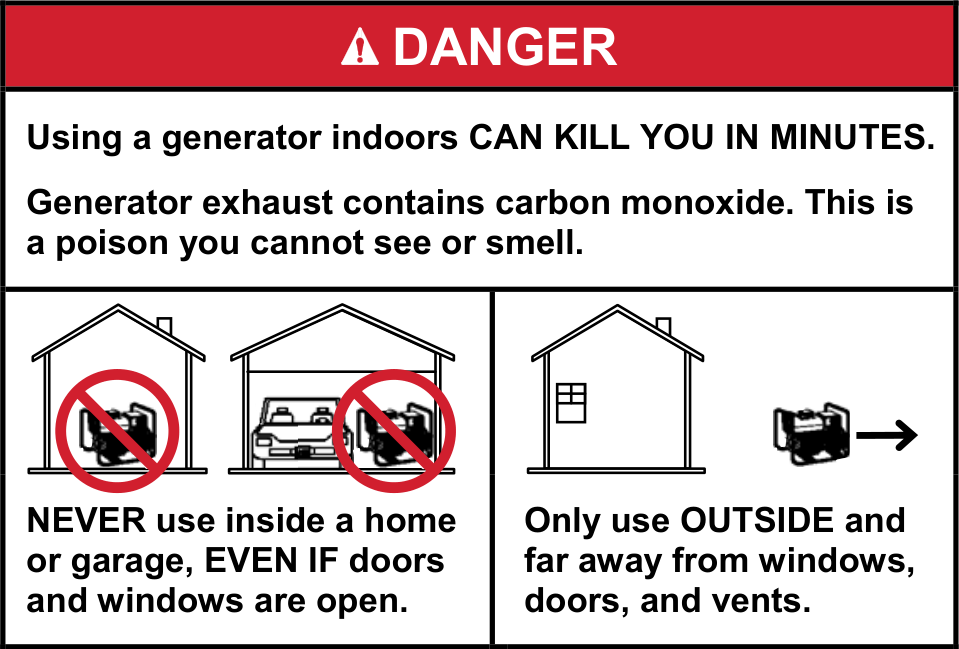
From U.S. Consumer Product Safety Commission, What to Know About Generators and Carbon Monoxide (2022), p. 1. Public domain; cropped. Not endorsed by CPSC.
How far away is far enough
The standard advice is at least 20 feet from the house. Sources phrase it slightly differently:
- CPSC: outdoors only, at least 20 feet from the house, exhaust pointed away from the home and other buildings.
- CDC: at least 20 feet from any doors, windows or vents. CDC's 2012 handout says more than 20 feet from your home, doors and windows.
- Ready.gov: at least 20 feet from windows, doors and attached garages.
Distance is not the only thing that matters. Two studies show why:
- Close outside still kills. NIST's report for the CDC notes that up to half of the nonfatal generator CO poisonings in the 2004 and 2005 hurricane seasons involved a generator outdoors but within seven feet of the home. After Hurricane Katrina, the CDC's review of 51 poisonings found generators had been run under a deck (28.6 percent of cases with a known location), near a window (26.2 percent), and in sheds, garages, carports and basements.
- Wind and exhaust direction matter. NIST's computer modeling of a two-story house found a generator had to be more than 15 feet away to avoid high indoor CO, and 30 feet, the next distance modeled, generally kept it low. Pointing the exhaust away from the house cut the highest indoor CO to 3 percent of what it was with the exhaust pointed at the house. But in one case, a wind of 5 meters per second (about 11 mph) pushed the exhaust plume down against the house without thinning it, and indoor CO stayed high even at the longer distance. NIST says its results apply to the houses and weather it modeled, not to every situation.
So treat 20 feet as a minimum, not a target. Farther is better where your cords and yard allow it.
Placing the generator
- Outdoors, at least 20 feet from the house, farther if you can
- Exhaust pointed away from the house and from neighbors' homes
- Not on a porch, under a deck, in a carport, or in a shed or garage, even with the door open
- Not near windows, doors, vents or an air-conditioner intake; CPSC suggests closing windows near the generator and sealing vent openings in the exhaust path
- 3 to 4 feet of clear space on all sides and above it (OSHA)
- On a dry surface where water can't pool or run underneath (CPSC)
- In an apartment or townhouse: never in a shared hallway or any other space inside the building; the CPSC records include deaths from a generator run in an apartment building's hallway
Carbon monoxide alarms
A CO alarm is the only thing that can warn a sleeping household. The CPSC's guidance:
- Install battery-operated CO alarms, or plug-in alarms with battery backup, on every level of the home and outside sleeping areas (see Fig. 6-2). A plug-in alarm without a battery is useless in an outage.
- Interconnected alarms are best: when one sounds, all of them sound.
- Choose alarms certified to UL 2034, IAS 6-96 or CSA 6.19.01.
- Test them monthly.
- Never ignore or disarm one. If it sounds, get everyone outside, then call 911.
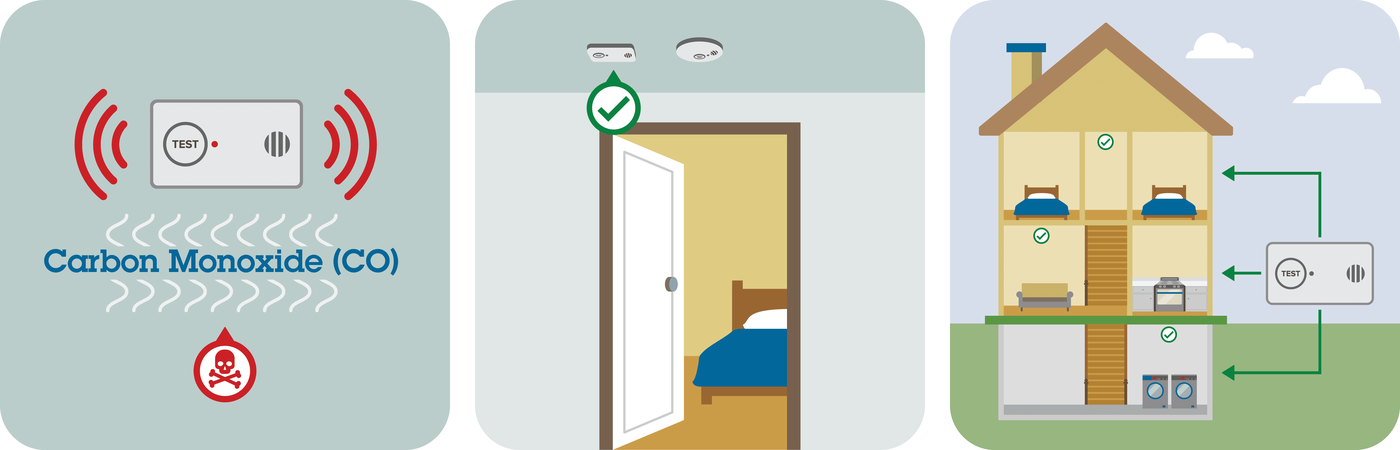
- The alarm sounds when carbon monoxide builds up; the gas itself can't be seen or smelled.
- Outside each sleeping area.
- On every level, including the basement.
From U.S. Fire Administration pictograph 29 (copyright-free). Not endorsed by FEMA or USFA.
Ready.gov adds that alarms should be in central locations on every level. An alarm only warns the people who can hear it: some of the deaths in the CPSC report happened in an attached garage while the alarm sounded inside the house, so nobody should be in the garage with a running engine at all.
Alarms before an outage
- At least one CO alarm on every level and outside each sleeping area
- Each runs on batteries or has battery backup
- Fresh batteries in, and a spare set in the kit
- Certification mark (UL 2034, IAS 6-96 or CSA 6.19.01) on each unit
- Tested this month; date written on the back
- Everyone in the house knows the sound, and that it means "get out, then call 911"
Knowing the symptoms, and what to do
The CDC lists headache, dizziness, weakness, upset stomach, vomiting, chest pain and confusion; the CPSC adds sleepiness. The CDC describes them as flu-like, and the Katrina review found many people mistook their poisoning for the flu. During an outage, if several people in the house, or the pets, feel ill at once while a generator or other fuel-burning device is running, assume CO.
- Get everyone outside into fresh air right away. Don't stop to find the source.
- Call 911 from outside.
- Don't go back in. OSHA's guidance is to stay out until trained, properly equipped responders say it is safe.
If someone is unresponsive or not breathing normally, start CPR while help is on the way; the first five minutes covers what to do first in any emergency.
Generators that shut themselves off
Since 2018 the two U.S. voluntary standards for portable generators, UL 2201 and ANSI/PGMA G300, have required a generator to shut off when CO builds up around it. UL 2201 also requires the engine to emit less CO in the first place.
CPSC staff modeled 511 real generator deaths and estimated that generators meeting UL 2201 would have averted nearly all of them, and generators meeting G300 nearly 87 percent. The CPSC found few generators on the market met UL 2201, though G300 conformance was more common. Makers' own pages are clear that the feature is a backup: Champion's description of its CO Shield system, on a unit it says meets G300, states it is not a substitute for an indoor CO alarm or for safe operation.
When you buy, the CPSC suggests looking for a CO shut-off feature and, if possible, reduced emissions, and checking the packaging for the standard it meets. Then place it exactly as if it had no such feature.
Electricity: shock, rain and cords
OSHA points out that generator power is as dangerous as utility power, with extra risk because people often bypass the circuit breakers built into a house's wiring.
Rain and snow. The CPSC says the shock risk is highest in wet conditions. Run the generator under an open, canopy-like cover on a dry surface where water cannot reach or drain under it, and dry your hands before touching it. Never move it indoors or close to the house to keep it dry. The CPSC's 2025 winter guidance adds two options: follow the maker's instructions, which may mean a non-combustible generator tent rated to NFPA standards, or wait for the rain or snow to pass. Ready.gov warns that touching a wet generator, or something plugged into it, can cause a shock. OSHA says not to touch a generator's electrical parts while you are wet or standing in water.
Cords.
- Plug appliances straight into the generator, or use heavy-duty extension cords made for outdoor use (CPSC), grounded with three prongs (OSHA).
- Each cord must be rated for more watts than everything plugged into it (CPSC). OSHA says to replace underrated cords with heavier-gauge ones and not to overload the generator, which can overheat it and start a fire.
- Check the whole length for cuts and tears before use (CPSC). Don't let it be pinched in a window or door.
- Use GFCI protection, built into the generator or the cord, around wet or damp areas (OSHA).
- Ground the generator as its manual directs (OSHA).
Flood-soaked equipment. OSHA says not to use electrical equipment that has been under water until it is thoroughly dried and checked, and to shut off anything that smells strange or starts smoking. See floods for the rest of the after-flood hazards.
Never plug a generator into a wall outlet
Plugging a generator into the house wiring through an outlet, called backfeeding, can electrocute utility workers and neighbors on the same transformer, and it bypasses the home's circuit protection (CPSC). The only safe way to feed house circuits is a transfer switch or interlock installed by a licensed electrician; see transfer switches and interlock kits.
Fire, burns and refueling
OSHA notes that a generator gets hot while running and stays hot for a long time after it stops, and that gasoline or kerosene spilled on hot engine parts can ignite.
- Turn it off and let it cool before refueling (CPSC, OSHA, Ready.gov). Plan your refueling for when you can spare the downtime, not in the dark with the engine hot.
- Refuel outdoors, where the generator stands; Ready.gov says fuel, like the generator, belongs outdoors and at least 20 feet from windows, doors and attached garages. OSHA warns that vapor from spilled fuel can travel a long way to a flame or spark, so keep smoking and open flames well away.
- Keep fuel out of the house, in labeled, non-glass safety containers, and away from fuel-burning appliances such as a gas water heater in a garage (CPSC).
How much fuel to keep, which containers are legal and how to keep gasoline from going stale are in fuel storage. If someone is burned, see burns.
Noise and neighbors
OSHA warns that generator noise and vibration can cause hearing loss and fatigue; keep the generator as far as practical from where people gather, and wear hearing protection if you have to work near it. Remember that your exhaust can reach the house next door as easily as your own: point it away from neighbors' windows too. The CPSC's 2022 handout asks everyone to check on neighbors during long outages, and a knock on the door of someone running a generator in a garage may save a life.
What not to do
- Don't run a generator in the house, garage, basement, crawlspace, shed, carport or on a porch, however briefly, with any number of doors open.
- Don't run it under a deck or beneath a window "just for tonight."
- Don't use a plug-in CO alarm with no battery backup during an outage.
- Don't silence or unplug an alarm because you think it is a false alarm.
- Don't refuel a running or hot generator.
- Don't backfeed through a wall outlet.
- Don't run a cord through a window you then can't close.
- Don't let a CO shut-off feature talk you into putting the generator closer.
A routine for every outage
Each time you start the generator
- Alarms: batteries in and tested
- Generator set out at least 20 feet from the house, exhaust pointed away from all homes
- Windows and vents on that side of the house closed
- Dry surface, open canopy if wet; hands dry
- Cords inspected, rated for the load, routed so doors and windows still close
- Loads brought on one at a time, within the generator's rating (see generator size)
- Fuel and funnel staged outside, away from the engine
- Everyone knows: any alarm, headache or dizziness means everyone outside, then 911
If a generator isn't practical, a battery power station or a small solar setup makes no exhaust and can run small loads indoors. And because the same CO danger applies to grills, camp stoves and heaters, see cooking without power, staying warm and home fire safety before an outage, along with the timeline in power outages.
Sources
- CPSC — Portable Generator Hazards (Safety Alert, Publication 5123)
- CPSC — What to Know About Generators and Carbon Monoxide (2022)
- CPSC — Fatal Incidents Associated with Non-Fire Carbon Monoxide Poisoning from Engine-Driven Generators and Other Engine-Driven Tools, 2010–2020 (June 2021)
- CPSC — New report finds voluntary standards can reduce CO risk from portable generators (February 23, 2022)
- CPSC — Winter storm safety tips to prevent carbon monoxide poisoning and fires (December 12, 2025)
- CPSC — Carbon Monoxide Information Center
- CDC — Carbon Monoxide Poisoning Basics
- CDC — Use a Generator Safely
- CDC — When the power goes out, keep your generator outside (2012)
- ATSDR/CDC — Proper use of generators in the home (2006)
- CDC MMWR — Carbon Monoxide Poisoning After Hurricane Katrina (2005)
- NIST Technical Note 1666 — Modeling the Effects of Outdoor Gasoline Powered Generator Use on Indoor Carbon Monoxide Exposures, Phase II (July 2010, hosted by CDC)
- OSHA — Using Portable Generators Safely (Fact Sheet FS-3286)
- Ready.gov — Power Outages
- Champion Power Equipment — 4500W Dual Fuel Open Frame Inverter (model 201321), CO Shield description
6.5 · Chapter 6, Power & Light
Storing gasoline, diesel and propane safely
A generator is only as useful as the fuel you have for it, and fuel stored badly is a fire waiting for a spark. Here are the legal limits fire departments publish, the containers to use, how long each fuel keeps, and a rotation that keeps it fresh.
Fuel is the part of a generator plan that people leave until the storm is forecast, when the station lines are long and the pumps may soon have no power of their own. Storing some ahead makes sense, but gasoline is one of the most dangerous things a household keeps. Its vapor is heavier than air, it spreads along the floor, and it ignites from a pilot light or a static spark.
This article covers how much each fuel a home may legally hold, the containers to use, how long each fuel keeps and how to make it keep longer, and the handling that prevents fires. Running the generator itself safely is in generator safety.
Fuel and vapor can explode
- Never store fuel inside the home. Keep gasoline, propane, kerosene and other flammable liquids outside living areas, in properly labeled, non-glass safety containers, and not near a fuel-burning appliance such as a gas water heater in a garage (CPSC).
- Gasoline vapor is heavier than air and can travel along the floor to a flame or spark (Maryland Department of the Environment, citing API); OSHA says vapors can travel long distances to an ignition source.
- Never refuel a running or hot engine. Gasoline spilled on hot parts can ignite (CPSC, OSHA).
- Never siphon by mouth. Gasoline can be harmful or fatal if swallowed; if someone swallows it, don't make them vomit, and get medical help at once (MDE).
The three fuels compared
| Gasoline | Diesel (and kerosene) | Propane | |
|---|---|---|---|
| Hazard class in fire codes | Flammable liquid (Class I-A) | Combustible liquid (Class II) | Liquefied petroleum gas in pressurized cylinders |
| How long it keeps | Degrades in as little as about 30 days untreated (Gold Eagle; Honda says fuel in the carburetor goes stale fastest) | Keeps longer than gasoline but does degrade, and can grow microbes (FEMA P-1019) | Can be stored indefinitely (FEMA P-1019) |
| Container | Approved gas can, 5 gallons or smaller (Unified Fire Authority) | Approved container, not jars or milk jugs (Lehi) | DOT cylinder with an OPD valve, inspected by date (Anoka County) |
| Where | Detached garage or shed preferred; limited in an attached garage; never in a basement (Commerce Township, Lehi) | Outside the residence; never in a basement (Lehi) | Outdoors or in a detached shed or garage, not in the house or an attached garage; Lehi alone allows two 1-pound cylinders inside (Commerce Township, Lehi) |
Gasoline powers most portable generators: almost all the generators in the CPSC's CO death records with a known fuel used it. Propane needs a generator built or converted to burn it (a "dual fuel" model, for example), and diesel needs a diesel engine. Choose the generator and the fuel together.
How much you may store
Home fuel storage is governed by the fire code your state, county or city has adopted; all three examples below are based on an edition of the International Fire Code (IFC). Limits vary from place to place, by code edition and by local amendment, so the numbers below are examples from three fire departments, not the law where you live. Check your own limit with your local fire department or fire marshal before you buy cans.
| Rule | Commerce Twp., Mich. (2021 IFC) | Lehi, Utah (2012 IFC) | Unified Fire Authority, Utah (older IFC edition) |
|---|---|---|---|
| Gasoline (and camp fuel) total at a home | 30 gallons, preferably in a detached garage or shed | 25 gallons, preferably in a detached garage or shed | 30 gallons |
| In an attached garage | No more than 10 of those gallons | No more than 10 gallons | Not stated separately |
| In a basement | None | None | Not stated |
| Diesel, kerosene, lamp oil | Not covered | 60 gallons outside the home; the page gives two different attached-garage limits (10 and 25 gallons) | 120 gallons of diesel |
| Container size | Approved type | Approved or original retail containers | 5 gallons or smaller |
| Empty cans | Count as full | Count as full | Not stated |
| Fuel in vehicle tanks | Doesn't count | Doesn't count | Not stated |
| Fire extinguisher | At least one 2A:20B:C, 10 to 50 feet from the fuel | One 2A:10B:C above 5 gallons, 10 to 50 feet away | A 2A:10B:C suggested |
| Propane cylinders | Never inside the building, full or empty | Up to 25 gallons of portable cylinders, in a detached garage or shed; two 1-pound cylinders may be kept inside | Not covered |
Two things stand out. First, empty cans count as full where the code says so, because an "empty" can still holds explosive vapor. Second, the codes and the fire departments disagree on propane indoors: Commerce Township, citing the 2021 IFC, says no propane cylinder of any size may be stored inside a building, while Lehi, citing NFPA 58, allows two 1-pound cylinders inside. The safer reading is to keep all propane outdoors.
Lehi's own recommendation is more modest than its legal limit: about 5 gallons of flammable liquids and 25 gallons of propane in portable cylinders, used within six months.
How much you actually need
Work out fuel from what your generator burns, not from a round number. Makers publish a runtime for one tank at a stated load. One example: Champion lists its model 201321 dual-fuel inverter as running 22 hours at 25 percent load on its 4.02-gallon gasoline tank, or 21 hours at 25 percent load on a 20-pound propane cylinder.
- Find your generator's tank size and runtime at a given load in its manual or spec sheet.
- Divide tank size by runtime to get gallons per hour at that load. For the Champion example, 4.02 ÷ 22 is about 0.18 gallons an hour at quarter load.
- Multiply by the hours a day you will really run it. Many households run a generator in blocks (to cool the refrigerator, pump water, charge batteries) rather than around the clock. Four hours a day at that rate is under a gallon; 24 hours is about 4.4 gallons.
- Multiply by the days you want to cover, then check the total against your local limit.
Heavier loads burn more fuel per hour, so use the figure for the load you will actually run; generator size shows how to add up that load. If the daily total is more than you can store legally or rotate, plan fewer running hours, or cover small loads with a power station and solar instead.
Containers
Gasoline. Use only containers approved and labeled for gasoline. OSHA says fuel should be stored and moved in approved containers designed and marked for their contents; the CPSC specifies non-glass safety containers; Maryland's fact sheet says never glass or unapproved containers; Lehi and Commerce Township say no milk jugs.
Cans sold in the U.S. since January 1, 2009 meet two federal rules, as NDSU Extension explained when they took effect: air-toxics rules that require a spout that locks shut and seals when not pouring, and walls with barrier layers that hold vapor in; and the Children's Gasoline Burn Prevention Act, which requires a child-resistant closure. Older cans don't have to be thrown away or upgraded. The new spouts take practice: fuel won't pour until you press the lever.
Fill no more than 95 percent full, so the fuel has room to expand as it warms (MDE). Cap it tightly, and don't use a can that won't seal.
Propane. Portable propane cylinders are pressure vessels regulated by the Department of Transportation. Anoka County, Minnesota, lists the checks:
- Look for the date stamped on the collar. A cylinder more than 12 years old must be recertified before it can be refilled.
- Cylinders from 4 to 40 pounds, the common 20-pound grill tank included, made after September 30, 1998, need an OPD (overfilling prevention device) valve. It has a three-lobed handwheel and "OPD" marked on the brass. A cylinder without one can't be refilled, though some retailers will swap it for a filled cylinder that has one.
- Replace any cylinder that is corroded or has loose parts. Never try to remove the valve.
Filling cans at the pump
Static electricity causes fires when cans are filled in the wrong place. Maryland's fact sheet, drawn from American Petroleum Institute guidance:
- Turn off the vehicle, and any camper heater, stove or pilot light.
- Put the can on the ground. Never fill it inside a vehicle, in a trunk, in a pickup bed, on a flatbed or on a trailer floor. Gold Eagle explains why, citing NIOSH: a can sitting on a plastic bed liner or carpet isn't grounded, so static from the flowing fuel can't drain away and can ignite the vapor.
- Keep the nozzle touching the can the whole time, and fill slowly.
- Hold the nozzle by hand; don't use a latch.
- Stop at 95 percent and cap it tightly.
- Let any spill on the can evaporate before putting it in the vehicle.
A photograph appears here on the website.
Gold Eagle adds touching metal on your vehicle before filling, to discharge static, and setting the can about five feet from the vehicle.
Carrying it home. Secure the can so it can't tip or slide. The sources differ on where: Maryland says never to leave it in direct sun or in a car trunk, while Gold Eagle says to carry it in the trunk or truck bed and, in a car, to prop the trunk lid slightly open to limit heat. Propane cylinders travel and are stored upright, valve at the top, never on their side (Anoka County).
Where to keep it at home
- A detached shed or garage is best (Commerce Township, Lehi). Never the house or a basement.
- Away from heat and flame: water heaters, furnaces, space heaters, electric motors, car engines and the sun (MDE, Unified Fire Authority, CPSC). OSHA adds the generator itself, cigarettes, lighters and matches.
- Cool and well ventilated, at roughly room temperature (MDE, Unified Fire Authority).
- Caps on, spouts and vents sealed (Unified Fire Authority).
- Propane outdoors (Commerce Township), upright and away from the grill it isn't connected to (Anoka County), and, Lehi says, at least 10 feet from gasoline or other flammable liquids if they share a space.
- A fire extinguisher nearby but not next to it: the departments above put it 10 to 50 feet from the fuel, so you can reach it without reaching into the fire. See home fire safety.
Keeping fuel fresh
Gasoline
Gasoline starts to break down within weeks. Gold Eagle, which makes STA-BIL, says untreated fuel can start degrading in as little as 30 days, forming gum and varnish that clog carburetors and fuel lines. Honda says fuel in the carburetor bowl goes bad faster than fuel in the tank, because there is little of it, it sits near engine heat and it is exposed to air. Honda also advises against fuel with more than 10 percent ethanol in its generators, because ethanol is corrosive and pulls water from the air into the fuel.
Stabilizer slows the breakdown; it doesn't reverse it. Honda says plainly that stabilizer will not restore stale fuel, and that stabilizers themselves have a shelf life. Gold Eagle claims STA-BIL Storage keeps gasoline fresh for up to 24 months when added to fresh fuel and stored in "proper conditions"; that is the maker's own claim, and the page doesn't spell out what those conditions are.
- Add stabilizer at the pump or as soon as you get home, to fresh fuel. Honda says to treat each can every time you refill it. Gold Eagle's dose for STA-BIL Storage is 1 ounce per 2.5 gallons; follow the label of the product you buy.
- Keep the generator's tank nearly full in storage. Honda says a partly filled tank lets air speed up deterioration; Gold Eagle says to fill the tank at least 95 percent before adding stabilizer. Cans are the exception: fill them no more than 95 percent, so the fuel has room to expand (MDE).
- Run the treated fuel through the engine. Honda says to run the engine outdoors for 10 minutes the first time you use stabilizer, so treated fuel replaces untreated fuel in the carburetor; Gold Eagle says about five minutes.
- Date every can with a marker the day you fill it.
Storing the generator itself. Honda's guidance for its small EU-series generators, by how long the machine will sit:
| Unused for | Honda's guidance |
|---|---|
| 1 to 2 months | Fill the tank with fresh fuel and stabilizer, run the engine briefly, close the fuel cap vent, store cool and dry |
| 2 to 12 months, or used less than once a month | Drain the carburetor, close the fuel cap vent, store cool and dry |
| More than a year | Drain the tank and carburetor |
Honda's engine division gives a different cut-off for its GCV and GSV engines: stabilized fuel for 30 to 90 days, and for longer than 90 days, run the engine until the whole fuel system is empty. Your generator's own manual decides.
Diesel
FEMA's guide to emergency power says diesel is less volatile than gasoline and keeps longer, but it does degrade over time, and degraded diesel can make a generator unreliable. Its advice, written for facilities, scales down to a household: don't store more than you will use, test or replace fuel when its quality drops, and keep fuel filters clean, because biological growth in stored diesel clogs them. Our suggestion, in the same spirit as FEMA's advice to share a tank with equipment that burns fuel often: cycle stored diesel through a vehicle or tractor that uses it regularly.
Propane
FEMA P-1019 says propane can be stored indefinitely, which is its great advantage for a household that runs a generator only a few times a year. The trade-off is that it is stored under pressure and is highly volatile, so cylinder condition and inspection dates matter more than the fuel's age.
A rotation that works
The safest stored gasoline is gasoline you use. A simple cycle, with dates on every can:
Fuel rotation
- Fill cans with fresh fuel and stabilizer; write the date on each can
- Within six months, as Lehi's fire department advises, pour the oldest can into a car with a fairly full tank, and refill it fresh (Honda passes on the EPA's suggestion to use year-old stabilized fuel this way; Maryland says good excess gasoline can go into a car or truck tank)
- Don't pour two-stroke fuel mixed with oil into a car (Maryland)
- Check propane cylinders' dates and valves each season
- Recount your total against your local limit, counting empty cans as full
- Put the schedule on the household's rotation calendar
Getting rid of bad fuel. Never pour gasoline on the ground, down a drain or into a stream, or put it in the trash; it can cause fires and contaminate water, and fines may apply (MDE). Take stale or contaminated gasoline to a household hazardous waste collection. Don't put propane cylinders in the trash either, even empty ones: Anoka County says they can explode in garbage trucks. Take them to a propane dealer, gas retailer or gas service company instead.
What not to do
- Don't store fuel in the house, a basement, or an attached garage beyond your code's small allowance.
- Don't keep gasoline in glass, milk jugs or any container not made for it.
- Don't fill a can sitting in a truck bed, trunk or trailer.
- Don't store fuel next to the water heater, furnace or the generator.
- Don't keep more than you can use and rotate; old fuel is a hazard and a starting problem.
- Don't refuel a hot or running generator.
- Don't use gasoline as a cleaner or to start a fire. Maryland says to use it as motor fuel only.
During a long outage, fuel runs out sooner than people expect and stations may close. The power outages page sets out what fails and when, and hurricanes covers the run-up to a storm, when fuel should already be stored rather than bought.
Sources
- CPSC — Portable Generator Hazards (Safety Alert, Publication 5123)
- OSHA — Using Portable Generators Safely (Fact Sheet FS-3286)
- Maryland Department of the Environment — Gasoline Safety fact sheet (2009, from API guidance)
- Charter Township of Commerce, Michigan — Home Storage of Flammable Liquids (2021 International Fire Code)
- Lehi Fire Department, Utah — Home Fuel Storage Limits (2012 International Fire Code)
- Unified Fire Authority, Utah — Allowable Home Storage for Flammable and Combustible Liquids (older IFC edition)
- NDSU Extension — New regulations imposed on portable fuel containers (May 4, 2009)
- FEMA P-1019 — Emergency Power Systems for Critical Facilities (September 2014, WBDG copy)
- Anoka County, Minnesota — Propane Tanks
- Honda Power Equipment — Avoiding fuel-related problems (EU-series generators)
- Honda Engines — Storage and transportation, GCV and GSV engines
- Gold Eagle — STA-BIL Storage essentials
- Gold Eagle — Essential tips on how to fill a gas can
- CPSC — Fatal Incidents Associated with Non-Fire Carbon Monoxide Poisoning from Engine-Driven Generators and Other Engine-Driven Tools, 2010–2020 (June 2021)
- Champion Power Equipment — 4500W Dual Fuel Open Frame Inverter (model 201321) specifications
6.6 · Chapter 6, Power & Light
Solar power for a household outage
A solar panel makes power for free and silently, but only while the sun is on it, and only as much as its label says on a cool, perfect day. Here is how the parts fit together, how to read the numbers, and how to size a small system that keeps the essentials running.
Solar is the one source of household power that doesn't run out of fuel. It makes no exhaust, so unlike a generator it carries no carbon monoxide risk, and it makes no noise. Its limits are just as real: it produces only while light falls on the panel, far less than the label suggests on a hot or hazy day, and nothing at night unless you store it in a battery.
For a household preparing for outages, solar is best understood as a way to refill batteries: a power station, a battery bank, phones and radios. Running a whole house from the sun takes a professionally installed system with storage. This article explains how the parts work, how to read a panel's label, and how to size a small system for the loads that matter. Choosing the battery box itself is covered in how to choose a portable power station.
Why rooftop solar may not help in an outage
Many people with solar on the roof are surprised when their lights go out with everyone else's. A typical grid-tied system feeds the house and the utility through an inverter, and the DOE's Solar Energy Technologies Office explains that standard small inverters ride through brief flickers in the grid but, during longer or larger disruptions, disconnect themselves from the grid and shut down. That protects line crews from power being fed back into lines they are repairing, the same danger described in transfer switches.
The DOE says solar systems with batteries can run without support from the grid during an outage if they are designed to do so. Its homeowner's guide notes that storage lets you use solar power when the sun isn't shining, including when the power goes out, and suggests asking your installer about battery options. If you have rooftop solar, find out now which kind you have; don't assume.
The rest of this article is about systems you can set up yourself: portable panels and small off-grid setups that charge batteries directly.
How a solar panel works
The EIA describes a photovoltaic (PV) cell as a device with no moving parts that turns sunlight straight into electricity. Light arrives as photons; those absorbed by the cell knock electrons loose in the semiconductor, and the cell's construction sweeps those electrons toward the front surface. That builds up a voltage between the front and back of the cell, much like a battery's two terminals, and current flows when a circuit connects them (see Fig. 6-4).
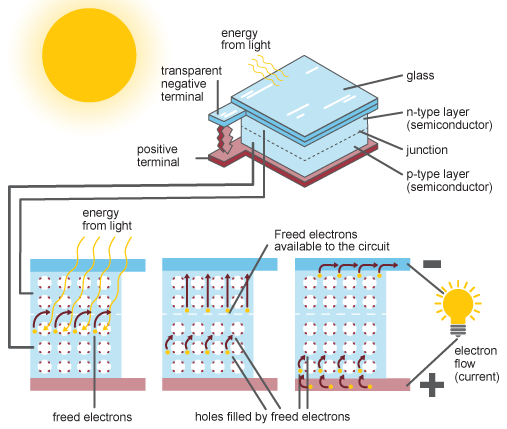
From U.S. Energy Information Administration, "Inside a photovoltaic cell", Solar explained (eia.gov). Public domain; title, source line and logo cropped. Not endorsed by EIA.
- One cell makes only 1 or 2 watts.
- A panel (module) is many cells wired together in a weatherproof frame. More cells or more area means more output.
- An array is two or more panels working together.
Panels make direct current (DC), the kind a battery stores. Household outlets and most of the grid use alternating current (AC), so an inverter is needed to run ordinary plugs.
Efficiency has climbed: the EIA says commercial panels averaged under 10 percent in the mid-1980s, about 15 percent by 2015, and close to 25 percent for the best modules now. Higher efficiency doesn't mean more power from a "100-watt" panel; it means the panel needs less area, and so less weight, to make those 100 watts.
Pointing it. The EIA says panels produce most when they face the sun directly. Most fixed systems in the Northern Hemisphere face due south at a set angle. A portable panel you can tilt and turn through the day will collect more than one laid flat.
Reading a panel's label
Every panel carries numbers measured under Standard Test Conditions (STC): light of 1,000 watts per square meter, roughly noon sun, with the cells at 25°C (77°F). Carroll Electric Cooperative's guide to panel ratings explains each one:
| Label figure | What it means | Why you care |
|---|---|---|
| Pmax (rated power) | Maximum power at STC, the "100 W" in the name | The ceiling, not the daily output |
| Vmp | Voltage at the maximum power point | What an MPPT controller tries to hold the panel at |
| Imp | Current at the maximum power point | Vmp × Imp = Pmax |
| Voc (open-circuit voltage) | Voltage with nothing connected | The highest voltage the panel makes; must stay under your controller's or power station's input limit |
| Isc (short-circuit current) | Current with the leads joined | The most current the panel makes; check it against your controller's or power station's input limit |
| Temperature coefficient of Pmax | Power lost per degree the cells run above 25°C | How much a hot day costs you |
| NOCT | The cell temperature reached in more realistic test light and air temperature | Used to estimate real output |
Renogy's 100-watt RSP100DC datasheet, for example, gives Vmp 19.97 V and Imp 5.01 A (19.97 × 5.01 ≈ 100 W), Voc 22.79 V and Isc 5.31 A, with a module efficiency of 20.0 percent. (Renogy's product page for the same panel line advertises 25 percent efficiency; the datasheet it links to says 20.0. When a maker's figures disagree, go by the datasheet and ask the maker.)
Why a panel makes less than its label
Heat. Panels in sun run hotter than the air. Carroll Electric's guide shows how to estimate the loss: multiply the temperature coefficient by the difference between the NOCT and 25°C. For its example panel, -0.45 percent per °C × (45 − 25) = a 9 percent loss. The same arithmetic on Renogy's datasheet figures (-0.32 percent per °C, NOCT 47°C) gives about 7 percent. Victron's charge-controller paper shows the extreme: its example 100-watt panel, at a cell temperature of 75°C (167°F), makes about 77.5 watts.
Sun hours. Carroll Electric puts average peak sun hours in Arkansas and Missouri at about 4 a day, even where the sun is up for 7; Carroll describes peak sun hours as the part of the day's sunshine that is usable for efficient production. Your area and season will differ.
Everything else. The same guide lists soiling, shading, wiring losses, inverter losses, panel aging and roof heat as further losses. On partial shading, the DOE notes that with panels wired in a series "string" to one inverter, shade on one panel can pull down the output of the whole string.
The cold has the opposite effect on voltage. Victron's paper shows panel voltage falling as the cells heat up, so on a cold, bright morning the panel's voltage is at its highest. Leave headroom between the panel's Voc and your controller's or power station's maximum input voltage, especially if you wire panels in series, and follow the equipment maker's limits.
The four parts of a small solar system
| Part | Job | Notes |
|---|---|---|
| Panel | Turns light into DC | Portable (folding) or framed rigid |
| Charge controller | Feeds the battery safely and stops overcharging | PWM or MPPT; built into power stations |
| Battery | Stores energy for night and cloudy days | Lead-acid or lithium (LiFePO4) |
| Inverter | Turns battery DC into household AC | Not needed for 12-volt or USB loads |
A portable power station combines the last three in one box, which is why it is the easiest starting point: you plug a panel into it. Building the system from separate parts gives you more capacity for the money and lets you grow it, at the cost of wiring, fusing and more to learn.
Charge controllers: PWM or MPPT
Victron's white paper sets out the difference clearly.
- PWM (pulse width modulation) is in essence a switch between the panel and the battery. When it closes, the panel is pulled down to near the battery's voltage. As the battery fills, the controller switches the panel on and off rapidly to avoid overcharging, which gives it its name.
- MPPT (maximum power point tracking) finds the voltage at which the panel delivers its most power, holds the panel there, and converts that power down to the battery's voltage. That lets a 12-volt battery be charged from panels wired in series at, for example, 36 volts. It costs more.
How much that matters depends on temperature. In Victron's worked example, a 100-watt panel at 25°C delivers 100 watts through MPPT but about 81 watts through PWM, 19 percent less, because the PWM controller holds the panel at about 13.5 volts instead of its 18-volt sweet spot. At a cell temperature of 75°C the panel's own best voltage has dropped so far that both deliver about 77 watts. Victron's summary: MPPT outperforms PWM in cold to temperate climates, and the two perform about the same in subtropical to tropical ones.
When a PWM controller is fine
A PWM controller works best when the panel's Vmp sits only a little above the battery's charging voltage, such as a "12-volt" panel (Vmp around 18 to 20 V) on a 12-volt battery, and in hot weather. A higher-voltage panel, like Renogy's 200-watt panel with a Vmp of 31.03 V, is a poor match for PWM on a 12-volt battery; it needs MPPT to use its voltage.
Batteries
Lithium iron phosphate (LiFePO4) is used in many power stations, including all four in the Almanac's comparison; its long cycle life and stability are compared with other chemistries in how to choose a portable power station.
Lead-acid batteries are common in home-built systems, and they need care. Battery University's guide to charging them:
- A full charge takes 12 to 16 hours, longer for big stationary banks. About 70 percent goes in during the first 5 to 8 hours; the last 30 percent takes another 7 to 10. That matters with solar, because the sun may set before the battery is full.
- Leaving one partly charged ruins it. Skipping the topping charge, or storing it low, causes sulfation and permanent capacity loss. Store it fully charged and give it a topping charge every six months (every 6 to 12 months for AGM types).
- Charging makes hydrogen, especially when overcharged, and hydrogen is explosive. Charge in a well-ventilated area; our suggestion is never in a closed room where people sleep.
- Heat calls for a lower float voltage above about 85°F, and Battery University advises against charging above 120°F (49°C).
Batteries and DC wiring can burn
- Lead-acid batteries give off explosive hydrogen while charging. Ventilate the space and keep flames and sparks away (Battery University).
- A panel in light has voltage across its leads even with nothing connected; that is its open-circuit voltage, Voc (Carroll Electric). Treat the leads as live in daylight, and cover the panel or work in shade when you wire it (our suggestion).
- Respect the fuse and voltage ratings on the panel's datasheet. Renogy's panels, for example, list a maximum series fuse rating of 15 A and a maximum system voltage of 600 VDC.
- Large banks wired into a house belong to a licensed electrician, like a transfer switch.
- If someone is burned, see burns.
Sizing a small system: a worked example
The method is the same arithmetic as for a power station, run in reverse: start from what you need each day, then work out how much panel and battery it takes.
1. List the daily loads. Using the typical draws in the power station guide (a phone charger at 20 W, a laptop at 50 W) and the 15 W LED bulbs used in generator size:
| Load | Watts | Hours a day | Watt-hours a day |
|---|---|---|---|
| Two phones charging | 20 | 2 each | 80 |
| Laptop | 50 | 3 | 150 |
| Four LED bulbs | 60 | 4 | 240 |
| Total | 470 Wh |
Check your own devices' labels; these are planning figures.
2. Allow for the inverter. If these run from AC outlets, the power station guide's planning factor of 0.85 means drawing about 470 ÷ 0.85 ≈ 553 Wh from the battery. USB and 12-volt loads skip most of that loss.
3. Size the panel. Divide by your peak sun hours, then allow for heat. With Carroll Electric's 4 peak sun hours: 553 ÷ 4 ≈ 138 W. Allowing about 9 percent for heat (Carroll's example) brings that to about 152 W. Soiling, wiring and shade take more, so a 200-watt panel is a sensible minimum for this list in that climate, and more if you want to catch up after a cloudy day.
4. Size the battery. To carry two days of clouds, you need about 2 × 553 ≈ 1,100 Wh of usable capacity. A 1 kWh-class LiFePO4 power station is close. A lead-acid bank must be larger than its usable figure, because the maker limits how deeply it should be discharged; use the maker's figure.
5. Check the season. The free PVWatts calculator from the National Renewable Energy Laboratory, which both the DOE and Carroll Electric point to, estimates output by address and month. Size for your worst month if you want the system to work in a winter outage.
Sizing your own
- List each load, its watts and hours a day; total the watt-hours
- Divide AC loads by 0.85 for inverter loss
- Find your peak sun hours (PVWatts), and use your worst month
- Panel watts = daily Wh ÷ peak sun hours, plus at least 10% for heat and more for shade and dirt
- Usable battery Wh = daily Wh × days of cloud you want to ride through
- Panel Voc under the controller's or power station's maximum input, with headroom for cold
- Panel watts within the power station's maximum solar input
Portable or rigid panels
Portable folding panels pack away and set up in a minute. The catch is weather: Jackery rates its SolarSaga 100 Air IP68 yet its FAQ says not to leave it in rain or soaking in water. Several fold for travel and include a kickstand or angle guide. Bifacial models collect some light from the back as well; EcoFlow's 220-watt panel lists 220 W front and 175 W rear, while its page claims both "up to 25%" and "up to 28%" more energy from the dual-sided design, so treat the gain as variable.
Rigid framed panels of glass and aluminum carry long warranties (Renogy: 25 years on power output, 10 on materials) and can be mounted permanently, but are heavy (Renogy's 200-watt panel weighs 23.4 lb) and need a mount and a separate controller.
Small USB panels, around 20 watts, charge phones, lights and radios directly. Goal Zero's Nomad 20 gives up to 10.5 W from its USB port, or up to 20 W from its 8 mm solar port into a power bank or power station. A panel holds no charge, so whatever it powers stops when the light goes. For keeping a weather radio and phones alive, that may be all a household needs.
Setting up during an outage
- Face the panel south, tilted toward the sun, and turn it through the day if you can (EIA).
- Keep every panel out of shade. The DOE notes that shade on one panel in a series string can cut the output of the whole string.
- Keep the battery or power station in the shade. Jackery's own guidance is to keep the power station away from heat and direct sun while the panel sits in it.
- Turn the power station on. Jackery's support answer on the product page notes its units charge from solar only when switched on.
- Wipe the glass with a soft, damp cloth when dusty (Jackery).
- Run the big loads at midday, when the panel is producing, and save the battery for night.
Solar, generator or both
Solar can't start a well pump or run an air conditioner the way a generator can, but it needs no fuel, makes no exhaust and works for as long as the outage lasts. A generator delivers big power on demand but needs fuel you have stored safely and must run outdoors because of carbon monoxide. Many households pair them: the generator for a few hours of heavy loads, solar to refill the batteries that carry the night. See power outages for how needs change from the first day to the first weeks.
Solar panels compared
Match the panel to what it will charge: a USB panel for phones and lights, a folding 100–220 W panel for a power station, or framed panels and a charge controller for a battery bank. Check the panel's open-circuit voltage (Voc) against your controller's or power station's maximum input. Specs are the makers' own, as published on the date shown; ratings are at Standard Test Conditions.
Goal Zero
Nomad 20
- Rated power
- 20 W
- Open-circuit voltage
- 18–22 V
- Outputs
- USB 5 V up to 2.1 A (10.5 W max); 8 mm solar port 14–22 V up to 1.3 A (20 W max)
- Cells
- Monocrystalline
- Weight
- 2.28 lb
- Size folded
- 11.5 × 7.4 × 1.25 in
- Warranty
- 2 years
- Price on maker's page
- $149.95
Jackery
SolarSaga 100 Air
- Rated power
- 100 W
- Efficiency
- Up to 23% (bifacial PERC cells)
- Outputs
- 100 W to a power station; USB-A and USB-C ports
- Weight
- 7.1 lb
- Water rating
- IP68, but the maker's FAQ says not to leave it in rain or soak it
- Operating temperature
- -4 °F to 149 °F
- Cable
- 9.84 ft, with DC8020 to DC7909 adapter
- Price on maker's page
- $299.00
EcoFlow
NextGen 220W Bifacial Portable Solar Panel
- Rated power
- 220 W (±5 W) front, 175 W rear
- Open-circuit voltage
- 21.5 V (Vmp 18.4 V)
- Short-circuit current
- 12.4 A front (Imp 11.9 A)
- Efficiency
- 25% (N-type TOPCon cells)
- Weight
- About 15.4 lb
- Size folded
- 24.2 × 23.2 × 1.3 in
- Water rating
- IP68
- Warranty (US)
- 12 months
- Price on maker's page
- $449.00
Renogy
100W 12V Monocrystalline Panel (RSP100DC)
- Rated power
- 100 W
- Open-circuit voltage
- 22.79 V (Vmp 19.97 V)
- Short-circuit current
- 5.31 A (Imp 5.01 A)
- Efficiency
- 20.0% per datasheet (product page advertises 25%)
- Temperature coefficient of power
- -0.32% per °C
- Weight
- 13.0 lb, framed glass
- Size
- 34.1 × 22.8 × 1.2 in
- Warranty
- 25 years power output, 10 years materials and workmanship
Renogy
200W 24V Monocrystalline Panel (RSP200DC)
- Rated power
- 200 W
- Open-circuit voltage
- 37.44 V (Vmp 31.03 V)
- Short-circuit current
- 6.85 A (Imp 6.45 A)
- Efficiency
- 20.7% per datasheet (product page advertises 25%)
- Temperature coefficient of power
- -0.32% per °C
- Weight
- 23.4 lb, framed glass
- Size
- 49.7 × 30.1 × 1.2 in
- Warranty
- 25 years power output, 10 years materials and workmanship
Specs are the makers’ published figures, read November 3, 2026. “Used” marks gear the editor has used; the rest is compared on specs only. How we compare gear.
None of these panels was tested by the Almanac; the specs are the makers' own, read on the review date.
Sources
- EIA — Solar explained: Photovoltaics and electricity
- DOE Solar Energy Technologies Office — Solar Integration: Inverters and Grid Services Basics
- DOE Solar Energy Technologies Office — Homeowner's Guide to Going Solar
- Carroll Electric Cooperative — A Guide to Solar Panel Ratings
- Victron Energy — Which solar charge controller: PWM or MPPT? (January 20, 2020)
- Battery University — BU-403: Charging Lead Acid
- Renogy — RSP100DC 100W monocrystalline solar panel datasheet
- Renogy — RSP200DC 200W monocrystalline solar panel datasheet
- Jackery — SolarSaga 100 Air product page and FAQ
- EcoFlow — NextGen 220W Bifacial Portable Solar Panel specifications
- Goal Zero — Nomad 20 specifications
Terms used in this chapter
- automatic transfer switch
- The switch built into a permanently installed home standby generator. It senses the outage and switches over on its own, so no one has to be home or do anything.
- backfeeding
- Sending generator power into house wiring through a wall or dryer outlet with no transfer switch. It can electrocute utility workers and neighbors on the same transformer and is illegal in many places.
- carbon monoxide
- A poison gas in generator exhaust that you can't see or smell. The CPSC says a generator in an enclosed space can produce deadly levels within minutes, and the gas can linger for hours.
- charge controller
- The part of a solar setup between panel and battery that feeds the battery safely and stops it overcharging. The two kinds are PWM and MPPT; a portable power station has one built in.
- CO alarm
- An alarm that sounds when carbon monoxide builds up. CPSC wants battery or battery-backup units on every level and outside sleeping areas, tested monthly. If one sounds, get outside, then call 911.
- CO shut-off
- A generator safety feature that turns the engine off if carbon monoxide builds up around it. CPSC suggests buying one that has it, but it is a backup, not a reason to run the generator closer to the house.
- cycle life
- How many full charge and discharge cycles a battery lasts. A rating such as 3,000 cycles to 80% means it should still hold 80% of its original capacity after 3,000 cycles; it keeps working, holding less.
- fuel stabilizer
- An additive put in fresh fuel to slow its breakdown in storage. Honda says to treat each can every time you fill it, that stabilizers have a shelf life, and that none will restore stale fuel.
- interconnected alarms
- Smoke or CO alarms linked so that when one sounds, they all sound. USFA and CPSC recommend them, and NFPA says its alarm code, NFPA 72, requires interconnected alarms throughout the home.
- interlock kit
- A metal bracket on the main panel that blocks the main breaker while a generator feeds the panel through its own breaker. Consumer Reports' 2021 estimate: $50–$150 for the kit plus $400–$800 labor.
- inverter
- The part of a power station that turns the battery's direct current into household alternating current. It loses some energy as heat, which is why runtime is figured at about 85% of capacity.
- LiFePO4
- A lithium-ion battery chemistry with a cycle life of 2,000 and higher and good thermal stability, per Battery University. It is heavier than NMC for the same capacity and weaker in the cold.
- main breaker
- The switch in the electrical service panel that cuts power to the whole house. To shut off, switch off the individual breakers first, then the main; to restore, the main first, then each breaker.
- MPPT
- Maximum power point tracking: a charge controller that holds a solar panel at the voltage where it makes the most power and converts it to battery voltage. Victron finds it beats PWM in cold to temperate climates.
- NMC
- A lithium-ion battery chemistry that holds more energy for its weight than LiFePO4 (150–220 Wh per kg) but has a shorter cycle life of 1,000–2,000 and begins thermal runaway at a lower temperature.
- OPD
- Overfilling prevention device: the valve, marked "OPD" with a three-lobed handwheel, needed on 4- to 40-pound propane cylinders made after September 30, 1998. A cylinder without one can't be refilled.
- open-circuit voltage
- The voltage across a solar panel's leads with nothing connected, the highest it makes. It must stay under the controller's or power station's input limit, with headroom for cold.
- peak sun hours
- The hours of sun equal to a panel's full rated output. Carroll Electric Cooperative puts the average at about 4 a day in Arkansas and Missouri, even where the sun is up for 7; it varies by place and season.
- pure sine wave
- An inverter whose AC output has the smooth wave shape of grid power. ResMed's 2015 guide called for one of at least 300 W continuous and 500 W peak for its CPAP machines used with a humidifier.
- PWM
- Pulse width modulation: the simpler kind of solar charge controller, in essence a switch that pulls the panel down to near battery voltage and switches it on and off rapidly to avoid overcharging.
- running watts
- The steady power an appliance draws once it is going, or the most a generator can supply for an extended period. A generator's running watts must cover everything that will be on at once.
- Standard Test Conditions
- The test conditions behind a solar panel's label figures: light of 1,000 watts per square meter with the cells at 25°C (77°F). Panels in sun run hotter, so they usually make less than the label.
- starting watts
- The short burst of extra power a motor needs to start, usually lasting two to three seconds. To size a generator, add the single largest starting surge to the total running watts.
- transfer switch
- A small panel, installed by an electrician usually next to the main panel, that feeds chosen circuits from the utility or the generator, never both at once. Consumer Reports' 2021 cost: $500–$1,500 installed.
- uninterruptible power supply
- A UPS: a unit left plugged into the wall that switches the devices plugged into it to battery when grid power fails. Power station makers quote the switchover time in milliseconds.
- watt-hours
- A measure of stored energy: the size of a battery's tank. A 1,000 Wh battery could in theory supply 100 watts for 10 hours; through the AC outlets, plan on about 85% of the rating.