Chapter 3 · Food
Cooking without power: stoves, grills, canned heat and the fireless cooker
Every way of cooking without electricity burns fuel, and burning fuel makes carbon monoxide. Get the location right and the rest is ordinary cooking. Here is where each method is safe, how to run it, and how a century-old fireless cooker can stretch your fuel.
Read first: Generator safety
When the power goes out, the food in the pantry is only as useful as your ability to heat it. The good news is that a household already owns most of what it needs: a grill, a camp stove, or a fireplace. The danger is in where people use them. Every year people die from carbon monoxide after cooking or warming up indoors with equipment that was built for outdoors.
So this page starts with the one rule that matters most, and then goes through each method in turn.
Carbon monoxide kills: grills and camp stoves go outside
- Never burn charcoal indoors. CDC says burning charcoal gives off carbon monoxide (CO) whatever its color, red, gray, black or white. CPSC says never use charcoal to cook or heat inside a home, garage, tent, camper, van, car, truck or mobile home.
- Never use a portable gas camp stove indoors (CDC). Ready.gov says charcoal grills and camp stoves are for outdoor use only.
- Never heat the house with a gas oven (CDC), and don't cook or burn anything on a stove or fireplace that isn't vented to the outside.
- Never run a generator indoors, in a garage or on a porch, even with doors and windows open. CDC says outdoors, more than 20 feet from windows, doors and vents; CPSC says outside only, at least 20 feet from the house. See generator safety.
- CO has no color or smell. CDC says it kills more than 400 Americans a year in poisonings not linked to fires, and that people who are asleep or have been drinking can die before they notice any symptoms.
- Symptoms: headache, dizziness, weakness, upset stomach, vomiting, chest pain and confusion; CDC says they are often described as "flu-like." If you suspect CO poisoning or a CO alarm sounds, get outside right away, then call 911 (CPSC).
Why outdoor equipment can't come inside
CDC lists the sources plainly: CO is in the fumes any time fuel is burned in stoves, lanterns, grills, fireplaces, gas ranges, furnaces, cars and small engines. Indoors it builds up and poisons the people and animals breathing it.
A fireplace is built to deal with that: its chimney carries the fumes away, which is why CDC's rule is about venting. A charcoal grill and a camp stove have no vent at all, which is why the sources draw the line where they do. CPSC's warning on camping equipment adds three points worth knowing:
- CO poisoning is easily mistaken for a cold or the flu, and is often caught too late.
- Alcohol and drugs make the symptoms harder to recognize.
- CO is especially dangerous to unborn babies, infants, older people, smokers and people with anemia or heart disease. CDC adds people with breathing problems.
CO alarms
Every home that cooks or heats with fuel during an outage needs working CO alarms. The two federal sources differ slightly on care:
| CDC | CPSC | |
|---|---|---|
| Type | Battery-operated or battery back-up | Battery-operated or battery back-up |
| Where | Near every sleeping area | Outside sleeping areas and on each floor |
| Checking | Check batteries when the clocks change each spring and fall | Test alarms monthly |
| Replacing | Per the maker's instructions, or every 5 years | — |
The stricter of each is a sound habit: test monthly, change batteries twice a year, replace on the maker's schedule. Smoke alarms are covered in home fire safety.
The methods compared
| Method | Where it's safe | Good for | Main hazards | Sources |
|---|---|---|---|---|
| Charcoal grill | Outdoors only, away from the house | Grilling, boiling a pot | CO; burns; hot coals for hours | CDC, CPSC, NFPA |
| Gas (propane) grill | Outdoors only, away from the house | Grilling, a pot on the grate or side burner | CO; gas leaks; burns | CDC, NFPA |
| Portable camp stove | Outdoors only | Boiling water, one-pot meals | CO; fuel; tipping | CDC |
| Fireplace or wood stove | Indoors, if properly vented and the chimney is sound | Slow cooking, boiling | CO if the chimney is blocked; house fire | FEMA, CDC |
| Canned heat, candle warmers, chafing dishes, fondue pots | For keeping cooked food hot, attended | Warming, not cooking from raw | Burns, flash fire, spilled fuel | FEMA, Ready.gov, Sterno |
| Fireless (retained-heat) cooker | Anywhere: no flame inside it | Finishing grains, beans, soups after a short boil | Food left too long below 140°F | USDA FB 771, FSIS |
| No cooking at all | Anywhere | Canned food straight from the can | — | FEMA, Ready.gov |
Eating without cooking
The simplest fuel-free option is in the pantry already. FEMA and Ready.gov both say commercially canned food can be eaten straight from the can, without heating. That is one reason the three-month pantry leans on canned food: it needs neither fuel nor extra water.
If you do heat food in its can, Ready.gov's steps are: take off the label, wash and disinfect the can with a solution of one part bleach to ten parts water, and open the can before heating it.
Grills
A grill is the most capable outage stove most households own. NFPA's safety guidance applies with extra force when the grill is being used every day.
Placement. NFPA says to put the grill well away from the house and deck railings, and out from under eaves and overhanging branches. It reports that nearly a quarter of grill structure fires started on an exterior balcony or open porch. Keep children and pets at least 3 feet from the grill.
Gas grills. Check the tank and connections for leaks before use. NFPA's method: with the cylinder turned on, brush or spray a soapy solution on the hose, regulator and burner connections. Bubbles mean a leak: turn the cylinder off at once. Always open the lid before lighting a gas grill.
Charcoal. Use a chimney starter with newspaper, or charcoal lighter fluid only. NFPA says never add lighter fluid to coals or kindling that are already lit, and never use gasoline or any other flammable liquid to start a charcoal fire.
Afterward. CDC says charcoal gives off CO whatever its color, so coals that look dead are still a hazard. NFPA says to let coals cool completely, then empty them into a metal container with a tight lid, used only for coals, kept outside and away from anything that can burn. Never empty coals into a trash can. And because CPSC says never to use charcoal inside a home or garage, a grill with live coals stays outside until they are out.
Never leave a grill unattended while it is in use (NFPA). Keep it clean: NFPA found the grill had not been cleaned in about a fifth of grill fires.
Camp stoves
A camp stove is handy for boiling water and one-pot meals, and tempting to bring inside on a cold night. CDC's rule is short: never use a portable gas camp stove indoors. CPSC's camping alert applies the same thinking to tents, campers and vehicles, and warns against running heaters or lanterns while sleeping in an enclosed space.
- Use it outdoors, never in a garage, tent or vehicle, and follow the maker's instructions for the fuel it takes.
- Storing propane, gasoline and other fuels is covered in fuel storage.
Fireplaces and wood stoves
FEMA's booklet names the fireplace as the place for emergency cooking indoors. That only holds if it vents properly. CDC says to have the chimney checked or cleaned every year, because debris can block it and let CO build up inside, and not to cook or burn anything in a fireplace or stove that isn't vented. Keep a CO alarm working in the house whenever the fire is lit, and see staying warm for using the fire as a heat source.
Canned heat, candle warmers and fondue pots
FEMA and Ready.gov list candle warmers, chafing dishes and fondue pots for keeping cooked food hot, and FEMA adds two conditions: use only devices approved for warming food, and always put out open flames before leaving the room. These are warmers, not stoves: they keep a pot of soup hot, but they are slow and weak for cooking from raw.
Small flames indoors: the sources differ
FEMA's booklet lists these warmers right after naming the fireplace for indoor cooking, and Ready.gov lists them among emergency cooking options; neither says they must be used outdoors. CDC's rule is broader: don't burn anything in a stove or fireplace that isn't vented, and CDC says carbon monoxide comes from any burning fuel. No source here says how much CO a chafing-fuel can or candle warmer gives off indoors.
Our suggestion, if you use one inside: only to keep already-cooked food warm, for a short time, with someone in the room, a window open for air and a working CO alarm nearby. Never use one to heat a room, never leave it burning while anyone sleeps, and put it out before leaving the room, as FEMA says. If anyone gets a headache, dizziness or nausea, put it out, get everyone outside and call 911.
Sterno's safety sheet for its chafing fuel gives the handling rules (the copy cited is hosted by a restaurant-supply retailer; we could not find it on Sterno's own site):
- Pry the lid off with a blunt object such as a spoon, never a sharp knife, and cup your hand over the lid as it opens.
- Put the can under the chafing dish before lighting it, seated securely, and light it with a long match or long lighter.
- Never carry a lit can, or a chafing dish with a lit can under it, and never use one lit can to light another.
- Put the flame out with the can's cap or a snuffer, never by blowing on it and never with your hands. Let the can cool before touching it.
- Keep hair, loose clothing, napkins and tablecloths away from the flame.
Burns from any of these are covered in first aid for burns.
The fireless cooker: retained-heat cooking
A fireless cooker is a box that holds heat in a pot. You bring food to a boil on any stove, put the covered pot into a heavily insulated nest, close the lid, and the stored heat finishes the cooking with no flame at all. The USDA's Office of Home Economics published instructions for a homemade one in Farmers' Bulletin 771 (the printed copy is dated February 1917). Its reasons for using one, fuel saved and no need to watch the pot, fit an outage better than they fit the farm kitchen it was written for.
How it works, and how much heat it holds
The bulletin's principle: a hot body wrapped in a good insulator keeps its heat for a long time. In its own test, a 6-quart kettle of boiling water at 212°F, packed in crumpled newspaper, was still 172°F after four hours and 155°F after eight hours. That is why the bulletin advised leaving food in the cooker for six to eight hours, and for some dishes overnight.
Building one (FB 771's method, with modern changes)
- An outer box with a tight hinged lid and a latch: the bulletin suggests a well-built wooden box, an old trunk or a small barrel. It must be big enough to allow at least 4 inches of packing all around the pot (see Fig. 3-3).
- A pot with straight sides and a flat, deep-rimmed lid that seats well down to hold the steam. The bulletin favored enameled ware or aluminum and warned against tinned iron, which rusts from the trapped moisture. Size the pot to the food: the bulletin says small amounts of food don't cook well in a large kettle.
- A nest for the pot: a cylinder that fits it snugly but lets it lift in and out freely. A loose fit leaves an air gap that cools the food.
- Packing. Of the cheap materials, the bulletin rated crumpled newspaper the best: clean, odorless and good at holding heat if packed hard. Crush single sheets, tamp a layer at least 4 inches deep in the bottom of the box, stand the nest on it, and pack more paper around it as solidly as you can. It also lists wool, hay and excelsior. (Some packing materials the bulletin recommended are no longer used; stick to these.)
- A cushion to fill the space between the top of the packing and the box lid, made of heavy cloth stuffed with cotton or crumpled paper.
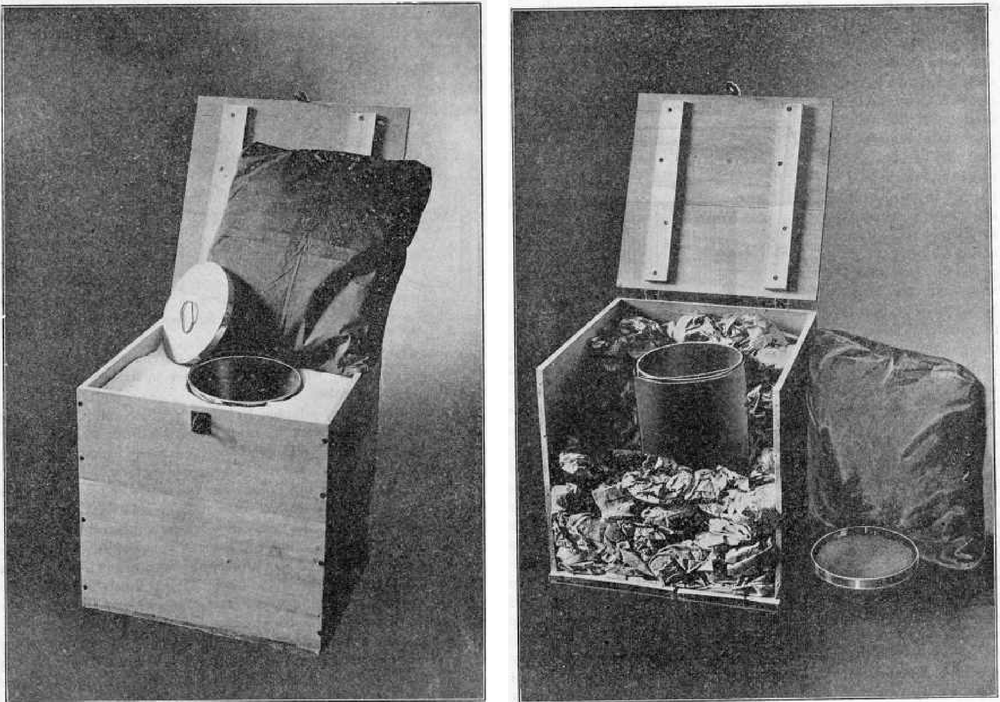
Figs. 1 and 4 from USDA Farmers' Bulletin 771, Homemade Fireless Cookers and Their Use (1916), pp. 5 and 8. Public domain; cropped and set side by side.
The bulletin also describes a version with an extra heat source inside the box, and itself warns that it can set the packing on fire. This page leaves that version out: the only heat in the box should be the hot pot itself.
Using it
- Use less water. Nothing evaporates in a closed cooker, so the bulletin says to use less liquid than a stovetop recipe.
- Boil first, then move fast. The bulletin's recipes boil the food on the stove before it goes in: white rice for 5 minutes, then 45 minutes to an hour in the cooker; oatmeal for 10 minutes, stirring, then 2 to 3 hours in the cooker until soft. Move the pot straight from the flame to the nest and close the box at once.
- Don't open it. The bulletin warns that opening the cooker lets out a large amount of heat and means reheating the food.
- Fill the space. If you must use a big pot for a small amount, the bulletin suggests setting a small covered container inside the big pot and filling the rest with boiling water, which holds heat far better than air.
- Cook together only what finishes together. Foods with different cooking times can't share a cooker.
A modern food-safety rule for retained-heat cooking
FB 771 was written before today's food-safety guidance. USDA's Food Safety and Inspection Service says bacteria grow fastest between 40°F and 140°F, doubling in as little as 20 minutes, and that hot food should be kept at or above 140°F. The bulletin's test was a full 6-quart kettle of boiling water, which stayed above 140°F for eight hours; it gives no figures for longer, and a smaller or half-full pot, a looser box or a cold room will lose heat faster.
- Bring the food to a full boil before it goes in, and use a pot that the food nearly fills.
- Our advice: don't leave food, especially meat, beans or rice, in the cooker overnight as the bulletin's recipes sometimes do.
- Check with a food thermometer when you take it out. If it is still at 140°F or above, it is being held hot as FSIS advises. If it has fallen below 140°F, our advice, following FSIS's 2-hour rule, is: if it may have been below 140°F for more than 2 hours, throw it out; otherwise reheat it to 165°F or until hot and steaming, as FSIS says for reheating.
- FSIS's rule for slow cookers applies by analogy: if you weren't there to know how long the food sat without heat, throw it out, even if it looks done.
- Once out of the cooker, eat it or refrigerate leftovers within 2 hours (1 hour above 90°F).
Food safety for any outage cooking
The same FSIS rules apply whatever the heat source:
- The 2-hour rule. Don't leave cooked food out of refrigeration more than 2 hours, or 1 hour above 90°F.
- Hot holding. Keep hot food at 140°F or above until it's eaten.
- Reheating. Bring leftovers to 165°F, or hot and steaming.
- A slow cooker caught by the outage. FSIS: if you weren't home for the whole cook and the power went out, throw the food away even if it looks done. If you were home, finish cooking it right away by another means, such as a gas stove or an outdoor grill. Fully cooked food stays safe in a switched-off cooker for up to 2 hours.
What to keep and discard from the refrigerator and freezer is in food safety in a power outage.
Fire safety
Outage cooking moves open flames into places they don't normally go. FEMA's rule covers most of it: put out open flames before leaving the room. Add NFPA's: never leave a lit grill unattended, and keep children and pets 3 feet back. Smoke alarms, extinguishers and escape plans are in home fire safety. Everything that fails when the grid goes down, and in what order, is laid out in power outages.
Outage kitchen
- Working CO alarms near sleeping areas and on each floor, with spare batteries
- A grill or camp stove, used outdoors only, with the maker's instructions
- Fuel for it, stored safely, and a way to light it (long matches or a long lighter)
- A soap solution and brush for checking gas connections
- A metal can with a tight lid for spent coals
- A manual can opener
- A pot with a tight lid, and a box and newspaper or blankets for a fireless cooker
- A food thermometer
- Bleach for disinfecting cans before heating
- A fire extinguisher where you cook
- Water for cooking dry foods (see how to store water)
Where to go next
The food to cook is in the three-month pantry and Mylar bags and buckets. For running a generator safely, see generator safety, and for storing the fuel, fuel storage.
Sources
- CDC — Carbon Monoxide (CO) Poisoning Basics
- CPSC — Charcoal (Carbon Monoxide Information Center)
- CPSC — CPSC Warns of Carbon Monoxide Poisoning Hazard with Camping Equipment (Pub. 5008, 2014)
- CPSC — What to Know About Generators and Carbon Monoxide (2022)
- NFPA — Grilling Safety
- FEMA — Food and Water in an Emergency (FEMA 477, 2004)
- Ready.gov — Food
- USDA Food Safety and Inspection Service — "Danger Zone" (40°F–140°F)
- USDA Food Safety and Inspection Service — Slow Cookers and Food Safety
- USDA Farmers' Bulletin 771 — Homemade Fireless Cookers and Their Use (1916, issued 1917)
- Sterno — Chafing Fuel Safety Tips (maker's sheet, hosted by WebstaurantStore)