Chapter 7 · Heat, Cooling & Shelter
Staying warm without power
In a winter outage, improvised heat can be more dangerous than the cold: carbon monoxide and house fires kill people every winter. Start with what can't be used indoors, then close the house down to one warm room and dress the people, not the building.
Read first: Power outages
When the furnace stops in winter, the instinct is to find heat anywhere: light the oven, bring the grill or camp stove inside, run the car in the garage. CDC warns against every one of them. A cold house is uncomfortable and, for babies and older people, dangerous over time. Carbon monoxide can kill the people in a house while they sleep: CDC warns that sleeping people can die before they have any symptoms.
So this page starts with what not to burn, then works outward: shrink the space you heat, dress and feed the people in it, use only heat sources made for indoor use, and know when it's time to go somewhere warmer. The medical side, how to spot and treat hypothermia and frostbite, has its own page: hypothermia and frostbite.
First: the two things that kill
Carbon monoxide: what must never be used for heat indoors
Carbon monoxide (CO) is a gas you can't see or smell. CDC says more than 400 Americans die each year from CO poisoning not linked to fires, more than 100,000 visit an emergency department and more than 14,000 are hospitalized. People who are asleep or have been drinking can die before they have symptoms.
- Never heat a home with a gas oven or gas range (CDC, Ready.gov, FEMA; see Fig. 7-1).
- Never use a generator, charcoal grill or camp stove inside a home, basement or garage, even with doors and windows open (CDC). CDC also lists portable flameless chemical heaters among the things not to use indoors.
- Never use a fuel-burning heater or lantern while sleeping in a tent, camper or vehicle (CPSC).
- Keep a generator outdoors, at least 20 feet from windows, doors and vents, with the exhaust pointed away from buildings (CDC, CPSC, Ready.gov). CPSC says a gasoline generator can make as much CO as hundreds of cars, and that about 750 people died of generator-related CO poisoning from 2012 to 2022. The full rules are in generator safety.
- Never run a car or truck in an attached garage, even with the garage door open (CDC).
- Don't burn anything in a stove or fireplace that isn't vented to the outside (CDC).
- Have a working CO alarm that runs on batteries or has battery backup (details below).
Symptoms (CDC): headache, dizziness, weakness, upset stomach, vomiting, chest pain, confusion; often described as "flu-like." If a CO alarm sounds, CDC says to leave the house right away and call 911. If anyone feels dizzy, light-headed or sick to their stomach and you suspect CO, get everyone out into fresh air and get medical help promptly (CDC).
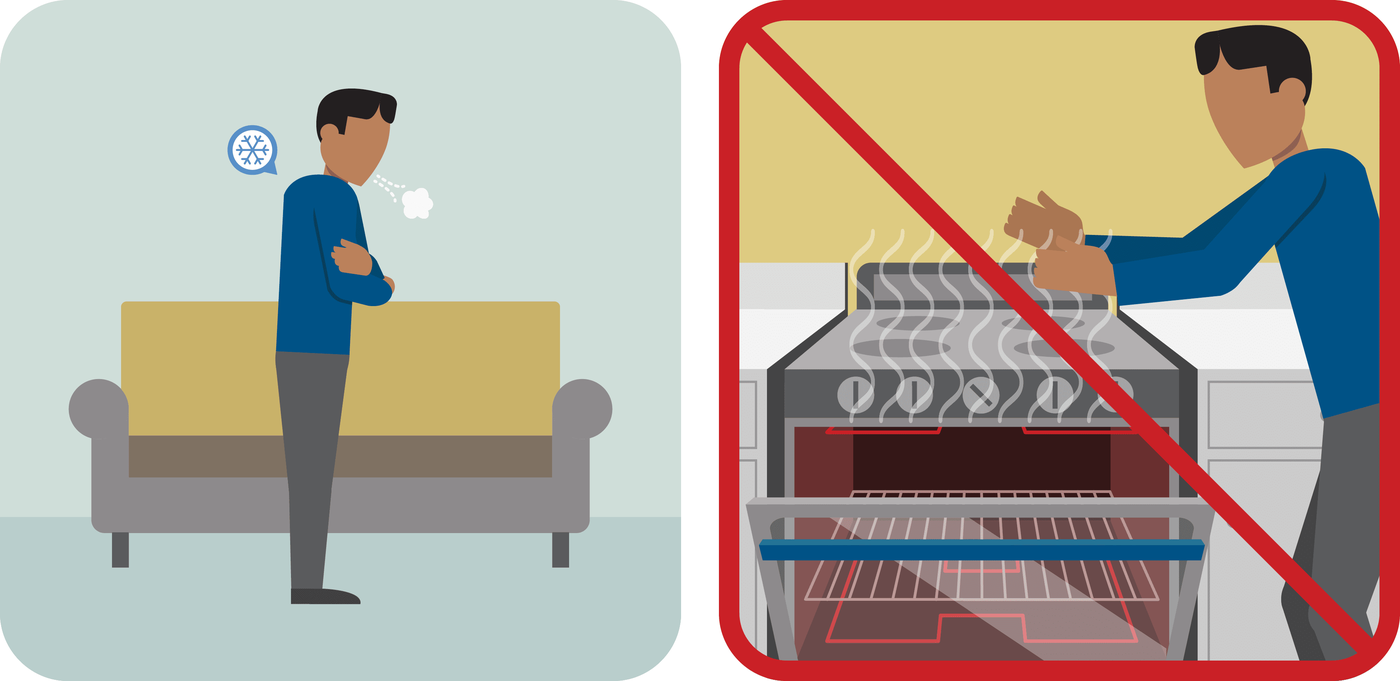
From U.S. Fire Administration pictograph 103 (copyright-free). Not endorsed by FEMA or USFA.
Heating fires
USFA says heating was the second leading cause of home fires in 2021: an estimated 32,200 home heating fires, 190 deaths and 625 injuries. Portable heaters were only about 3% of home heating fires from 2017 to 2019, but 41% of the deadly ones. CPSC's 2026 figures for portable heaters alone are about 1,600 fires, 70 deaths and 150 injuries a year (2020–2022).
- Keep anything that can burn at least 3 feet from any heater, fireplace, wood stove, radiator or candle (USFA, CPSC).
- Turn space heaters off when you leave the room or go to sleep (USFA, CPSC).
- Use flashlights and battery lanterns, not candles, for light (CDC, CPSC; see Fig. 7-2).
- Keep a multipurpose dry-chemical fire extinguisher near the area being heated (CDC), and see home fire safety.
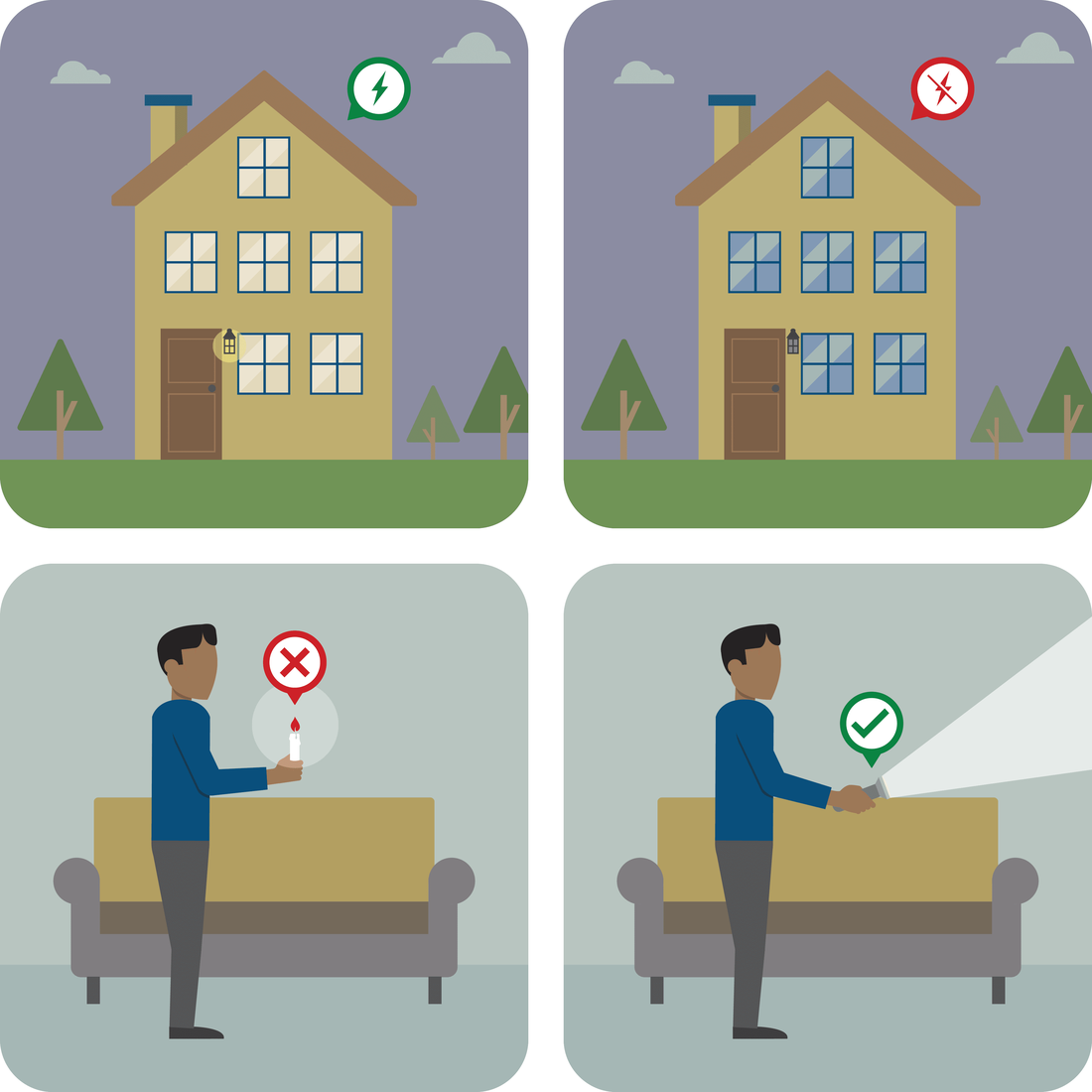
From U.S. Fire Administration pictograph 102 (copyright-free); panels set two by two. Not endorsed by FEMA or USFA.
Shrink the house to one warm room
Heat leaks out of a house through every wall, window and gap, so the more rooms you try to keep warm, the faster any heat source loses. FEMA's 2026 winter toolkit gives the household version of the answer: close off the rooms you aren't using and keep the heat where you are.
Read this before you close a room around a heater
A closed-off room is only safe if nothing in it can fill it with carbon monoxide. If the warm room has a kerosene heater, a fireplace or any other fuel-burning heat, CPSC and FEMA rules for that heater come first (see the note below and the heater sections further down), and the room needs a working battery CO alarm near the area being heated (CDC). A generator, grill, camp stove or gas oven is never the heat source for a warm room.
- Pick the room. Our suggestion, not a source's: choose one the whole household can sleep in, with a door, few outside walls and, if you have one, a window that gets direct sun. If you'll use a fireplace or a heater, keep anything that can burn at least 3 feet from it (USFA, CPSC, FEMA).
- Close off the rest. FEMA says to close the heating vents and shut the doors of rooms you're not using.
- Stop drafts. FEMA says to lay a rolled towel along the bottom of the doors. If a kerosene heater is running in the warm room, leave that room's door open or crack an outside window instead (CPSC; see the note below).
- Use the sun. FEMA says to open blinds and curtains in the day, especially on windows in direct sun, and close them at night to hold the heat in.
- Bring the household in. Sleep in the warm room. A baby still sleeps on its own crib, bassinet or play yard in that room, not in an adult bed (Safe to Sleep; see below). Bring pets inside too; CDC says to bring pets indoors in a winter storm.
- Keep an eye on the temperature. CDC advises older adults to keep an easy-to-read thermometer where they will see it and check the indoor temperature often.
One warm room, but not a sealed one
Closing a room off conflicts with one kind of heater. CPSC says a kerosene heater should run in a room with the door open to the rest of the house, and that if you must close the door, or the house is new and tight or has been weatherproofed, you should open an outside window about an inch to dilute the pollutants it makes. The two pieces of advice cover different things. FEMA's is about keeping heat in; CPSC's is about keeping a kerosene heater's carbon monoxide and other pollutants from building up. Where they meet, the CO rule wins: close off the unused rooms, but give a room with a kerosene heater the air CPSC calls for. For a fireplace, FEMA says to make sure the flue is open so smoke and CO leave by the chimney. With electric heat or blankets alone, nothing in the room burns fuel, so closing it off adds no CO risk.
Before winter: make the house hold heat
These are jobs for a dry autumn day, not the night the power goes out (CDC, Ready.gov):
- Caulk and weather-strip doors and windows; insulate walls and the attic.
- Fit storm windows, or cover windows with plastic from the inside.
- Insulate water pipes that run along outside walls, so they are less likely to freeze. Water already in the pipes is also an emergency supply; see finding water at home.
- Have a professional inspect the furnace, chimney, flue and any fuel-burning appliance every year (CDC, CPSC, USFA). A blocked or creosote-coated chimney causes both fires and CO buildup.
- Install CO and smoke alarms with battery backup and test them.
Keep the people warm, not just the room
A room in an outage may never get warm. People can stay warm inside it if they dress, eat and move the right way. FM 21-10, the Army's field hygiene manual, was written for soldiers in the field, and its cold-weather rules for keeping the body warm apply just as well in a cold house.
Dress in loose layers
- Several loose layers top and bottom, not one heavy garment and not tight clothing. FEMA says layering insulates better, and FM 21-10 warns against tight clothes, including tight underwear, because they restrict blood flow.
- Wear a hat. FEMA says a hat keeps your whole body warmer; FM 21-10 says to wear headgear to stop heat loss.
- Keep dry. FM 21-10 says wet or damp clothes pull heat from the body, so change them as soon as you can, and take off a layer before working hard so you don't sweat into your clothes. Change damp socks too.
- Don't spill fuel or other liquids on clothing. FM 21-10 says evaporating liquid cools skin and stained clothing insulates less. That matters when you're filling lamps or heaters.
- Blankets, sleeping bags and warm coats are the first heat source CDC lists.
Eat, drink and move
- Eat regular meals. FM 21-10 says to eat all meals to keep up energy; FEMA's toolkit lists eating and drinking among the ways to stay warm. Hot meals cooked on fuel need care; cooking without power covers how to make them safely, which is outdoors for anything that burns fuel.
- Drink water and warm drinks without alcohol. FM 21-10 says alcohol makes the body lose heat faster, and that people dehydrate in the cold too: dark yellow urine means you aren't drinking enough.
- Move. FM 21-10 says to work the big muscles of the arms, shoulders, trunk and legs, and, in a small space, to keep exercising fingers and toes.
- Avoid tobacco. FM 21-10 says it cuts blood flow to the skin.
- Don't sit or stand on cold floors for long; FM 21-10 warns against standing directly on cold, wet ground. In a cold house, that means keeping bedding and feet off a cold floor where you can.
Babies, older adults and anyone ill
CDC says older adults are more likely to have health problems caused by cold. Check on them, and on babies, often. The signs to watch for, and what to do, are on the hypothermia and frostbite page.
Babies need warmth without loose bedding. The NIH's Safe to Sleep campaign says quilts, comforters, pillows and loose blankets don't belong in a baby's sleep area, even when it is cold, because they can block breathing. To keep a baby warm, it says to use a wearable blanket or an extra layer of clothing instead, to dress the baby for the room's temperature, and to keep the baby's head and face uncovered for sleep. It also warns against letting a baby overheat: watch for sweating, flushed or hot skin, or a chest that feels hot. Safe to Sleep also says to share a room with a baby but not a bed: the baby sleeps on its own surface, such as a crib, bassinet or play yard, near the adults.
Heat sources compared
Every heat source below is safe only if it is made for indoor use and used the way its maker says. The rest are not heat sources.
| Heat source | Indoors? | Needs | The main risks and rules |
|---|---|---|---|
| Blankets, sleeping bags, coats, layers | Yes | Nothing | None; CDC's first-listed heat source |
| Electric space heater | Yes | Electricity: grid, generator by cord, or a large battery | Fire. Plug into a wall outlet, not an extension cord or power strip (CPSC); off when asleep or out of the room (CPSC, USFA); 3 feet clear |
| Kerosene heater | Yes, where legal (CDC) | 1-K kerosene | CO and fire. Refuel outdoors, cold; door open or window cracked an inch (CPSC) |
| Fireplace or wood stove | Yes, if code-compliant (CDC) | Dry firewood; open flue | CO and fire. Annual chimney inspection; 3 feet clear; never leave the flame unattended (FEMA) |
| Gas log fireplace | Yes (CDC lists it) | Gas supply | CO; keep vents and flues clear (CDC) |
| Gas oven or range | No | — | CO. Never used for heat (CDC, Ready.gov, USFA) |
| Charcoal grill, camp stove, gas lantern, flameless chemical heater | No | — | CO (CDC) |
| Generator | No: outdoors, 20+ feet away | Gasoline, propane | CO; runs electric heaters by cord from outside (generator safety) |
| Car engine | Only if you're stranded in the car: about 10 minutes an hour, exhaust pipe clear of snow (FEMA) | Fuel | CO; never run in an attached garage, even with the door open (CDC) |
Sources: CDC, CPSC, USFA, FEMA, Ready.gov, as named in each row.
Electric space heaters
CPSC's 2026 guidance: keep heaters at least 3 feet from drapes, furniture, bedding and anything else that burns; plug them straight into a wall outlet, never an extension cord or power strip; and turn them off when you sleep (see Fig. 7-3). FEMA adds: check that the cord isn't damaged or frayed. CPSC's older guidance adds three habits worth keeping: put the heater on a flat, stable surface where it can't be knocked over; buy one carrying the mark of a nationally recognized testing laboratory; and if the plug, cord, outlet or faceplate feels hot, turn it off and have an electrician look at it. Check any heater for recalls at cpsc.gov/recalls before using it (CPSC).
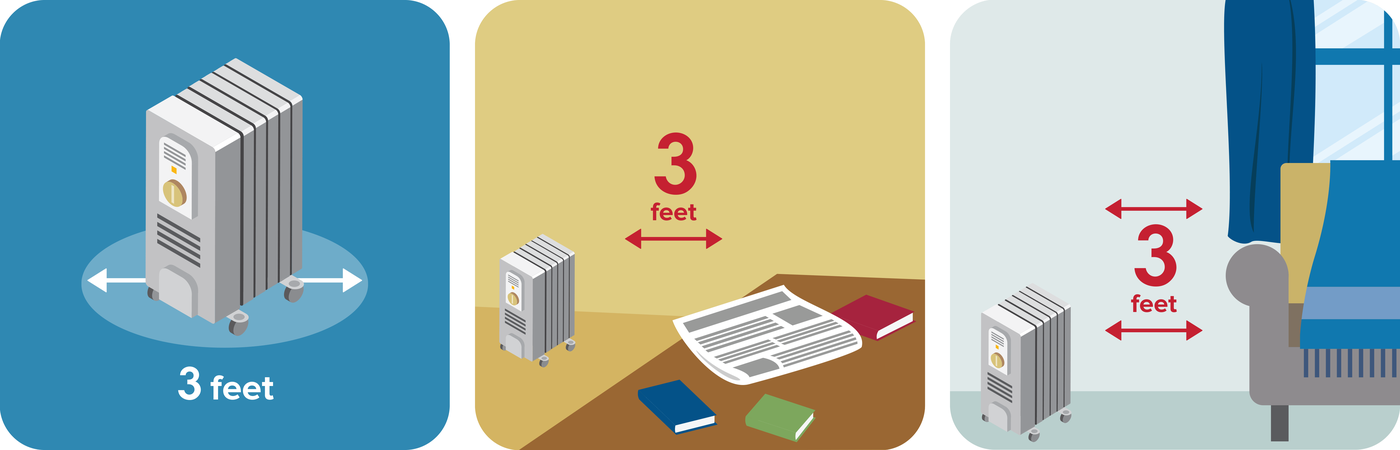
From U.S. Fire Administration pictograph 27 (copyright-free). Not endorsed by FEMA or USFA.
An electric heater needs a lot of power. In an outage it runs from a generator outside through a suitable cord, or from a large battery for a limited time. See generator size for wattage and portable power stations for runtime.
Kerosene heaters
CDC lists kerosene heaters among acceptable heat sources but says to check that they are legal where you live. CPSC's kerosene rules (Publication 5052):
- Use only water-clear 1-K grade kerosene. Never gasoline: CPSC says even a little gasoline mixed in can greatly raise the risk of fire or explosion. Buy from a dealer who can certify the grade, since other grades release more pollutants and look the same.
- Store kerosene in its own container, usually blue, never a red gasoline can or one that once held gasoline. Keep it away from other fuel containers. Storage rules are in fuel storage.
- Refuel outdoors, away from anything that burns, and only after the heater is off and cool. Don't fill above the "full" mark; that space lets the fuel expand.
- Run it at the recommended flame height, with the wick set and cleaned as the manual says.
- Give it air: door open to the rest of the house, or an outside window open about an inch (see the note above).
- If it flares up, don't move it or try to smother it or throw water on it. Use its shut-off switch if it has one; if the fire doesn't go out, get out and call the fire department.
CPSC also says not to use fuel-burning portable heaters while sleeping in tents, campers and vehicles.
Fireplaces and wood stoves
CDC lists a code-compliant fireplace with dry firewood among heat sources, with a warning to be extremely careful with wood stoves and fireplaces. FEMA says to make sure the flue is open so smoke leaves through the chimney, to keep anything that can burn at least 3 feet from the flame, and never to leave an open flame unattended. CPSC and USFA both call for a yearly professional inspection of the chimney and flue.
CO alarms: where and how many
The sources agree on the essentials and differ in the details:
- Where: CPSC says on every level of the home and outside sleeping areas (see Fig. 6-2); CDC says near every sleeping area, and its winter guidance adds one near the area being heated.
- Power: battery-operated or with battery backup, so it works in an outage (CDC, CPSC, Ready.gov). CPSC says interconnected alarms are best.
- Testing: monthly (CPSC, CDC winter guidance).
- Batteries: CPSC says replace them at least once a year or use sealed 10-year batteries; CDC says check them when the clocks change in spring and fall, and its winter page says replace them twice a year. Twice a year meets both.
- Replacement: CDC says replace the alarm as its maker says, or every 5 years.
Knowing when to leave
If the house can't be kept warm, leaving is the safe choice, not a failure. CDC says to shelter with friends or at a community shelter if your home is too cold. FEMA's toolkit says to look up your nearest warming center before winter and know how to get there; your local emergency management website lists them, and calling 211 can help you find one. It also warns that warming centers may not take pets, so call ahead (see pets in an emergency). Go only if travel is safe: during a winter storm, FEMA and Ready.gov say to stay off the roads when officials ask.
If you're caught in a car, FEMA says to stay with the vehicle unless a building you know is close, run the engine and heater for about 10 minutes each hour, and keep the exhaust pipe clear of snow so CO doesn't back up inside. The rest is in the car kit.
If you can't afford heating at all, Ready.gov points to LIHEAP, the federal Low Income Home Energy Assistance Program.
What not to do
- Don't heat with the oven, range, grill, camp stove or a generator indoors (CDC).
- Don't run space heaters on extension cords or power strips, or while you sleep (CPSC).
- Don't put gasoline in a kerosene heater, or refuel it indoors or while hot (CPSC).
- Don't seal a room tight around a fuel-burning heater (CPSC).
- Don't pile blankets on a sleeping baby; use a wearable blanket or an extra layer (Safe to Sleep).
- Don't drink alcohol to warm up (FM 21-10).
- Don't leave candles or open flames unattended (CDC, CPSC, FEMA).
- Don't ignore a CO alarm or flu-like symptoms that several people share. Get out, then call.
Staying-warm kit
- Battery or battery-backup CO alarms, tested, one outside each sleeping area and one on every level
- Smoke alarms, tested, and a multipurpose dry-chemical fire extinguisher
- Warm blankets, a cold-rated sleeping bag and a hat for each person
- Spare dry socks, gloves and base layers
- A wearable blanket for each baby
- Rolled towels or draft stoppers for the bottoms of doors
- Plastic sheeting and tape for windows
- An indoor thermometer that is easy to read
- Flashlights and battery lanterns, with spare batteries, instead of candles
- If you use one: a heater made for indoor use, with fuel stored safely outdoors
- The address of the nearest warming center, and how to get there
For the larger picture of a long outage, see power outages. When officials tell you to stay indoors for a reason other than cold, see shelter in place.
Sources
- CDC — Carbon Monoxide (CO) Poisoning Basics
- CDC — What to Do to Protect Yourself During a Power Outage
- CDC — Preparing for a Winter Storm
- CDC — CDC Offers Winter Safety Tips (press release, February 17, 2021)
- CPSC — Keep Warm and Safe This Winter: Tips for Using Generators, Furnaces and Space Heaters (January 23, 2026)
- CPSC — CPSC Stresses Kerosene Heater Safety (Publication 5052, revised 2011)
- CPSC — Portable Heaters & Camping Equipment
- CPSC OnSafety — Your Space Heater Needs Space (2017, archived)
- U.S. Fire Administration — Heating Fire Safety
- FEMA / Ready.gov — Stay Safe and Warm Toolkit (January 26, 2026)
- Ready.gov — Winter Weather
- NICHD Safe to Sleep — Ways to Reduce Baby's Risk
- U.S. Army — FM 21-10, Field Hygiene and Sanitation (2000), Chapter 2, Section II