Chapter 12 · Hazards
Floods: risk, warnings, water on the road, and the cleanup
Floods are the most common disaster in the United States, and most flood deaths happen to people who drove or walked into the water. Here is how to know your risk, read the warnings, stay out of the water and clean up after it.
Read first: Risk assessment
Ready.gov calls floods the most common disaster in the United States. A flood is simply water over land that is normally dry, but it comes in very different forms: a river that rises over days, a creek that becomes a torrent in an hour, a storm surge, a street that fills because the drains can't keep up. The defense against all of them is the same three things: know whether your home is at risk, act on the warnings, and stay out of the water.
That last one sounds obvious. The records show it is the one people get wrong.
Types of flooding
The National Weather Service describes these kinds of flooding:
| Type | What happens | Warning time |
|---|---|---|
| Flash flood | Water rises fast over low ground, typically within 6 hours of heavy rain, a dam or levee failure, or a jam breaking. The NWS says a mountain creek 6 inches deep can become 10 feet deep in under an hour | Minutes to a few hours |
| River flood | A river overflows its banks; classed as minor, moderate or major | Often days |
| Coastal flooding and storm surge | Seawater driven ashore by a hurricane or a nor'easter; surge can reach several miles inland | Hours to days, with hurricane forecasts (see hurricanes) |
| Urban flooding | Pavement keeps rain from soaking in, so cities are especially prone to flash floods | Short |
| Burn scars and debris flows | After a wildfire, bare ground sheds rain; soaked soil can flow downhill as mud | Short |
| Ice jams | Ice holds back water, flooding upstream; when it breaks, flash flooding downstream | Short |
| Dam or levee failure | Can happen with little warning | Very short |
The NWS sums up the timing: intense storms can bring a flash flood within minutes or hours, while other kinds of flooding can take days or weeks to develop. It also warns that dry washes can flood even when it isn't raining where you stand.
Know your risk
Flood maps
FEMA calls its Flood Map Service Center (msc.fema.gov) the official online home of the flood hazard maps made under the National Flood Insurance Program, including the Flood Insurance Rate Maps (FIRMs). Search your address there to find your flood zone.
What the zones mean, from FEMA's FloodSmart site:
| Zone | Risk | Meaning |
|---|---|---|
| A (and AE, AH, AO, AR, A99) | High | Close to a pond, stream or river, or to a protective barrier still being built |
| V and VE | High, coastal | High risk plus storm waves |
| Shaded X (older maps: B) | Moderate | Usually between the 100-year and 500-year flood limits, or shallow flooding, or behind a levee |
| Unshaded X (older maps: C) | Low | Usually above the 500-year flood level; may still have ponding and drainage problems |
| D | Undetermined | Possible flood hazard, never studied |
FloodSmart's own FAQ labels the two X zones the other way round from its zone summaries; the table above follows the summaries, which match the 100- and 500-year definitions.
What "100-year flood" really means. FEMA's retrofitting guide explains that the term is misleading: it means a flood with a 1% chance of happening in any given year, not one that comes once a century. One such flood doesn't make another less likely next year; the guide notes floods often come in clusters. FEMA's flood maps page puts the risk in a homeowner's terms: in a high-risk area, there is at least a one-in-four chance of flooding over a 30-year mortgage. The 1% flood is the "base flood," and its height at your site is the base flood elevation (BFE), shown on the FIRM. Under NFIP rules it is the lowest height to which the lowest floor of a building in Zone A must be raised or floodproofed.
Maps are a floor, not a ceiling. Ready.gov warns that flooding doesn't always follow map boundaries, and FEMA says there is no such thing as a no-risk zone. FloodSmart reports that almost one-third of National Flood Insurance Program claims come from outside the high-risk areas. FloodSmart also suggests checking your zone every year, because maps are updated.
The NWS adds the local knowledge no map gives: which roads near you collect water, and the fastest route to higher ground. Put both on your risk assessment and your household plan.
Flood insurance
- Homeowner's insurance generally doesn't cover floods. Ready.gov, the NWS and FloodSmart all say so. Flood insurance comes from the National Flood Insurance Program (NFIP) or a private insurer.
- There is a waiting period. Ready.gov says a policy typically takes up to 30 days to take effect; the NWS says many take at least 30 days. Either way, buying it when the river is rising is too late.
- It is required in some cases. FloodSmart says that in high-risk zones (A or V), a federally backed mortgage requires flood insurance, in communities that take part in the NFIP. Elsewhere it is optional but recommended.
- FloodSmart gives the NFIP's number as 877-336-2627; your local floodplain administrator can also tell you your zone.
Prepare the home
From the NWS, Ready.gov and CDC:
Before a flood
- Flood zone looked up and written on the household plan
- Flood insurance in force (it takes up to 30 days)
- Check valves in the plumbing, fitted by a professional
- Sump pump tested; consider a battery backup
- Circuit breakers or fuses clearly labeled, so you can shut off the right ones fast (see utility shutoffs)
- Valuables moved up to higher floors; drains and gutters cleared
- Documents in a waterproof container, with password-protected digital copies (see documents)
- At least 3 days of food, water and medicine (NWS); CDC says at least 1 gallon of water per person and per pet per day for at least 3 days (see how to store water)
- Rubber boots and gloves, flashlights, batteries, a first aid kit, and a NOAA Weather Radio
- Phones and radios charged, with spare batteries
- A plan for pets, and a place to stay outside the flood area (see pets)
- Sandbags or barriers if you plan to use them. The NWS warns that filling sandbags takes longer than you think
Bigger fixes. FEMA's Homeowner's Guide to Retrofitting describes six ways to protect a flood-prone house: elevating it, relocating it, demolishing and rebuilding, wet floodproofing (making parts of the house resist damage and letting water in and out), dry floodproofing (sealing it so water can't get in), and barriers such as floodwalls or levees (see Fig. 12-3). FEMA notes that only elevation, relocation, demolition and some wet floodproofing meet the NFIP's minimum requirements, and that insurance still matters after any of them. CDC adds that a licensed electrician can raise electrical components to at least 12 inches above the home's projected flood elevation.
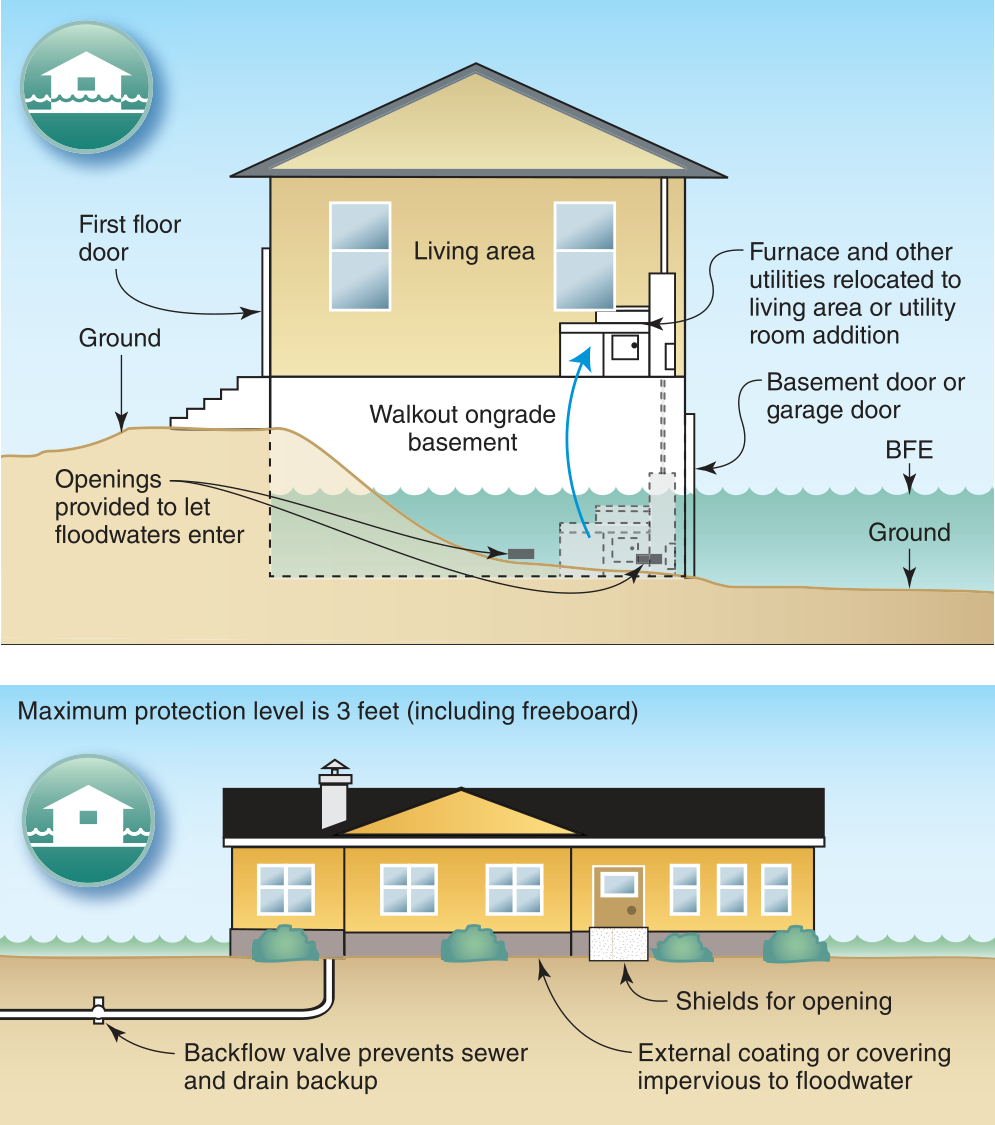
- Top, wet floodproofing (Fig. 3-15): openings let floodwater in, and the furnace and other utilities are moved above the base flood elevation (BFE).
- Bottom, dry floodproofing (Fig. 3-16): a watertight coating on the walls, shields for the door and other openings, and a backflow valve so sewage can't back up the drains. FEMA limits it to about 3 feet of water.
Figs. 3-15 and 3-16 from FEMA P-312, Homeowner's Guide to Retrofitting, 3rd ed. (2014), pp. 3-27 and 3-30. Public domain; cropped and stacked. Not endorsed by FEMA.
Watches and warnings
The National Weather Service uses four main flood alerts:
| Alert | Means | What to do |
|---|---|---|
| Flood Advisory | Flooding that may be a nuisance, not serious enough for a warning, but still dangerous if ignored | Take care on low roads |
| Flood Watch | Conditions favor flooding; it is possible, not certain | Get ready: charge phones, move valuables up, review your route to higher ground |
| Flood Warning | Flooding is about to happen or already happening | Act: move to higher ground or leave if told |
| Flash Flood Warning | A flash flood is imminent or occurring | Move to high ground immediately |
A watch is the time to prepare. A warning is the time to move. Set up more than one way to receive them; see phone alerts and NOAA Weather Radio.
Water on the road and on foot
The NWS says flooding kills more people each year than any other thunderstorm hazard, and it cites CDC: over half of all flood-related drownings happen when a vehicle is driven into hazardous floodwater. The next largest group is people walking into or near floodwater. The NWS says many of these deaths are preventable.
How much water it takes
The sources agree that it takes very little (see Fig. 12-4). Their figures vary a little, so here they are side by side:
| Depth of moving water | What it can do | Source |
|---|---|---|
| 6 inches | Knock an adult off their feet | NWS, Ready.gov |
| 12 inches (1 foot) | Float a car or small SUV / carry away most cars / sweep a vehicle away | NWS flood-during page / NWS vehicle page / Ready.gov |
| 18 inches | Carry away large vehicles | NWS flood-during page |
| 2 feet | Carry away SUVs and trucks | NWS vehicle page |
The two NWS pages differ for large vehicles (18 inches against 2 feet). Our suggestion is to plan on the smaller number: a pickup is not a boat.
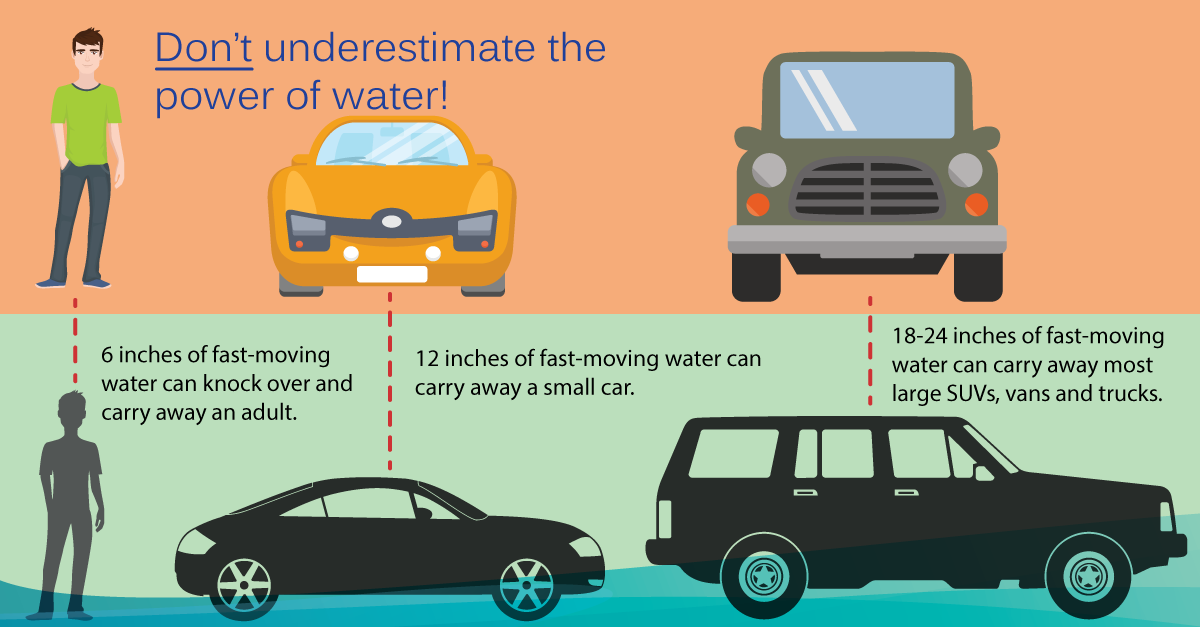
NOAA National Weather Service, "Don't underestimate the power of water!" (Weather-Ready Nation graphic). Public domain; adapted to remove the NOAA logo. Not endorsed by NOAA or the National Weather Service.
Why you can't judge it from the driver's seat
- The road may be gone. The NWS warns that the road under the water may have collapsed.
- The water is deeper than it looks, and hides hazards (NWS).
- A car is not protection. CDC says vehicles can be swept away or stall in floodwater.
- Strong swimmers drown too. CDC says fast-moving shallow water can be deadly, and even shallow standing water endangers small children.
Don't drive or walk into floodwater
- If water covers the road, turn back and find another way. Water you can't see the bottom of may be over a washed-out road. Never drive around a barricade (Ready.gov, NWS).
- Stay off bridges over fast-moving water; Ready.gov says they can wash out without warning.
- If your car is caught in fast-moving water, stay inside. If water rises inside the car, get onto the roof (Ready.gov). Call 911 if you can.
- If moving water traps you on foot, get to the highest point you can and call 911 (NWS).
- Floodwater can be electrified by downed power lines. Stay out of any water near them (CDC, Ready.gov).
The plain version of the safety slogan you may have heard: no errand is worth a drive into water. Plan a second route on the household plan and keep the car kit ready in case you have to wait it out.
During a flood at home
From the NWS and Ready.gov:
- Go to higher ground if you live in a flood-prone area, or leave right away if told to evacuate. The NWS says to leave before you are ordered if your home will likely flood.
- If time allows, shut off utilities and disconnect appliances before you go (NWS, CDC). CDC says to turn off power when there is standing water or downed lines. See utility shutoffs.
- Stay out of any basement or room where water covers the outlets or cords are under water. If you see sparks or hear buzzing, crackling or popping, get out (NWS).
- If trapped in the building, go to the highest level. Go onto the roof only if you must, and signal for help. Don't climb into a closed attic (Ready.gov).
- Keep listening to NOAA Weather Radio, the Emergency Alert System or local alerts.
What's in floodwater
CDC is blunt: no one knows exactly what is in floodwater at a given moment. Its list includes downed power lines; human and livestock waste; household, medical and industrial hazardous waste; coal ash with arsenic, chromium and mercury; sharp debris; and displaced animals such as rodents and snakes.
The illnesses CDC links to contact with it are wound infections, skin rashes, stomach illness, tetanus, and less commonly leptospirosis; along the Gulf Coast, melioidosis. In coastal waters, Vibrio bacteria can infect open wounds. CDC's advice is simple: the best protection is to stay out of the water.
If you must go in:
- Wear rubber boots, rubber gloves and goggles (CDC).
- Keep any open wound covered with a waterproof bandage, or stay out (CDC).
- Wash exposed skin with soap and clean water as soon as you can; use alcohol wipes or sanitizer if you have no water (CDC).
- Wash clothes in hot water and detergent before wearing them again (CDC).
- Don't let children play in floodwater or with toys it has touched until they are disinfected (CDC).
CDC says that after a puncture or a wound dirtied with soil or feces, a health care provider should decide whether you need a tetanus booster, so know when your last shot was. Get medical care promptly for an embedded object or any sign of infection (CDC). See wounds for how to clean and dress a cut.
After the water goes down
Going back in
The NWS and Ready.gov order of operations:
- Wait for the all-clear from authorities, and avoid driving unless it's an emergency. Obey road closures.
- Make sure the power is off before you enter. Have the utility or a qualified electrician repair wiring. Don't touch wet electrical equipment.
- Watch for gas leaks, which may not be obvious. If you smell gas, get out.
- Enter carefully. The NWS says floodwater can weaken floors and ceilings so they collapse. Watch for snakes and other animals (Ready.gov).
- Don't move propane tanks that have floated loose; CDC says to call the police, fire department or State Fire Marshal. Car batteries in floodwater can still hold a charge.
- Generators outdoors only, away from windows (Ready.gov). The NWS lists carbon monoxide among the leading causes of death after storms with power outages. See generator safety.
- Check the water. Authorities may issue a boil-water notice after a flood (NWS). See how to purify water, and if you have a well that flooded, wells.
- Sort the food. CDC lists stomach illness among the risks of floodwater, and says to follow local officials on whether tap water is safe to drink, cook or clean with. Check the refrigerator and freezer against food safety in an outage.
- Photograph the damage, including what you throw out, for the insurance claim (CDC), and contact your insurer.
Drying out and mold
Mold is the clock that starts when the water stops. CDC says to clean and dry or remove wet items within 24 to 48 hours to keep mold from growing.
| Step | CDC guidance |
|---|---|
| Protect yourself | Gloves, a mask and goggles; rubber boots |
| Who stays out | People with asthma, other lung conditions or weakened immune systems stay out of moldy buildings; children don't do cleanup (Ready.gov) |
| What goes | Anything soaked by floodwater that can't be fully cleaned and dried in 24–48 hours. Porous items that can't be disinfected, such as rugs, cloth, wall coverings and drywall, are thrown out |
| Air it | Open doors and windows; once the power is safe, run fans, air conditioners and dehumidifiers |
| Clean hard surfaces | Soap and water, then disinfect with a mix of 1 cup of bleach in 1 gallon of water. Remove all the mold you can see and dry right away |
| Don't mix | Never mix bleach and ammonia: the vapors are toxic |
| Don't cover it | Painting or caulking over mold doesn't stop it; fix the leak and remove the mold first |
Pooled water breeds mosquitoes; CDC suggests repellent with DEET or picaridin, or long sleeves and long pants.
If the outage that came with the flood goes on, the power outages timeline covers what to expect over the following days. And expect the door-knockers who follow every flood: disaster scams explains how to check a contractor before you pay one.
Sources
- Ready.gov — Floods
- NWS — Flood watch vs. warning
- NWS — Flood hazards (types of flooding)
- NWS — Flood safety: before
- NWS — Flood safety: during
- NWS — Flood safety: after
- NWS — Flood safety: vehicles and walking in floodwater
- FEMA — Flood Maps
- FEMA FloodSmart — National Flood Insurance Program home page
- FEMA FloodSmart — What is my flood zone?
- FEMA P-312 — Homeowner's Guide to Retrofitting, 3rd ed. (2014)
- CDC — Flood safety
- CDC — Floodwater after a disaster or emergency
- CDC — 8 Tips to Clean Up Mold
- CDC — Dry Off Wet Items After a Storm