Chapter 9 · Communications
The household radio plan, in full
Radios in a drawer are not a plan. A plan says who carries which radio, which channel to try first and second, when everyone listens, what the words mean, and where to go when the radios fail. Here is how to build one and fit it on a card.
Read first: Radio services
The guide to radio services ends with a short, one-page radio plan. This is the full version: the reasoning behind each line of that sheet, the choices you'll have to make, and a card you can print and put in every kit.
It sits inside a bigger document. FEMA's family emergency communication plan (FEMA P-1094) starts from the question every household eventually asks: what if something happens and we aren't together? Its answer is a written plan, because phones and computers can be unreliable in a disaster and the power may be off. A radio plan is the part of that plan that still works when the phone networks don't. Write the household plan first, or alongside this one, so the meeting places and contacts match.
Why radios need a plan of their own
A phone call needs only a number. A radio call needs both people to have agreed, in advance, on four things: the channel, the settings, the time, and the words. Without that agreement, two family members holding working radios can still miss each other completely. One is on channel 3, the other on channel 15; one listens at the top of the hour, the other turned the radio off to save the battery.
The plan settles all of that before anyone needs it. It also says what to do when the radios fail, because they will: batteries run down, hills block signals, and a radio left in a car is no help to someone at school.
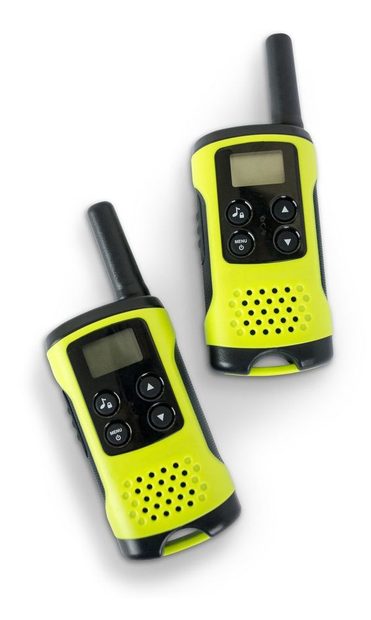
Photo: iStock.
The layers, in the order to try them
FEMA's advice is to text first, call briefly if you must, and have other ways to reach each other ready. The FCC gives the same order. A radio plan adds layers below the phone, ending with places to go when nothing else works.
| Layer | Works when | Fails when | Notes from the sources |
|---|---|---|---|
| 1. Text message | Cell network is up but busy | Network is down or the phone is dead | FEMA: a text needs far less bandwidth than a call and may send itself once capacity returns |
| 2. Brief phone call | Network has room | Lines are jammed | FCC: keep calls short, wait 10 seconds before redialing |
| 3. Out-of-town contact | Long-distance lines work when local ones don't | That person can't be reached | FEMA: a long-distance call may be easier than one across town |
| 4. FRS or GMRS radio | Family is within radio range | Out of range, battery dead, terrain in the way | No network needed; GMRS needs a license |
| 5. Amateur (ham) radio | Licensed members, a repeater or a clear path | No licensed operator at one end | Longest reach of the household options; needs an exam |
| 6. Meeting place | Everything above has failed | Never, if everyone knows the place and the time | FEMA lists four: indoor, neighborhood, out of neighborhood, out of town |
The rest of this page is about layers 4 to 6. Phone alerts covers the phone layers in detail.
Step 1: Who carries which radio
Start with people, not radios. List everyone in the household and, for each, where they usually are during the day: work, school, a care home, a route they drive. FEMA's plan asks for the same thing for schools, child care, caregivers and workplaces, along with each one's own emergency plan and pick-up arrangements, because a disaster can strike during school or work hours.
Then assign radios.
| Person | Usual location | Radio | License it runs under | Battery type | Role |
|---|---|---|---|---|---|
| (name) | Home | GMRS handheld | Licensee's GMRS call sign | Rechargeable pack + AA tray | Lead: sends meeting-place decisions |
| (name) | Office, 6 miles | GMRS mobile in car | Same call sign | Car power | Checks in from the car |
| (name) | School | FRS handheld | None needed | AA | Listens at check-in times |
| (name) | Home | Ham dual-band handheld | Their own ham call sign | Rechargeable | Reaches the out-of-area link |
Three choices on this table matter most.
Pick a lead person. FEMA's plan suggests deciding who will be the lead person to send out information about the meeting place. In radio terms, that person runs the check-ins: calls each name in turn, notes who answered, and passes on decisions. Pick a backup lead too.
Match radios to licenses. FRS radios need no license. GMRS radios do, but one license covers the licensee's immediate family; see how to get a GMRS license. Ham radios need each operator to hold a license of their own; see getting an amateur license. Write the call signs on the card.
Match batteries to supplies. A radio that takes AA cells can run on what's in the kitchen drawer; one with a proprietary pack needs a charger and power. Note which is which, and where the spares and chargers live. A portable power station or a small solar setup can keep packs charged through a long outage.
Step 2: Channels, written two ways
Choose a primary channel and a backup channel, and write each down by number and by frequency. Makers number channels differently, so "channel 15" on one brand may not be channel 15 on another. The frequency is what the radios actually use.
The 22 FRS channels are also GMRS channels, shared between the two services, so FRS and GMRS radios on the same frequency can talk to each other. Their power limits differ by channel group:
| Channels | Frequencies (MHz) | FRS power limit | Good choice for a family primary? |
|---|---|---|---|
| 1–7 | 462.5625, .5875, .6125, .6375, .6625, .6875, .7125 | 2 W ERP | Yes |
| 8–14 | 467.5625, .5875, .6125, .6375, .6625, .6875, .7125 | 0.5 W ERP | No: too weak for anything important |
| 15–22 | 462.5500, .5750, .6000, .6250, .6500, .6750, .7000, .7250 | 2 W ERP | Yes (GMRS radios may run more power here) |
Frequencies and limits are from 47 CFR 95.563 and 95.567. The GMRS license guide has the GMRS power limits and the repeater channels.
A sensible pattern is a primary on one group and a backup on the other, for example a primary in channels 1–7 and a backup in 15–22. If one channel is busy with neighbors or interference, the backup is in a different part of the band.
Privacy codes are not privacy
Most FRS and GMRS radios offer "privacy codes" (CTCSS or DCS tones). The FCC's rules describe these sub-audible tones as signals for selective calling and for opening a receiver's squelch. All they do is decide which signals your radio lets you hear. Anyone else on the same frequency can still hear you. The rules also say every Personal Radio Service channel is shared, with no one given exclusive use, and the FCC will not certify any new radio for these services with voice scrambling or other features that obscure speech if its application was filed on or after December 27, 2017.
So use a privacy code if it cuts out chatter from other users, but write it on the card and set every radio in the house the same way. A radio set to the wrong code will sit silent while the rest of the family talks.
Repeater and ham channels
If your household uses a GMRS repeater, write down its name, its output frequency and its tone, and get the owner's permission first (the GMRS guide explains why). If anyone holds a ham license, add a ham simplex frequency. The ARRL band plan lists 146.52 MHz as the national simplex calling frequency on 2 meters and 446.00 MHz as the national simplex frequency on 70 centimeters. Because those frequencies are well known, they are a natural place to call, but they are not yours alone; pick a less busy simplex frequency for routine family traffic if your area has one.
Step 3: Check-in times
Radios only connect people who are listening at the same moment. A check-in schedule is how a household makes that happen without everyone keeping their radio on all day and running the batteries flat.
Decide three things:
- When the plan starts. For example: when a warning is issued, when the power has been out for an hour, or when phones stop working. Write the trigger on the card so nobody waits to be told.
- When everyone listens. A short window at fixed times, such as the first five minutes of every hour during the first day, then at 8 a.m., noon and 6 p.m. after that. The longer an emergency runs, the more batteries matter.
- What to do if someone doesn't answer. Try again at the next window, then try the backup channel, then go to the meeting place at the agreed time.
| Phase | Listening window | Channel order | If someone is missing |
|---|---|---|---|
| First 24 hours | :00 to :05 every hour | Primary, then backup | Lead calls again at :30 |
| After the first day | 8:00, 12:00, 18:00 | Primary, then backup | After two missed windows, go to the meeting place |
| Radios not working | — | — | Neighborhood meeting place at the next even hour |
These times are an example, not a rule from any source. Choose times your household will actually keep, and write them down.
A note on keeping it short: the FCC's general rule for these services is to keep transmissions to the minimum length needed (47 CFR 95.357), and its emergency advice for phones is the same. Short check-ins leave the channel free for anyone with an emergency and save batteries on both ends.
Step 4: Plain-language status words
Short, agreed phrases save time on a crowded channel. Secret code words do not belong on the air, and the rules say so.
- GMRS is for two-way plain-language voice communications (47 CFR 95.1731) and forbids coded messages or messages with hidden meanings; the common "10 codes" are the one exception the rule names (47 CFR 95.1733). A family code word, such as a made-up word that secretly means "come and get me," is a coded message.
- Amateur radio forbids messages encoded to obscure their meaning (47 CFR 97.113).
- FRS rules have no coded-message clause of their own, but FRS shares its channels with GMRS, and plain words are just as quick. One card in plain English works on all three.
So the status words on your card should be plain English that anyone listening would understand. Their job is speed and clarity, not secrecy. Don't add a duress word or any phrase whose real meaning differs from what it says.
| Say | Meaning |
|---|---|
| "All OK, at home" | Safe, at home, no help needed |
| "All OK, at (place)" | Safe, at a named place; FEMA's example text is "I'm OK. At library" |
| "Moving to (place)" | Leaving now, heading to a named place |
| "Need pickup at (place)" | Safe but stuck; someone should come |
| "Need help, (what)" | Injured or in danger; say what and where |
| "Going to meeting place" | Radios aren't working well; meet at the agreed place and time |
| "Checking in, nothing new" | Heard you, no change |
Spelling names and numbers
Street names and numbers get garbled over a weak radio signal. The FAA's Aeronautical Information Manual gives the international (ICAO) phonetic alphabet that pilots and controllers use for single letters and difficult words, and amateur rules encourage a phonetic alphabet when giving a call sign.
| A Alfa | B Bravo | C Charlie | D Delta | E Echo | F Foxtrot | G Golf |
|---|---|---|---|---|---|---|
| H Hotel | I India | J Juliett | K Kilo | L Lima | M Mike | N November |
| O Oscar | P Papa | Q Quebec | R Romeo | S Sierra | T Tango | U Uniform |
| V Victor | W Whiskey | X Xray | Y Yankee | Z Zulu |
The same manual says to speak most numbers digit by digit ("one zero" for 10) and to say "point" for a decimal point in a frequency. It gives "niner" for 9 and "fife" for 5, which help when a signal is noisy.
Step 5: What a check-in sounds like
Every GMRS station must give its call sign at the end of a transmission or series of transmissions, and every 15 minutes during a long exchange; a unit number may follow the call sign (47 CFR 95.1751). Ham stations must identify at the end of each communication and at least every 10 minutes (47 CFR 97.119). The FRS rules (Subpart B of Part 95) set no identification requirement. Adding unit numbers to the card ("unit 1" for the lead, "unit 2" and so on) gives everyone a short name to use on the air.
A check-in might run like this, with the lead calling each unit in turn:
- Lead: "Unit 2, this is unit 1." (Wait.)
- Unit 2: "Unit 1, unit 2. All OK, at the office. Leaving at three."
- Lead: "Unit 2, copy, all OK, leaving at three." Repeating the key facts back catches mistakes.
- Lead calls the next unit, and so on down the list.
- Lead ends with the license call sign and "unit 1."
Listen for a few seconds before you transmit, in case someone else is using the channel.
Step 6: When the radios fail
FEMA's plan names four meeting places, and each fits a different failure:
- Indoor: where everyone goes for protection in high winds, such as a small interior room without windows on the lowest floor, or a safe room or storm shelter.
- In your neighborhood: where you meet if you have to leave home, such as a big tree, the mailbox at the end of the driveway, or a neighbor's house.
- Outside your neighborhood: where you meet if you can't get home, such as a library, community center, house of worship or a friend's home.
- Outside your town: where you meet if you can't reach the other places, or if the household is apart when the area is told to evacuate. Everyone should know the address and how they'd get there.
On the radio card, pair each place with a time rule, such as "If we can't reach each other, go to the neighborhood meeting place at the next even hour and wait 30 minutes." A time rule turns "meet at the library" into something two people can actually do without talking.
Add the out-of-town contact: one person outside the area whom everyone calls or texts with their status. FEMA and the FCC both recommend one, because that person can relay news between family members who can't reach each other directly.
Emergencies come first
If someone is hurt or in danger, call 911 first if any phone works; FEMA's plan says everyone, including children, should know how and when to call 911. The first five minutes covers what to do while help is on the way.
If no phone works, the radio rules make room for you. Any GMRS channel may be used for emergency messages, and every GMRS operator must give emergency traffic priority on every channel (47 CFR 95.1731). Amateur rules say nothing in them prevents using any means of radio communication for the immediate safety of life or protection of property when normal systems aren't available (47 CFR 97.403). Say clearly what is wrong and exactly where you are.
Charging radios and phones in a car
FEMA's plan suggests a car charger as backup power, and warns that the car must be somewhere well ventilated, not in a closed garage, to avoid carbon monoxide poisoning. A running engine in an enclosed space can kill. The same goes for any generator used to charge batteries: see generator safety.
Practicing the plan
FEMA's plan suggests practicing by having each person send a text or call the out-of-town contact, sending a group text, gathering everyone at the indoor and neighborhood meeting places, and talking through how each person would reach the farther places. It recommends reviewing and practicing at least once a year, or whenever information changes.
A radio drill fits the same day. Everyone goes where they'd usually be at that hour, turns on their radio at the agreed time, and the lead runs a full check-in on the primary channel, then the backup. Note who couldn't be heard and from where. Those gaps are the reason to practice: you learn that the school is out of range before you need it. A NOAA Weather Radio test morning is an easy recurring reminder.
After the drill, do what FEMA suggests: talk about what worked, what didn't, and what needs updating, and print new copies if anything changed.
What not to do
- Don't rely on one channel or one radio. Have a backup channel, a backup lead and a meeting place.
- Don't use secret codes. GMRS forbids coded messages and hidden meanings (10 codes excepted), and ham rules forbid messages encoded to obscure their meaning. Plain words are faster anyway.
- Don't assume a privacy code keeps you private. It only filters what you hear.
- Don't leave the card on a phone. FEMA's point about writing numbers on paper is that a dead or lost phone takes its contacts with it.
- Don't transmit on a service you aren't licensed for. GMRS needs a license for the family; ham needs one for each operator.
- Don't make the plan so complicated that a child or a frightened adult can't follow it. One card, short lines.
The printable card
Print this, fill it in, and put a copy in every 72-hour kit, get-home bag and car, with one posted at home. FEMA's card (FEMA P-1095) holds the household contacts, school and workplace plans, an "In Case of Emergency" contact, the out-of-town contact, the four meeting places and important numbers; this card adds the radio lines.
Household radio card
- Plan starts when: (trigger, such as a warning, an outage over an hour, or phones down)
- Lead (unit 1) and backup lead
- Each person: name, unit number, radio, battery type
- GMRS licensee and call sign; ham call signs, if any
- Primary channel: number, frequency, privacy code
- Backup channel: number, frequency, privacy code
- GMRS repeater (if used): name, output frequency, tone, owner's permission
- Ham simplex frequency (if licensed)
- Check-in windows: first 24 hours, then after the first day
- What to do after a missed check-in
- Status words: all OK, moving to, need pickup, need help, going to meeting place
- Indoor, neighborhood, out-of-neighborhood and out-of-town meeting places, with a time rule
- Out-of-town contact: name, mobile, email
- NOAA Weather Radio frequency and county code
- Local AM and FM emergency stations
- Where the spare batteries and chargers are kept
- Date the card was last checked
Review the card whenever someone changes schools or jobs, gets a new radio or phone number, or moves. The household plan and this card should always tell the same story.
Sources
- FEMA — Create Your Family Emergency Communication Plan (FEMA P-1094, July 2018; copy hosted by U.S. Army Garrison Fort Riley)
- FEMA — Family Emergency Communication Plan fillable card (FEMA P-1095, July 2017)
- Ready.gov — Make a Plan
- FCC — Tips for Communicating in an Emergency
- eCFR — 47 CFR Part 95, Personal Radio Services (95.333, 95.357, 95.359, 95.377, 95.381, 95.563, 95.567, 95.1731, 95.1733, 95.1751)
- eCFR — 47 CFR Part 97, Amateur Radio Service (97.113, 97.119, 97.403)
- ARRL — Band Plan
- FAA — Aeronautical Information Manual, Chapter 4 Section 2, Radio Communications Phraseology and Techniques (4-2-7, 4-2-8)