Chapter 5 · Sanitation & Hygiene
Handwashing without running water
When the water stops, the sink stops, and hands become the easiest way for illness to move through a household. A jug, a bucket and a bar of soap fix most of it. Here is how to set them up, which water to use, and where hand sanitizer falls short.
Read first: Emergency toilets
In an ordinary week, the sink does the work without anyone thinking about it. In an outage, a boil-water notice or a flood, it may not, and that is when people start eating with hands that have just emptied a bucket toilet, changed a diaper or cleaned up after a sick child. CDC says handwashing helps prevent both diarrheal and respiratory infections, the two kinds of illness that spread fastest through a household living in close quarters.
The fix is cheap and old. The Army's field hygiene manual, FM 21-10, treats a handwashing device at every latrine and every kitchen as standard equipment for soldiers living without plumbing. A household can do the same thing with a water jug, a bucket and a bar of soap.
Why handwashing matters more when the water is off
Germs move from people and surfaces to hands, and from hands into the mouth, eyes and nose, or onto food. CDC lists the routes: touching your face with unwashed hands, preparing or eating food with them, touching contaminated surfaces, and coughing or sneezing into them.
An emergency multiplies all of these at once. Toilets may be buckets (see emergency toilets). Food may be cooked on a camp stove outdoors and eaten from the pot. Water for cleaning is rationed, so people skip washing to save it. And illness is harder to treat when the clinics are closed. That is why FM 21-10 tells leaders to make handwashing at latrines mandatory, not merely available.
When to wash
CDC's list for everyday life is the same list you need in an emergency, and FM 21-10's field list overlaps it closely.
Key times to wash hands (CDC, FM 21-10)
- Before, during and after preparing food
- Before and after eating (FM 21-10 adds: before touching eating utensils)
- After using the toilet, including a bucket toilet
- After changing a diaper or cleaning up a child who has used the toilet
- Before and after caring for someone who is sick with vomiting or diarrhea
- Before and after treating a cut or wound
- After blowing your nose, coughing or sneezing
- After touching an animal, its food, treats or waste
- After touching garbage
- After handling anything that could carry germs, and often through the working day (FM 21-10)
If water is short, these are the moments to spend it on. The two that matter most in a household without plumbing are after the toilet and before food, because they sit at either end of the route that spreads diarrheal illness.
How to wash: CDC's five steps
CDC's handwashing handout gives five steps: wet, soap, scrub, rinse, dry (see Fig. 5-2). Its longer guidance explains what each step does.
- Wet your hands with clean water, warm or cold. CDC says the temperature doesn't matter: warm and cold water remove the same number of germs, and water would have to be hot enough to scald you before it killed them. In an outage, that means you don't need to heat wash water.
- Lather with soap, covering the backs of your hands, between your fingers and under your nails. CDC explains that a good lather forms tiny structures called micelles that trap germs, chemicals and dirt so the rinse can carry them away. The rubbing itself also does physical work.
- Scrub for at least 20 seconds. CDC says studies show 20 seconds of scrubbing removes harmful germs and chemicals, and shorter washing removes fewer. Humming "Happy Birthday" twice is CDC's timer.
- Rinse under a stream of clean water. A stream carries the loosened germs off your hands and away; a basin keeps them in the water.
- Dry completely with a clean towel or by air. CDC says germs spread more easily from wet hands.
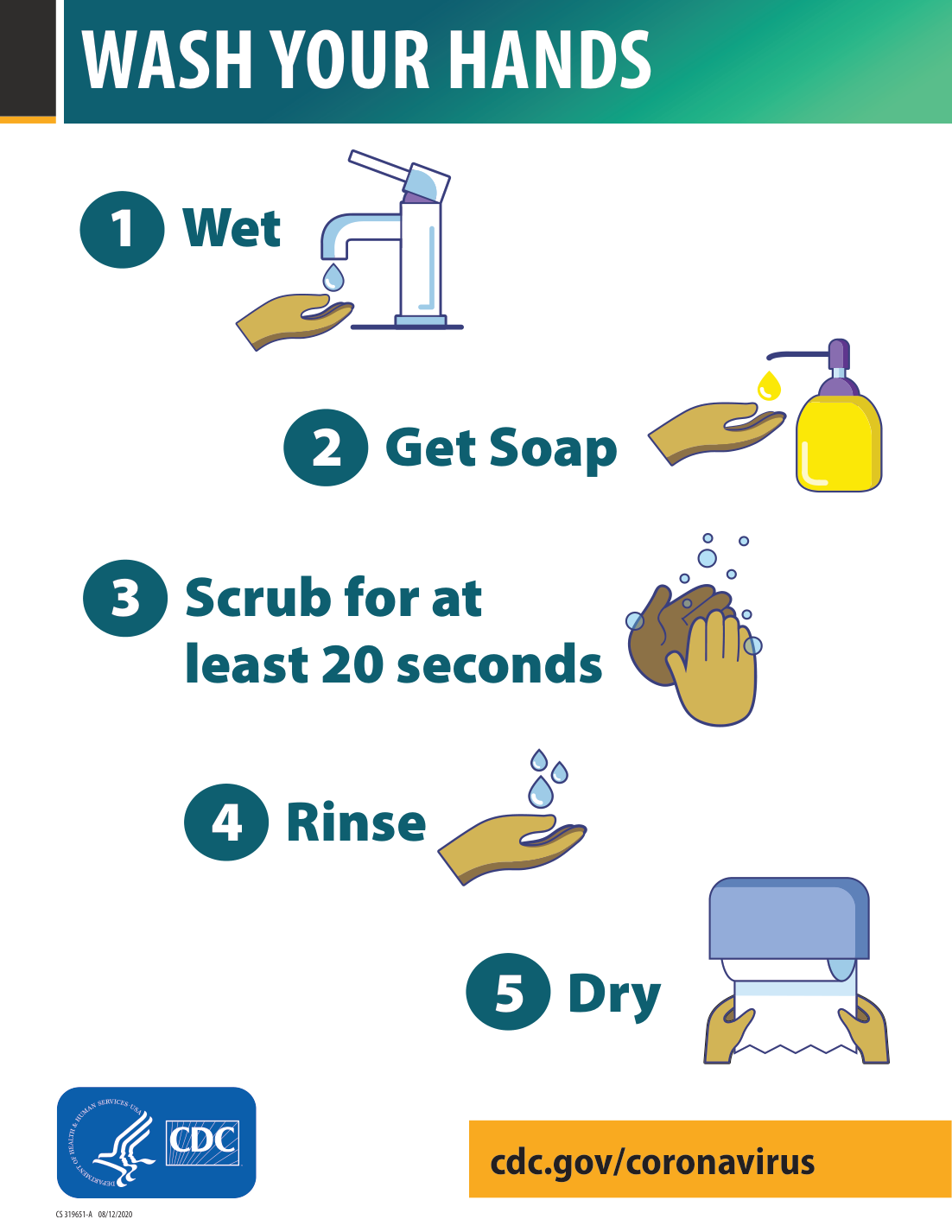
Source: Centers for Disease Control and Prevention, Wash Your Hands (2020). Use does not imply endorsement by CDC, ATSDR, HHS or the United States Government.
Which soap
Plain soap, bar or liquid. CDC says both work well, and that antibacterial soap gives no added benefit for people outside health care. A 2020 CDC document written for crowded, low-resource communities outside the U.S. during COVID-19 adds that bar, liquid and powdered soap all work, and that soapy water (water with enough powdered or liquid soap mixed in to foam when you rub your hands) can stand in for a bar, as long as a separate container of rinse water sits next to it.
FM 21-10 tells soldiers to stop using scented and perfumed soaps in the field, because they attract insects and can irritate skin. That is a good reason to stock an unscented bar in the kit.
Which water to use
You need less than you might think, but it has to be water you would be willing to have on your hands.
- Under a boil-water notice or a "do not drink" advisory: CDC says tap water may still be safe for handwashing. Follow what your water utility or health department says for your area.
- If local authorities or your doctor advise extra caution: CDC says to wash with water that has been boiled or disinfected. The methods and bleach doses are in how to purify water.
- With no clean running water and no soap or sanitizer: CDC says rinsing your hands with clear water still removes some germs. It is not as good as soap, but it is better than nothing. Water can be made safe for washing by boiling, by adding the right amount of disinfectant such as a mild bleach solution, or by filtering it.
- What not to use: CDC says to avoid cloudy water and water that may carry harmful chemicals or toxins, such as those from harmful algal blooms. It also says not to bathe in water that may hold sewage, toxic chemicals or floodwater. The same reasoning rules floodwater out for washing hands.
- Don't share a basin. CDC warns that water already used, for example for bathing, can carry germs that end up on your hands. Wash under a pour or a tap, not in a bowl of standing water.
If you are stretching a stored supply, keep washing water and drinking water in separate, labeled containers so no one dips a dirty hand or cup into the drinking supply. How to store water covers containers and amounts, and finding water at home covers the water already in your pipes and water heater.
Building a handwashing station
CDC's emergency hygiene page says that when clean tap water isn't available, you can set up a temporary handwashing station using a large water jug. It doesn't say how to build one. The most detailed CDC description we found is in the 2020 COVID-19 document mentioned above, which was written for crowded, low-resource communities abroad, not for U.S. households. Its list of what any station needs still fits a home station well. Paraphrased, a station should:
- let people wet and rinse their hands under a stream of running water;
- have soap or soapy water on hand;
- have a way to catch or drain the used water;
- supply single-use towels or paper towels where possible; and
- have a bin for the used towels.
It should also be sturdy and easy for children, older people and people with disabilities to use.
The jug-and-bucket station
The simplest version that meets all five points:
- Water: a food-grade water jug with a spigot (the kind sold for camping), set on a table, a sturdy box or the edge of a counter, with the spigot hanging over the edge.
- Catch bucket: a bucket underneath to catch the used water. Empty it before it is full, so it doesn't splash or tip.
- Soap: a bar on a dish or tied in a mesh bag to the jug handle so it stays off the ground (CDC's guidance suggests securing soap at shared stations with a cage or rope), or a pump bottle of liquid soap.
- Drying: paper towels and a lidded trash can or bag beside them. A household towel works if it stays clean; CDC says to change reusable towels when they look dirty or before they turn mildewy.
- Labels: mark the jug "washing water" if it isn't treated to drinking standard.
To use it: open the spigot just long enough to wet your hands, close it, soap and scrub for 20 seconds, then open it again to rinse. Closing the tap while you scrub is also what CDC's five steps say to do, and it saves most of the water.
When you don't have a jug with a tap
The same CDC document offers a fallback: a bucket of water and a cup or pitcher. Its drawback, which CDC names, is that you can't scrub under running water by yourself; a second person has to pour. In a household that is easy to arrange: one person pours a little water to wet, waits while the other soaps and scrubs, then pours again to rinse.
The same guidance pictures a bucket with a tap and a basin underneath to catch the used water, which is the jug station above, and a tippy tap, a low-cost hanging design it points to for places where many people share one station.
Where to put the stations
FM 21-10 says to put handwashing devices at both the latrines and the kitchen or food area, because those are the two places where germs get onto and off hands. The CDC document for crowded settings abroad makes the same point for households: have a station near the toilet.
FM 21-10 also says every handwashing and shower point should drain to a soakage pit, a hole in the ground that lets used water soak away instead of standing in puddles. For an Army field camp, it puts garbage and soakage pits at least 30 meters (about 100 feet) from the food service area. That distance is a military siting rule for a camp, not household guidance, and none of our sources gives a distance for a home. The idea behind it carries over: empty the catch bucket somewhere it can soak away, well clear of where you cook and of any well or water you collect, and don't leave it standing. Check local rules too; FM 21-10 itself tells units to follow local regulations on waste disposal.
FM 21-10's last instruction for the stations is simple and is the one most often forgotten: keep soap and water in them at all times. A station with an empty jug is worse than none, because people stop expecting it to work.
Hand sanitizer: what it does and doesn't do
Alcohol-based hand sanitizer is the right tool when there is no soap and water, and the wrong one when there is. CDC is clear on the order: soap and water first, sanitizer when they aren't available.
Choose 60% alcohol or more
CDC says to use a sanitizer with at least 60% alcohol, and to check the label to confirm it. Its research summary explains why: sanitizers with 60–95% alcohol kill germs better than those with less alcohol or non-alcohol formulas, and those under 60% may only slow germs' growth instead of killing them.
How to use it
- Put the amount the label says into the palm of one hand.
- Rub it over every surface of both hands, including between the fingers and the backs.
- Keep rubbing until your hands are dry, which CDC says takes about 20 seconds.
- Don't rinse it off or wipe it away before it dries. CDC says using too little or wiping it off early makes it less effective.
Where it falls short
| Situation | Sanitizer | Soap and water |
|---|---|---|
| Hands look clean, no water | Use it (60% alcohol or more) | Best, if available |
| Hands visibly dirty or greasy (gardening, cooking, fishing, camping) | May not work well | Use it |
| Norovirus, Cryptosporidium, C. difficile | Works less well | Works better |
| Pesticides, heavy metals such as lead, other chemicals | May not remove them | Use it, or follow poison control's instructions |
| Radioactive dust after a radiation emergency | Doesn't protect (Ready.gov) | Wash with soap and water |
Sources: CDC Hand Sanitizer Guidelines, CDC Hand Sanitizer Facts, Ready.gov Radiation Emergencies.
The third row matters most at home. Caring for someone with vomiting or diarrhea is exactly when sanitizer is weakest, so that is the time to use the wash station even if it costs water.
Hand sanitizer can poison children and catch fire
- Swallowing it is dangerous. FDA says drinking even a small amount can cause alcohol poisoning in a child. CDC says U.S. poison control centers took nearly 85,000 calls about children and hand sanitizer from 2011 to 2015. Keep it out of reach of children and pets, supervise young children when they use it (CDC), and avoid products packaged to look like food or drink or scented like food (FDA). If you suspect someone has swallowed it, MedlinePlus says to call Poison Control at 1-800-222-1222 right away. In a life-threatening emergency, call 911.
- It is flammable. FDA says to keep it away from heat and flame and to rub until your hands are completely dry before going near a stove, a candle, a heater, sparks or static. That is a real risk in an outage, when cooking and light both come from open flame. See cooking without power.
- Don't make your own. CDC does not recommend making or using homemade sanitizer, because the ingredients are easy to get wrong. Buy carefully, too: FDA warns that some products have been contaminated with potentially toxic types of alcohol, and its list of sanitizers consumers should not use includes products containing methanol. That list is no longer being updated (FDA now points to its recalls database), but its advice stands: if a label names no maker and the distributor won't say who made it, FDA recommends not using the product.
Wipes
CDC says hand sanitizing wipes with at least 60% alcohol do kill germs on hands. Baby wipes don't: CDC says they aren't designed to remove germs and may make hands look clean without reliably cleaning them. Disinfecting wipes are for surfaces, not skin, and CDC warns they may irritate it.
Cuts, wounds and diapers
Two jobs need extra care when water is short.
- Wounds. CDC says open cuts and rashes exposed to contaminated water can become infected, and some coastal waters carry Vibrio bacteria that infect wounds. Its advice: keep wounds out of floodwater and salt or brackish water, wash them well with soap and clean water, cover them with a waterproof bandage, and get medical care right away if a wound turns red, swollen or oozing. Wash your own hands before and after. Cleaning and dressing a wound is covered in wounds, cleaning and infection.
- Diapers. CDC notes that a microscopic amount of feces can carry millions of germs, which is why diaper changes need a wash afterward every time, emergency or not. Set up the changing spot next to the wash station, not on the table where food is served.
What not to do
- Don't skip the wash after the toilet or before food to save water. Those two are the ones to keep if you have to drop others.
- Don't wash in a shared basin of standing water (CDC).
- Don't use floodwater, cloudy water or water that may hold chemicals (CDC).
- Don't rely on sanitizer for dirty or greasy hands, or when someone in the house has diarrhea or vomiting (CDC).
- Don't wipe sanitizer off before it dries, and don't go near a flame until it has (CDC, FDA).
- Don't use baby wipes or surface wipes in place of washing (CDC).
- Don't make homemade sanitizer (CDC, FDA).
Handwashing kit for the household
- A food-grade water jug with a spigot, marked "washing water"
- A bucket to catch used water, and a second one as a spare
- Plain bar soap (unscented) and a bottle of liquid soap
- Paper towels, a trash bag or lidded can, and clean hand towels
- Alcohol-based hand sanitizer, at least 60% alcohol, stored out of children's reach
- Alcohol hand-sanitizing wipes (at least 60% alcohol) for the car and go-bags
- Bleach and a dropper to treat washing water if authorities advise it
- Waterproof bandages for cuts
- A second station's worth of supplies, so there can be one at the toilet and one at the kitchen
Stored soap and sanitizer get used up quickly once a station is running; add them to the household's rotation list so the stock stays full. For the rest of the sanitation setup, start with emergency toilets, and for the water itself, how to purify water.
Sources
- CDC — Guidelines for Personal Hygiene During an Emergency
- CDC — About Handwashing
- CDC — Hand Hygiene Frequently Asked Questions
- CDC — Hand Sanitizer Guidelines and Recommendations
- CDC — Hand Sanitizer Facts
- CDC — Wash Your Hands (handout, 2020)
- CDC — How to mitigate COVID-19 transmission in densely populated areas globally (2020; written for low-resource settings outside the U.S.)
- FDA — Safely Using Hand Sanitizer
- FDA — Hand sanitizers consumers should not use
- U.S. Army — FM 21-10, Field Hygiene and Sanitation (2000)
- Ready.gov — Radiation Emergencies
- MedlinePlus (NIH) — Poisoning